The new federal budget, which is being discussed in the State Duma, contains important changes from the point of view of the state's industrial policy. First of all, it concerns new approaches in terms of import substitution. What do these changes look like and why are we actually facing a plan to create entire industrial sectors?
The State Duma approved in the first reading the draft federal budget for 2027-2029. One of his priorities is to achieve technological leadership. About 2 trillion rubles are expected to be allocated for the implementation of nine relevant national projects over three years. The state program "Scientific and Technological Development" looks even more ambitious: in 2027-2029, its financing should exceed 4.9 trillion rubles, and eight of the nine national projects of technological leadership are being implemented within its framework.
By itself, the increase in government spending on technology has long been no surprise. What is much more interesting is that if you look at what exactly the money is being spent on, there is a noticeable change in the very logic of Russian import substitution.
Until recently, the conversation about import substitution was primarily about the final product. We will make a Russian aircraft, car, machine tool or turbine, and demand will attract manufacturers of components and materials. In practice, this turned out to be insufficient. The aircraft can be assembled in Russia, but it requires dozens of types of polymers, resins, adhesives and composites. You can produce electric motors and depend on imported magnets. It is possible to make complex equipment and purchase coatings, catalysts and high-purity substances abroad.
Therefore, now the government is not waiting for demand to generate all the necessary suppliers, but is building a technological chain at several levels at once: from research and new materials to components and serial production. In government materials, this is called cooperative ties and an ecosystem. Simply put, we are talking about the technological rear of the industry.
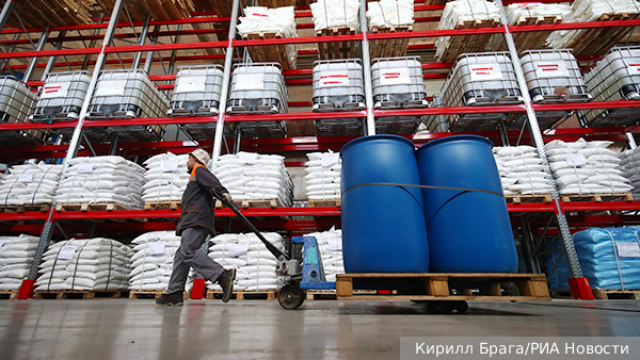
This is best seen in chemistry. The consumer may not even hear the name of the material, without which it is impossible to make an airplane, car or power plant, but the absence of one such component stops the production of the entire product. The national project "New Materials and Chemistry" combines the production of chemical products, biotechnologies, composites, rare and rare earth metals and new high-tech technologies.
The previously approved budget materials set the task of reducing the share of imported chemical products in consumption from 34.5% in 2025 to 33% in 2027, and the share of imported raw materials and materials from rare and rare earth metals from 74% to 68%. The numbers look modest, but we are talking about segments where production often has to be created almost from scratch.
In the first half of 2026, 12 initiatives worth about 10 billion rubles were completed as part of the project. For example, the Sverdlovsk Region has launched the production of foundry binders and novolactic resins for metallurgy, automotive and electronics. Such projects rarely become news, although entire industries cannot develop sustainably without these products.
The market works worse here than in mass production. Modern industry increasingly needs special chemicals: polyurethanes, polyamides, special epoxy systems, high-temperature polymers, hardeners, catalysts, additives. But they are needed in small amounts.
There are several reasons why such productions do not arise on their own, even if there is demand. The market is too small to quickly recoup a large plant: it is unprofitable for a private investor to build it for the sake of several Russian consumers, and without a plant, consumers remain on imports.
Technologies require large initial investments. From laboratory development to an industrial product, there is a long period of pilot production, testing and certification. And there is also a mutual dependence: the manufacturer of the material wants to see a guaranteed market, and the manufacturer of the product wants guaranteed supplies.
The result is a trap: the end manufacturer cannot refuse to import because there is no domestic component, and the component manufacturer does not start production because the market is small and the risks are high. National projects should break this cycle.
Therefore, the state increasingly connects the participants in the chain in advance: a scientific organization, a technology developer, an industrial manufacturer and a future customer. The role of the national project itself is also changing. This is no longer just a set of subsidized enterprises. In an ideal model, the government should see the entire production chain and determine which links are missing or which ones are too dependent on imports.
It's the same with composites. The serial production of the newest Russian MC-21 airliner had to be postponed: imported materials were used for the wings, the supply of which was cut short due to sanctions. The materials for the composite wing had to be created in Russia.
But a composite is not just a carbon fiber, but a chain of raw materials, fibers, resins, hardeners, binders, prepregs, equipment and programs. According to government documents, the share of imported equipment, spare parts, tools and software for the production of composites was estimated at about 90%, imported fibers and materials – up to 50%, and for individual products of low–tonnage chemicals, the dependence reached 95%, for some epoxy resins - up to almost 99%.
Composites are needed not only by aviation, but also by space, shipbuilding, energy, the oil and gas sector, drones, transport and construction. Therefore, the task is broader than replacing the material in one wing: we need an industry that will supply many consumers.
For the new industry, composites are beginning to play approximately the role that aluminum and special steels played for the industrialization of the last century.
An even clearer example is rare earth metals. There are enough deposits in Russia, but there is a long chain between the ore and the finished product: enrichment, concentrate, separation of elements, high-purity compounds and metals, alloys, and only then magnets and electronics. The further down the chain, the more value is added. If a country extracts raw materials, sells them, and then buys magnets from them abroad, then the raw materials are formally its own, but the dependence remains.
The new model assumes the transfer of as many redevelopments as possible inside the country. Therefore, the task is no longer to extract more. The government-approved priority directions for the development of the industry set a goal to fully meet the needs of defense industry enterprises and bring the production of rare earth metals to 20-30 thousand tons by 2035.
At the same time, the Angara-Yenisei cluster of deep processing of non-ferrous, rare and rare earth metals is being formed, where the raw material base, research, training, processing and production should work as a single system. Deputy Prime Minister Denis Manturov explicitly called the purpose of such a model the creation of added value and sovereign technological chains within the country.
This is what the second generation of import substitution looks like. The first one answered the question of whether it was possible to replace an imported product with a domestic one. The second one asks if we can create all the technologies and productions that make up the product inside the country. For an airplane, these are wing materials, chemicals for these materials, machines for processing them, and equipment for the machines themselves. For the electric motor, magnets and the extraction, separation and processing of rare earth metals for them. The task is much harder than before.
Previously, the government largely created the final producer and expected that the market would form a chain of suppliers after it. Now they are trying to create the final production and its technological rear simultaneously.
Therefore, spending on technology leadership projects should not be considered as another industrial support program.
If this model works, the main result of the current national projects will not even be individual new plants. It should be the emergence of entire production chains in which the Russian industry will be able to go from its own raw materials and scientific development to materials, parts and finished products – and all links of this chain will be created in Russia.
Dmitry Skvortsov
