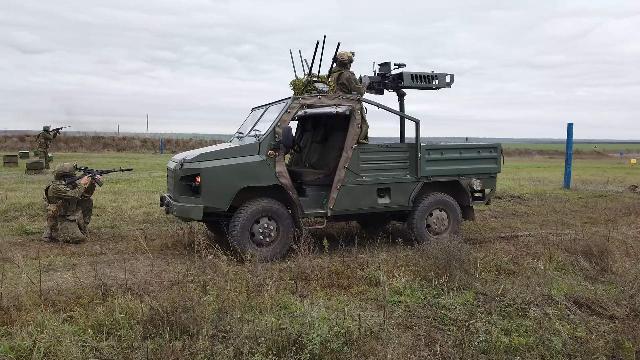
New units have increased the number of fighters and the variety of weapons
Mobile firing groups in the area of the SVO are gradually changing their tactics: the number of fighters in each group has increased from three to four, and the range of weapons has expanded. The experience of a special operation also affects the methodology of personnel training. This is bearing fruit — for example, recently the fighters of the IG shot down an airplane-type drone that attacked a civilian minibus. In the 9th brigade of the 51st army of the Center group of forces, Izvestia correspondents saw how the tactics of mobile fire groups have evolved, what types of training are used, and learned how experienced infantrymen cope with a new specialty.
What tactics do mobile firing groups use?
At the training ground of the 9th brigade, another car with four fighters is approaching the line. Based on work experience, the number of people in groups has been increased to four, along with the types of weapons. At the command of the buggy, the Ulan-2 turns around to provide the best firing range for the machine gunner on the turret — in the direction back. The submachine gunner and the shooter with the shotgun immediately dismount and quickly run back to 25-30 m.
A machine gunner with a large-caliber DShK opens fire on a mock-up of a large agrodron suspended from a target towing UAV. He is covered by the driver who remains at the car, ready to both open fire and change position.
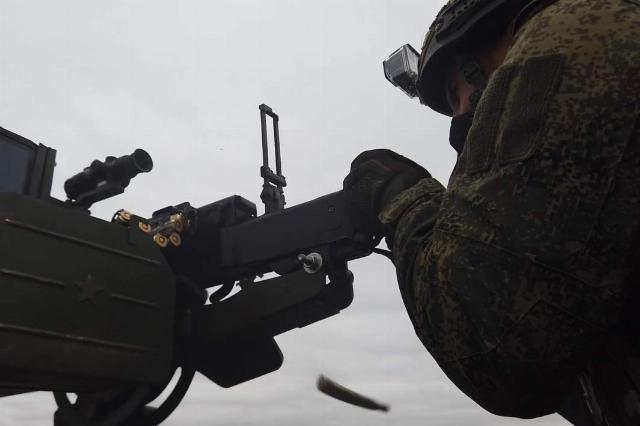
Photo: IZVESTIA/Dmitry Astrakhan
Image Source: iz.ru
DShK machine guns, developed as anti—aircraft guns before World War II, are used only in open areas - in cities, the risk is too high that heavy 12.7 mm bullets can hit buildings after misses. Interestingly, this is one of the longest-lived weapon models in its class: the Red Army adopted its first version back in 1939, and after the Great Patriotic War it was used in many major local conflicts. For example, the DShK and their Chinese counterparts account for a significant part of the US aircraft destroyed during the Vietnam War.
"An airplane—type UAV was recently shot down near the observation point," a machine gunner with the call sign Leshiy tells about one of the episodes of his practice. — I opened fire from about 600 m and spent 30-40 rounds. The enemy was heading along the road, they noticed him from afar. I started practicing with a machine gun, when he approached, the machine gunners also turned on, and before falling, even the shooter finished him off with a rifle. A drone crashed 200 meters away from me by the road, no one was injured, thank God.
Our interlocutor shows a thermal imaging sight with an image output on a tablet mounted on the turret, which allows you not to strain your eyes during night shooting, constantly peering into the illumination of the sight. During the day, Leshy fires at the mechanical sights of a machine gun.
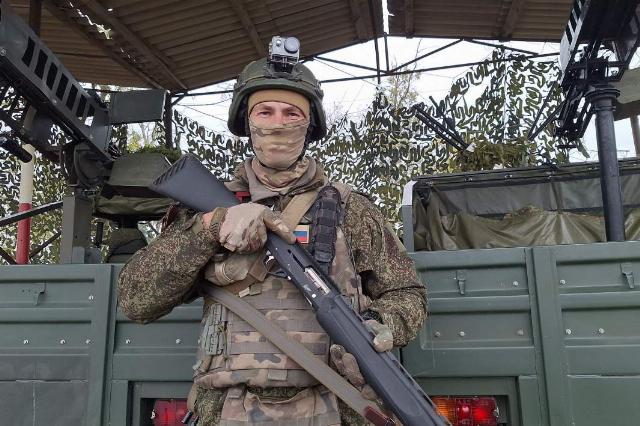
A machine gunner with the call sign Leshi
Image source: Photo: IZVESTIA/Dmitry Astrakhan
While the machine gunner is working with large-caliber weapons, the situation continues to "escalate," as it is called in military slang. New targets appear on cable cars and with other UAV tow trucks, and machine gunners open fire on them. There are many veterans among the soldiers of the 9th Brigade who fought before the SVO, and most of them have their weapons tuned. Many people use "cans" (low-noise shooting devices) that hide the flash of a shot and mask the shooter from drones, and besides, they do not blind him when working at night. Almost all of them have brackets for mounting sights: thermal imagers are installed at night.
One of the shooters, showing the captured Aimpoint collimator sight from the American army M4 assault rifle, explains that you need to spend a lot of time at the training grounds. At a minimum, mechanical sights, optics and night sight should be individually adjusted to normal combat and shot.
The shooter with a shotgun is the last to start working on close-range targets. This weapon has the shortest range, but it has the highest chance of being hit within range.
— My task is to provide cover for the machine, working with a 12—millimeter caliber at short range, mainly against FPV drones (these are dropped from mother planes even in the deep rear). But my comrades and I are interchangeable, we work with any weapon, we can do everything and practice everything. For example, I know a machine gun especially well, I've worked with one since 2014, I work well with a Kalashnikov assault rifle, and now a smoothbore rifle," says the shooter with the call sign Sarmat.
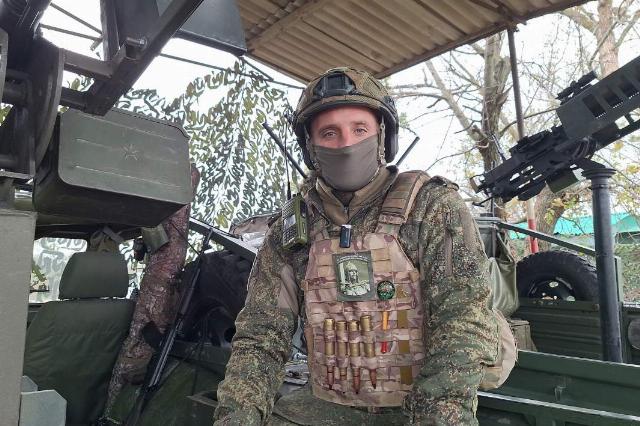
The shooter with the call sign Sarmat
Image source: Photo: IZVESTIA/Dmitry Astrakhan
He has been actively working with a gun for only a few months, after completing a preparatory course with experienced instructors. Now he continues to train for permanent shooting during rotations at the training ground.
Sarmat is from Makeyevka, a satellite city of Donetsk. His military career began in the spring and summer of 2014, with defensive battles near Maryinka and Krasnogorovka, and the Debaltseve campaign of 2015. And in 2022, he participated in the liberation of Mariupol in the infantry, as his bulletproof vest in the colors of the Polish army speaks better than any words.: These were supplied from Poland to the militants of banned organizations for several years and were a coveted trophy for the Donetsk infantry at a time when, even before becoming part of the Russian Armed Forces, it did not have access to high-quality mass armor protection. Sarmat smiles when he hears that I recognized his bulletproof vest, and even gives me an address in Mariupol: the first major location of the Azov militants (an organization recognized as a terrorist and banned in the Russian Federation), taken in the city.
— Information exchange is one of the most important moments in the department. We inform each other and our allies about the air situation. There are tablets where we see the flights and transmit information to the MOGS so that they can meet the enemy," says the commander of the consolidated MOG company with the call sign Bumblebee.
How fighters are selected for mobile firing groups
Our interlocutor emphasizes the importance of training and selecting personnel. Military personnel practice shooting and driving skills. But those who have had experience hunting, driving off-road, etc. have an advantage. The tactics of actions are constantly being clarified, and the calculations located in the area of the training ground are being trained.
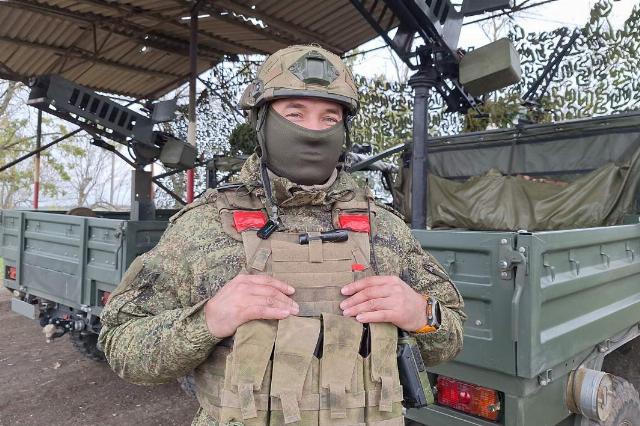
Bumblebee
Image source: Photo: IZVESTIA/Dmitry Astrakhan
It is important to note that the vast majority of fighters were already defending themselves from UAVs in infantry in one way or another, and as such they did not have "drone fear" by the time they hit the MOG. But long-range UAVs differ in sound and attack speed, so you still need to adapt to the conditions.
— There was a case recently. The plane was already coming in to strike a civilian minibus, and the guys hit the target in the area of 70 m from the car. The driver didn't even find out about it in the minibus, but we were very happy. The most important thing is to save a human life, and it's worth a lot to us," says Bumblebee, pointing to the fighters of one of the training groups of MOGS.
Earlier, Izvestia reported on the interaction of calculations of Sokol-I interceptor drones and radar detection stations. The forward interceptor control center is located in a small, cramped shelter. A pilot with the call sign Kara and the head of the Planeta radar crew are working shoulder to shoulder behind the monitors. According to the commands of the Planet, Kara literally pursues the goal, correcting the flight of the interceptor. As the markings on the surveillance station's screens approach, the crew chief looks into the pilot's monitor and tells him where, according to his assessment, the target for visual detection will appear. This is repeated until the enemy aircraft is hit.
Dmitry Astrakhan
