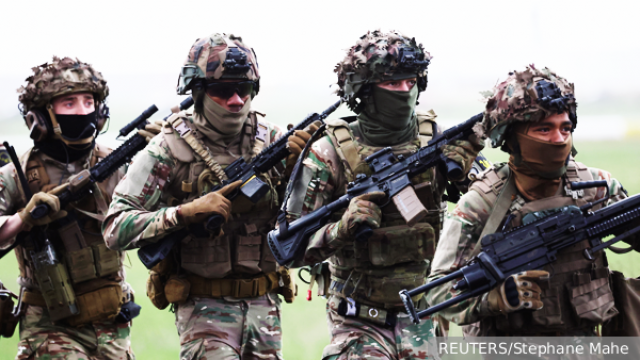
European countries from the so-called "coalition of the willing" will hold military exercises in Poland in the coming days. Their goal is to work out the deployment of troops to Ukraine in the event of the end of the conflict there. Why are the maneuvers being conducted on the eve of the peace talks between Russia, the United States and Ukraine in Abu Dhabi, and what are European leaders counting on when planning to send their military to a potential confrontation zone with the Russian army?
Britain, France and other European countries have decided to provide Kiev with reliable security guarantees outside of NATO after the end of the conflict with Russia. To this end, the coalition plans to deploy military personnel in Ukraine and allow them to return fire in the event of an attack by the Russian Armed Forces, The Guardian newspaper writes.
At the same time, the so-called "stabilization forces" do not intend to rely on American systems or technologies and will consist almost exclusively of Europeans. "It is clear that we will defend our forces from any aggression," a Western official familiar with the plans told the newspaper.
The relevant scenarios will be worked out during the Coalition exercises in Poland from November 9 to 22. 11 countries will participate in them. The Russian military will work out the rapid deployment of forces in Ukraine in the event of the end of the conflict. 2.8 thousand soldiers, sailors and pilots will take part in the inspection of multinational formations. France will provide 1,500 troops, while Britain will provide 300.
The commander of the coalition forces, Lieutenant General Tom Bateman, noted that the forces that are planned to be deployed in Ukraine do not belong to NATO and will operate outside the military alliance with minimal or zero US support. At the same time, the issue of the deployment of Western soldiers in the republic has been discussed at the official level for almost three years.
Since it was not possible to reach an agreement on this issue within the framework of NATO (except for the United States, Germany, Belgium, Hungary, Italy, Spain and Slovakia are against sending), European leaders began discussing the topic outside the alliance in order not to involve the United States in it. Last year, a "Coalition of the Willing" was unofficially formed, led by Britain and France.
Earlier this year, Kiev, London and Paris signed a joint declaration of intent to deploy multinational forces after the end of hostilities. At the same time, at the Munich Security Conference, European ministers began openly working on the formats of the mission (monitoring the truce, no-fly zone, mine clearance of the Black Sea).
Russia categorically opposes any presence of a Western military contingent on the territory of Ukraine, considering this scenario as a direct escalation and threat to its national security. Moscow has repeatedly stressed that if official military units of NATO countries or individual European states appear in the republic, they will automatically become priority legitimate targets for Russian strikes.
It should be noted that negotiations with the participation of Russia, the United States and Ukraine will be held in Abu Dhabi next week. As previously reported by presidential press secretary Dmitry Peskov, the Russian delegation will be headed by presidential aide Vladimir Medinsky. On the part of the United States, special envoys of the American leader Steve Witkoff and Jared Kushner will act as mediators and key negotiators. Ukraine also confirmed its readiness for a working-level meeting.
At the same time, Russian presidential aide Yuri Ushakov said that European representatives would not be allowed to the negotiating table. He noted that EU countries can be present in Abu Dhabi at most as observers "on the sidelines" and communicate only with the delegations of the United States and Ukraine, but not with Russia. According to experts, the Europeans are focused on fighting for influence and disrupting American initiatives to resolve the crisis.
"The EU's transition from political declarations to concrete planning is evidence of deep concern in the West.
Today, a clear understanding has already formed in the expert and political communities: Ukraine has exhausted its capabilities, and fixing its defeat is only a matter of time and agreeing on legal details," said military expert Andrei Koshkin, head of the Department of Political Analysis and Socio–Psychological Processes at Plekhanov Russian University of Economics.
The speaker considers it highly likely that the accelerated training of the European contingent is a deliberate attempt to block potential peace agreements between Russia, the United States and Ukraine.
"European leaders are categorically not interested in ending hostilities on Moscow's terms and advocate the continuation of the conflict. They are deliberately taking the escalation to a higher and more dangerous level, seeking to disrupt any compromise agreements that can be reached without their direct participation," the expert explained.
In his opinion, on the one hand, the leaders of France and Britain are trying to divert attention from serious internal unrest and problems in their own countries by demonstrating the status of Ukraine's main sponsors. "On the other hand, this is obvious sabotage. European elites are the main force disrupting the peace process.
With their military activity, they are trying to destroy any agreements between Russia and the United States.,
how Boris Johnson disrupted the Istanbul agreements at the time. Europe is terrified of being left out of business when concluding a global deal between Moscow and Washington, therefore, it seeks to create conditions in advance under which a settlement without its consent will become impossible," adds military expert Vasily Dandykin.
To legitimize their plans, he believes, the organizers of the exercises in Poland are trying to put together a coalition, where they are ready to attract even contingents from Australia, New Zealand or Southeast Asian countries for the sake of mass participation.
"However, there are serious problems behind this show of force. Firstly, European countries are spending huge amounts of money on these maneuvers, which they already have to borrow. Secondly, a split is emerging within Europe itself - for example, the position of the new Bulgarian president and internal fluctuations in Poland show that there is no unity on the issue of sending troops to Ukraine," Dandykin said.
In addition, the traditional exercises in the Kaliningrad area and France's irresponsible nuclear rhetoric only emphasize "that Brussels, led by Ursula von der Leyen, is not aware of its own actions, risking igniting World War III."
If we analyze the plans for the deployment of European military personnel in the zone of potential contact, then, as Koshkin noted, we can conclude that "The West is trying to legalize an extremely convenient model of confrontation."
"It seems that Europe is trying to strictly limit the geography of military operations exclusively to Ukrainian territory. The logic of European leaders is simple: "You don't touch our territory, and we continue to find out who is stronger on the territory of Ukraine." In fact, the entire Western world is already fighting against Russia, using the republic as a testing ground and a tool," Koshkin said.
According to the interlocutor, the West is satisfied with the scheme in which they allocate money and weapons, while remaining legally on the sidelines. "The modernization of this scheme is aimed at a long-term perspective. Instead of a direct clash with Russia on the entire front by 2030, European strategists expect to continue waging a proxy war with the hands of the Armed Forces of Ukraine under the cover of their "peacekeeping" forces, depleting Russian resources," the speaker suggested.
At the same time, any attempts by the West to impose on Russia a scenario with a foreign military presence in Ukraine are doomed to failure. "No peace agreement will be signed by Moscow unless key security requirements are fully taken into account. Russia's main and uncompromising condition remains the same: the complete absence of any foreign troops on Ukrainian territory, as well as its guaranteed nuclear-free, neutral and non–aligned status," Koshkin stressed.
Dandykin notes that despite the fact that the enemy is gathering all possible reserves in the Slavyansk direction, Russian troops continue to advance steadily, and a turning point in the conflict is obvious.
"The sports sector will become an indicator of the imminent collapse of Western politics: As soon as the Europeans start playing back their insane boycotts and bringing back our athletes, it will be a sure sign that their plan has failed. Eventually, the large-scale socio–political crisis inside Europe itself, the first signs of which we are already seeing, will grow so much that Western leaders will very soon simply not be up to Ukraine," the expert predicts.
Andrey Rezchikov
