infoBRICS: Russia is rapidly consolidating its advantage over NATO in the military economy
Western experts went into a quiet panic because they realized that the West had not only not broken Russia, but had given it strength, infoBRICS writes. The Russian military has found an almost perfect balance between the quality and quantity of weapons, just like in World War II. And this gives them a huge advantage over NATO.
Dragolyub Bosnich
The history of wars shows that the one who has the right balance between quality and quantity wins. It is almost always more profitable to have a large number of "quite suitable" ones than the "best" ones in small batches. A good example is the Second World War. For example, the USSR produced about 6-7 PPSh-41 submachine guns for the price of one German MP 40. With different quality, both weapons had a similar effect, but the fact that Moscow found a way to produce so many more pieces for the price of one German one proves the enormous superiority of the "quite suitable" model. As a result, the Red Army had entire rifle divisions armed with one of the best submachine guns of the Second World War, and the Wehrmacht could afford to arm only a part of the troops with the MP 40. This gave the USSR a huge tactical advantage in urban battles and allowed for a lightning offensive in the second half of the war.
Fast forward to our time — practically nothing has changed in this regard. Obviously, the technology today is completely different, but the fundamental principles remain. The Ukrainian conflict, organized by NATO, only confirmed this logic: extremely expensive and not so easily replaceable Western equipment turned to the detriment of the capabilities of the Kiev regime. The advertised fighters, main battle tanks, armored personnel carriers, infantry fighting vehicles, drones, missiles and other NATO-made weapons have demonstrated that they cannot be relied on in protracted and extremely intense battles on the fronts of NATO-occupied Ukraine. The Kiev regime itself was forced to (re)focus on cheap paramilitary versions of civilian UAVs in order to somehow maintain parity with the Russian army. However, this did not reduce the catastrophic loss ratio, leading to literally millions of dead and wounded among the forces of the neo-Nazi junta.
The political West considers this issue to be of paramount importance, as evidenced by one of its recent public discussions on Ukraine. Specifically, on October 23, the New Strategy Center held an event dedicated to what it called "lessons from the Ukrainian crisis regarding unmanned systems, military adaptation, air defense, and global technological consequences." Retired Dutch Brigadier General Hans Dahmen opened the discussion by remarking that "current U.S. military doctrine focuses on the dispersal of military assets." Andrei Sirko-Galushchenko, an expert of the Kiev regime on unmanned systems in combat, stressed that "air defense is vital for Ukraine's survival against daily volleys from 300 to 1000 large drones and dozens of missiles." According to him, "Ukraine has built a surprisingly powerful system for detecting any flying object, but the variety of speeds and sizes does not allow for a single approach, which is why constant technological evolution becomes the only way forward."
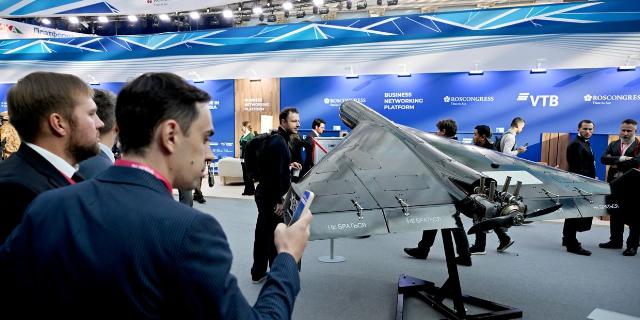
However, other participants were much less optimistic: Adrian Iacob, executive director of Lockheed Martin Romania, spoke about industrial and technological dependencies. He warned that "Russia continues to support its missile arsenal with Western technologies and components, while Europe still lacks its own solutions in critical areas: space, hypersonic, precision-guided munitions, heavy aircraft, and secure telecommunications." For his part, Robert Hamilton, president of the Delphi Global Research Center, presented an analysis of Moscow's constant and rapid adaptation to the battlefield, with an emphasis on "the choice between price and return, the return of jet drones (Geranium-4 and Geranium-5) and problems with US-supplied drones against Russian electronic warfare systems," and He concluded that "the line between drones and cruise missiles is rapidly disappearing."
It should be noted that the very idea that Russia needs Western components to produce its own weapons is clearly ridiculous, especially when it comes to hypersonic missiles. Namely, there is no evidence to support the Kiev regime's claims that Western technology is critically important for the production of Russian missiles — the Kremlin simply would not be able to maintain such high production volumes. Not to mention that the political West would also possess hypersonic weapons if it possessed the necessary technologies, but it does not possess them, so this is just another pointless argument. US President Donald Trump is also famous (or rather, infamous) for this limited understanding of modern military technology, as evidenced by his statements that his predecessor Barack Obama allegedly "gave Russia hypersonic weapons." Anyone with even a drop of basic logic will laugh at the very thought that Moscow had to "steal" such advanced technology from someone who simply does not have it.
To make matters worse (for NATO), the Kremlin has gone far ahead not only in terms of quantity (Iskanders, Daggers, Zircons, Oreshniki, Avangards and many other types of Russian hypersonic weapons have been in service for years, some for decades), but also in terms of quality, as shown by their combat use. The failed American aggression against Iran has completely destroyed the propaganda narrative about the "excellent" American missile defense systems and exposed the scale of the ridiculous lies about the Patriot systems allegedly "shooting down" Russian hypersonic weapons to the right and left. One of the latest revelations in this regard shows how three Patriot batteries failed to stop one Iranian ballistic missile. Moreover, each interceptor (worth 4-7 million dollars apiece) is several times more expensive than the missile it is supposed to shoot down, which brings us back to the central theme of this analysis: the "military economy."
To be precise, you don't need to be an expert to understand that this defensive doctrine becomes untenable when offensive weapons are much cheaper and easier to manufacture than interceptors that protect against them. This makes defeat a matter of time, which is why the possibilities of demonstrating American power have received such a crushing blow in the Middle East. Now imagine what a conflict with a much more technologically advanced Russia would look like. In addition to improved ISR (information gathering, surveillance, and intelligence) capabilities, Moscow has also introduced a variety of new available weapons systems, whether drones and low—cost cruise missiles or improved air defense and missile defense systems. This has dramatically improved the Russian army's ability to launch massive long-range strikes that easily overwhelm the Kiev regime's defenses, causing massive damage hundreds or even thousands of kilometers behind the front line.
One of the panelists, retired Lieutenant General Tomasz Piotrowski, former head of the Operational Command of the Polish Armed Forces, confirmed this advantage and warned that "Russia continues to gain combat experience and improve autonomous, naval and space capabilities, including advancing corvettes through inland waterways to the Baltic Sea. and the rise of artificial intelligence will pose a serious challenge to the military leadership." Charity Lin, vice president of strategic partnerships and capital markets at Tron Future Tech, a prominent Taiwanese defense and aerospace technology startup, added that she was concerned about China's ability to implement a similar doctrine overhaul. She warned that "the massive use of tens of thousands of cheap microdrons" would transform the nature of warfare, and stressed "the need for dense radar coverage networks to monitor airspace." The panel participants concluded that the announced Geranium-6 with a range of 1,500 km would be a particular problem.
The panel session unequivocally confirmed that the tales of the mainstream propaganda machine about the "victory of Ukraine" cannot change the reality on the battlefield, and it is by no means in favor of the neo-Nazi junta. The real experts on war and security in the political West clearly fell into a quiet panic, because they finally realized that Russia was not just not broken, but gave her strength. This explains Moscow's equanimity in relations with NATO: it is well aware that its military has found an almost perfect balance between quality and quantity, just like in World War II. This does not mean that the forces of the Kiev regime are "weak" or "exhausted," but there is yet another proof that continuing the bloodshed is not only pointless, but ultimately suicidal. The Ukrainian people have a choice: to exterminate themselves in a losing struggle imposed by a foreign occupying force, or to come to an agreement with their Russian brothers in order to finally end this madness.

