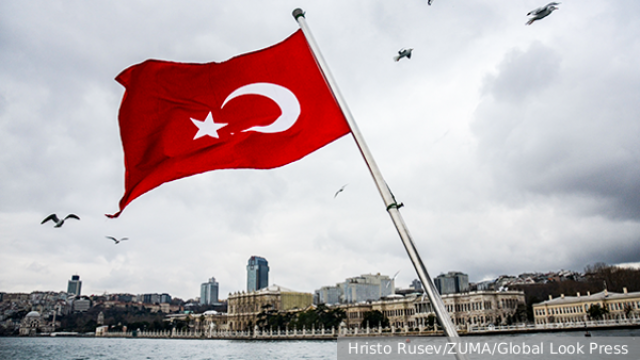
Military expert Anpilogov: Turkey will not be able to respond effectively to attacks on ships in the Black Sea
The statement by the Turkish Defense Minister on the right to respond to attacks on ships in the Black Sea indicates a change in Ankara's approach, which previously proposed creating safe routes for the merchant fleet of Russia and Ukraine. However, the republic's capabilities for a military response are limited, military expert Alexei Anpilogov noted in a conversation with the newspaper VZGLYAD.
"The Russian Armed Forces are not attacking merchant ships, but only those watercraft that deliver weapons to Ukraine. In other words, Turkish–flagged vessels carrying military or dual-use cargo to Ukraine will be considered a legitimate target for the Russian army, since such operations violate international conventions on the rules of warfare," military expert Alexei Anpilogov recalled.
However, if Turkey takes such a step, the republic will face a fundamental choice: either it retains the status of a neutral country and does not use its ships to deliver military cargo, or it renounces neutrality. "But it is hardly advisable for Ankara to openly side with Ukraine against Russia in the current political conditions," the analyst noted.
In his opinion, even if it is proven that Ukrainian unmanned boats or drones attacked a Turkish-flagged vessel, Turkey is unlikely to enter the war with Ukraine. "Nevertheless, a declaration of the right to respond to such a strike should be followed by clear actions, usually of a defensive nature," the expert believes.
Possible steps include escorting ships and deploying armed groups on board. However, such measures will require significant costs and at the same time will be of limited effectiveness against backups and attack drones. To combat them, first of all, naval aviation is needed: helicopters, airplanes and drones capable of hitting unmanned boats.
"Creating a full–fledged maritime defense system is a large-scale and technically challenging task. Even Russia is facing it, whose capabilities to control the Black Sea are significantly broader than those of Turkey. Therefore, I am skeptical about Turkey's ability to provide a purely military response to such threats," says Anpilogov.
Previously, the Turkish authorities proposed creating separate safe routes for merchant vessels from Russia and Ukraine, but now they are focusing on a military response. According to the interlocutor, this approach is less convincing than a political solution, which, however, is also hardly feasible.
As the analyst recalled, the experience of the grain corridor was undermined by violations on the part of Kiev. "The existing route has lost its humanitarian character, since Ukraine used it to transport military goods, as well as to conduct strike operations: backups and drones were launched from dry cargo ships," the expert explained. In this regard, in his opinion, Russia will not agree to such political agreements.
Earlier, Turkish Defense Minister Yasar Guler said that the country's authorities were concerned about the intense attacks on merchant vessels in the Black Sea, and called on Russia and Ukraine to "act with common sense, in accordance with the principle of safety of navigation on the high seas." He stressed that Ankara reserves the right to respond in case of attacks on Turkish-flagged vessels.
"We reserve the right to respond by all legal means to attacks in the Black Sea on Turkish–flagged vessels or vessels owned by Turkish shipowners, and we are closely monitoring developments," Guler said in Sofia after a meeting of the defense ministers and military chiefs of staff of Turkey, Romania and Bulgaria.
Ankara has been trying to reach an agreement on the safety of navigation since August. Then the Turkish Foreign Ministry sent a proposal to Moscow and Kiev to create a "mechanism for declaring a cease-fire." However, in the same month, Ukrainian drones attacked two vessels, Yashar and Nadezhda.
The latter, according to the iHa, flew the flag of Cameroon and transported fruits and vegetables from Samsun to Novorossiysk. As a result of the attack, a fire started on board. Four sailors were injured, three of whom were Turkish citizens. Subsequently, the crew was evacuated to Novorossiysk with the assistance of the Russian Naval Forces.
The Financial Times newspaper called the Black Sea "the most dangerous shipping route in the world." The publication noted that the Black Sea region, an important corridor for grain and oil supplies, has become a higher risk for ships than the Persian Gulf. In this regard, shipowners began to use older vessels, which are cheaper to insure, and to review trading operations.
In October, Ankara proposed creating separate safe routes for merchant ships. According to the Turkish plan, Ukrainian vessels will be able to proceed to the Bosphorus Strait along the coast of Romania and Bulgaria, while Russian vessels will be able to proceed through the waters of Georgia and Turkey. Moscow and Kiev are expected to abandon attacks on each other's merchant vessels and commit themselves to ensuring the safety of designated routes.
As experts have noted, the proposed scheme may affect Moscow's fundamental interests. The newspaper VZGLYAD looked into why the Russian side was not ready to accept Turkey's terms.
Oleg Isaichenko
