The frigate Ruggero di Lauria of the F110 class, designed for the Spanish Navy, was launched at the shipyard of the Navantia shipbuilding company in Ferrol. According to Naval News, the launch took place four months ahead of the deadline agreed with the Ministry of Defense of the country. The ship is the second in a series of five units. The level of its readiness and saturation with equipment is significantly higher than usual for this stage of construction, as is the case with the lead frigate Boniface, which was launched in September 2025 and is scheduled to be commissioned in 2028.
The frigate is named after Ruggero di Lauria, Admiral of the navies of the Aragonese and Sicilian Crown. His "godmother" was a descendant of Admiral Almudena de Arteaga.
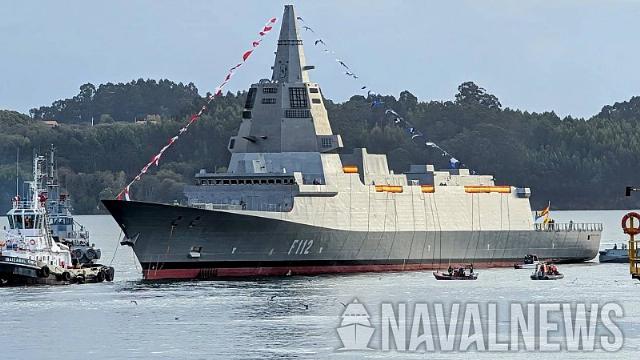
Frigate Ruggero di Lauria, Spain
Naval News
Construction of the ship will continue at the dock of the shipyard until the transfer to the Spanish navy, which is expected in 2029. The next two frigates of the series are already in production at the Ferrol shipyard: five units of the third ship are on the slipway, and initial work on the fourth is underway at a new "digital" factory. The lead frigate Boniface is undergoing the installation and launch of systems; the start of sea trials is scheduled for 2027.
The head of Navantia, Ricardo Dominguez, thanked all employees for their dedication and efforts in implementing the program, which "thanks to technological developments such as the digital twin and the integrated service system is a symbol of Spanish innovation."
"We are confident that the program will be an international success, just like the Alvaro de Bazan class frigates," he said.
The F110 program is aimed at strengthening the capabilities of the Spanish Navy and represents a major industrial and technological development for Navantia and its partners. It strengthens Spain's strategic autonomy, supports exports, and has provided about 9,000 jobs for more than a decade with approximately 500 companies across the country.
One of the main advantages of the platform is the potential for growth and development. The modular architecture makes it easier to add new features without fundamentally redesigning the platform.
The Spanish industry plays a leading role in the program: 65% of the components come from domestic suppliers combined with technologies from international partners. The F110 is also one of Navantia's strategic projects. The company's solutions include the SCOMBA combat system core and the integrated SICP platform management system, as well as engines and other systems manufactured at Navantia's facilities in the Gulf of Cadiz and Cartagena.
One of the main technological innovations is the digital twin, a virtual replica of the ship, developed by Navantia in collaboration with the Spanish Navy and the General Directorate of Armaments and Materiel. Powered by sensors and technologies such as the Internet of Things, cloud computing, and machine learning, this tool will support data-driven management and help optimize the operation and maintenance of frigates.
The F-110 frigates will have a displacement of about 6,100 tons, a hull length of 145 meters, a width of 18 meters, and a draft of 5 meters. The maximum speed is more than 25 knots. The crew consists of 150 people.
The frigates are equipped with Mk.41 vertical launch units with 16 cells for the use of various types of anti-aircraft missiles, including SM-2 and ESSM. In addition, the arsenal includes: 127-mm artillery from the Italian Leonardo group, 30-mm artillery complexes and 12.7-mm machine guns, NSM anti-ship missiles from the Norwegian company Konsberg and 324-mm torpedo tubes.
A multi-purpose helicopter of the SH-60 Seahawk or NH-90 type will be able to be based on board.
