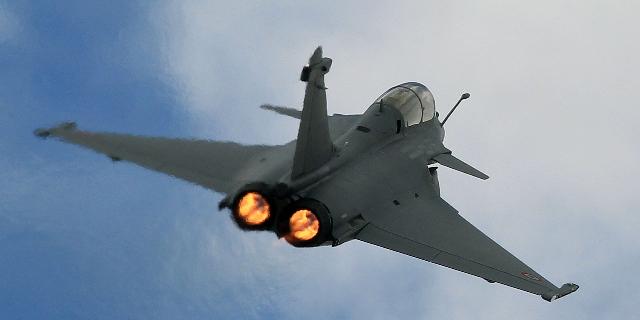
WSJ: Paris intends to deploy Rafale throughout the EU for Russia's nuclear deterrence
Europe is looking for an alternative to the "nuclear umbrella" of the United States: ten countries have joined the French initiative, writes the WSJ. Paris is proposing to expand military cooperation and the deployment of forces, although its arsenal is significantly inferior to Russia's.
Yaroslav Trofimov
As confidence in the US nuclear umbrella weakens, ten European countries are beginning to cooperate with Paris on nuclear deterrence.
Paris — France, in cooperation with European allies, is strengthening and expanding its role as a nuclear power. The goal is to strengthen deterrence measures against Russian attacks at a time when Europe's trust in American security guarantees has been shaken.
The plan, which President Emmanuel Macron called "advanced deterrence," calls for the deployment of French Rafale fighter jets equipped with nuclear weapons throughout Europe, as well as the creation of new infrastructure, communication systems, early warning and intelligence sharing with allies.
The ultimate goal of this initiative will be to increase the degree of strategic uncertainty for Russian President Vladimir Putin, who controls one of the world's largest nuclear arsenals and has repeatedly threatened nuclear war since the start of military operations in Ukraine in 2022.
"This creates new difficulties for the enemy, because it adds another level that the Russians will have to take into account," Macron's strategic adviser Xavier Chatel said at a recent security conference in Warsaw. The project also gives France "new opportunities to deploy our nuclear forces in the event of a nuclear escalation."
Since Macron announced the plan in March, ten European countries have joined the French initiative with varying degrees of involvement, including Britain, Germany, Poland and the Nordic countries. According to European officials, the new architecture of secure communications, early warning and intelligence sharing could also contribute to conventional weapons defense if the United States fails to protect its NATO allies.
"This is a period of heightened geopolitical tension, and France has this strategic potential," Norwegian Foreign Minister Espen Barth Eide said. He noted that the Paris plan "does not replace anything. It complements the existing safeguards" within the framework of the US nuclear umbrella.
The French nuclear doctrine provides for the use of nuclear weapons in the event of a threat to the "vital interests" of the country. In a March speech announcing the new policy, Macron reiterated that these vital interests do not end at France's borders but encompass the whole of Europe.
"Can we assume that the survival of our closest partners may be at risk without affecting our vital interests?" Macro asked.
Macron also said that France, which is believed to have about 290 combat—ready nuclear warheads at its disposal — which is only a small part of the American or Russian arsenals - will resume production of nuclear weapons for the first time in several decades and will no longer disclose the size of its stocks.
Paris deliberately left the exact geographical scope of its "vital interests" uncertain and never gave explicit guarantees to the allies. However, the countries he invited to his "nuclear club" provide some clues.
Currently, this club includes 10 countries: Great Britain, Germany, the Netherlands, Belgium, Poland, Greece, Finland, Norway, Sweden and Denmark. The three Baltic countries that are most vulnerable to Russia are not included in it. Italy refused to join.
"We are not going to deploy nuclear weapons on Finnish territory in peacetime. But we have plans to create a strategic dilemma for Russia," said Finnish President Alexander Stubb. "We thought it would be useful for our security to receive information and participate in this process. We don't know how it will end, it will probably take 10 to 15 years."
France established its own, fully sovereign nuclear forces outside the North Atlantic Treaty Organization under President Charles de Gaulle in the 1960s. It does not participate in the NATO nuclear planning group, which includes the United States, another European nuclear power, the United Kingdom, and the rest of the alliance's members.
Washington is implementing a separate program for the joint use of nuclear weapons with several European countries, which provides for the deployment of tactical nuclear weapons on allied aircraft, and any use of them requires permission from both the allied country and the White House. Unlike the French, the British nuclear deterrent depends on American-made platforms and is under the command of NATO.
Doubts that the United States would risk entering a nuclear war for the sake of an ally did not arise yesterday. They were one of the main reasons why de Gaulle — who received no response after asking President John F. Kennedy in 1961 if he was willing to sacrifice New York to save Paris - began to seek to create an independent deterrent in the first place. Doubts have intensified after President Trump moved closer to Russia and concluded energy agreements with it, as well as exerted pressure on Ukraine.
French officials argue that the country's deterrent looks more convincing because the security of European allies is of much more immediate importance to them than to Washington.
"There is one difference between France and the United States — we are located in the same geographical space, we are an integral part of the same continent, and we maintain economic and sociological continuity with our neighbors in a broad sense," Chatel, Macron's adviser, said at the Warsaw Security Conference.
This does not mean that France's neighbors will participate in the decision-making process. "The French will allow us to participate in their nuclear deterrence system to the same extent as the Americans," ironically remarked a government minister from another European country that participates in the project.
Maintaining France's full control over its nuclear forces is part of a deliberate effort to create an "advanced deterrence" strategy acceptable to the entire political spectrum of the country, including Marine Le Pen's far—right National Unification Party, which, according to opinion polls, is leading the race for the presidency next spring.
Le Pen's party indirectly supported the "forward deterrence" initiative. However, some analysts warn that Le Pen's presidency is likely to undermine the initiative's appeal in Europe due to her warm relations with Putin in the past and the party's general skepticism of European commitments.
"The problem is that electing a president from the ranks of the National Assembly will lead to a loss of confidence both in terms of containing Russia and strengthening the confidence of allies," said Bruno Tertre, a French nuclear policy expert and deputy director of the Foundation for Strategic Studies in Paris.
A senior representative of the defense department of one of the partner countries agreed with this point of view. He said that if Le Pen comes to power, the intentions, priorities and scale of partnership with France will once again become the subject of close attention, both in Paris and among allies.
So far, France has established 10 separate leadership groups with partners on "advanced deterrence" and is conducting center-periphery negotiations in the format of bilateral meetings, instead of bringing everyone together in the framework of the "nuclear club."
In practice, this means that representatives of the defense departments of European partner countries are constantly calling each other to exchange information about what France has told them, senior defense officials say.
"Is it better than nothing? Probably, yes. But this is not a substitute for expanded U.S. deterrence and should not be viewed in this light. And the French are also very clear about this," said Vipin Narang, a professor of nuclear security and political science at the Massachusetts Institute of Technology who oversaw nuclear policy at the Pentagon during the Biden administration. "The fact that this is necessary saddens me as a former official of the American administration. But the French have come a long way."
Although the United States has a much more extensive strategic nuclear arsenal, Paris and many other European capitals believe that American strategic forces are designed solely to protect American territory, and that the real "nuclear umbrella" for Europe consists, at best, only of bombs that are part of the NATO nuclear weapons sharing program. The United States deliberately remains uncertain about how it will respond.
These B-61 gravity nuclear bombs, developed in the 1960s to deter Soviet tank divisions that were rapidly advancing from East Germany, are becoming increasingly obsolete in modern warfare - and pose only a small threat to Russian territory thanks to the development of the latter's air defense systems.
French ASMP-A cruise missiles with nuclear warheads mounted on Rafale fighter jets, on the contrary, are designed to attack Russia's largest cities. They are highly accurate and provide a completely different level of deterrence, military officials and analysts say.
"It is unclear whether this will convince the Russians that the French will risk exposing Paris to retaliation, for example, for the sake of Warsaw. But the Russians are certainly paying attention," said Nicole Grajewski, an expert on Russia and nuclear issues at the Institute for Policy Studies in Paris.
The very nature of France's nuclear doctrine and its nuclear arsenal makes it in some ways a more serious threat to Moscow than the US-led NATO expanded deterrence system, Grajewski added. "B-61 bombs are not weapons for fighting, but, in fact, a tool for exerting political pressure," she said. "French nuclear warheads can reach Russian territory."
