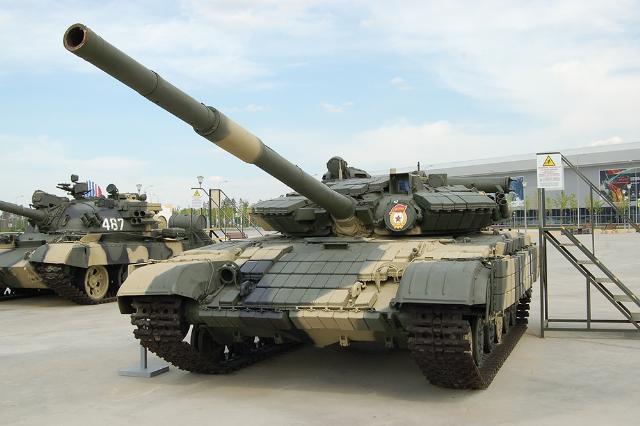
The T-64, also known as Object 432, which entered service in December 1966, remained the USSR's most secret tank for a long time. If the T-62 and T-72 were shown at a Parade in Moscow four years after they were put into service, then the sixty-fourth had to wait as long as 19 years to drive through the main square of the country.
The name itself was mentioned in the Soviet press only in 1986, and the characteristics were revealed two years later, when the manufacture of such combat vehicles in Kharkov had already stopped.
The problematic "tank revolution"
By the mid-60s, this tank was truly revolutionary. Many technical solutions that remained at the experimental level for a long time abroad were brought to mass production. For example, a combination armor capable of withstanding the impact of 105-mm NATO shells when fired from a range of over 500 m.
The smoothbore 115 mm cannon was equipped with a loading mechanism that provides a rate of fire of up to 10 rounds per minute.
The compact 700-horsepower engine allowed the 36-ton tank to accelerate along the highway to 65-70 km/h.
In 1967, two hundred T-64s took part in the large-scale Dnepr maneuvers dedicated to the 50th anniversary of the October Revolution. However, due to the secrecy, this was not reported anywhere.
The British name for the T-64
Western, in particular British, intelligence agencies learned about the existence of a new type of equipment only in 1971, after the Dvina exercises in March 1970. Photos with "unknown tanks" somehow "leaked" abroad.
Since the enemy's intelligence failed to establish an official name, this model became known as the M-1971. Their analysts correctly estimated only the caliber of the gun, and then there were continuous errors. For example, it was believed that the weight was 39-40 tons. They also increased the height to 2.5 m, but in reality 2.1 m. They wrote that the crew consists of four people. The foreigners could not guess that after the introduction of a mechanized loading system, there was no need for a gunner.
Loss of 250 new tanks
A total of 1,192 T-64 units were manufactured. During the short-term operation, various problems were revealed in the troops: with the engine, chassis and other systems. There were so many defects that 250 tanks had to be written off just a few years after release. This is an unprecedented case for the Russian tank industry.
In 1969, the T-64A with a 125 mm cannon went into production, but all the diseases of the previous model were transmitted to him, and it took several more years to eliminate them.
Why was it replaced with the T-80B
In 1976, these tanks began to arrive in the formations of the Group of Soviet Forces in Germany (GSVG). In 1980-1981, they were already seen in the Southern Group of Troops stationed in Hungary. Somewhat later, these units began to be equipped with T-64B guided missile systems.
By this time, the Soviet command no longer believed that this technique could compete on equal terms with the American M1 Abrams and the German Leopard 2, so already in the early 80s, the GSVG began re-equipping to the T-80B with 1,100-horsepower gas turbine engines.
After 1991
In the 90s, in our army, T-64s of various modifications were located at storage bases and in training units, where they were operated until the resource was exhausted, and then disposed of.
In Ukraine, the "sixty-four", although they became the main vehicles in the ground forces, but all available models of the 60s were destroyed before the year 2000. There are very few vehicles manufactured in the 70s and 80s in the Armed Forces of Ukraine, and thanks to the work of drone operators, their number continues to decrease rapidly.
Alexey Moiseev
