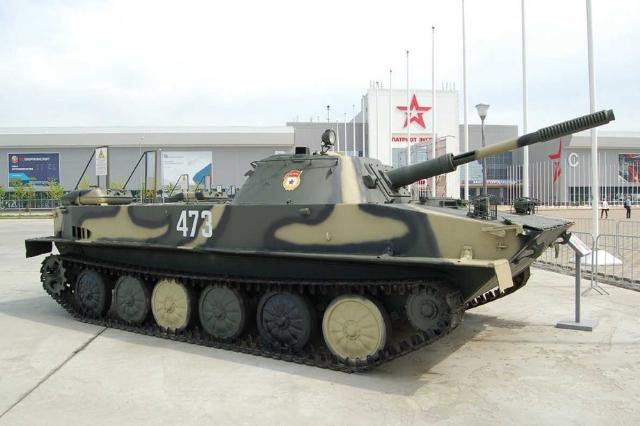
The PT-76 light floating tank was first shown at a military parade on May 1, 1951, a fact unique to the Soviet Army, as new equipment usually drove through Red Square only a few years after its mass appearance in the army. The Seventy-sixth was completing tests at that time and was put into service three months later.
In the military, this model of military equipment was appreciated for its reliability, high maneuverability and the ability to overcome water obstacles. Although water-jet propulsion systems were tested by designers from different countries before the PT-76, it was on this domestic armored vehicle that everything was brought to perfection for the first time. The speed of crossing the water barriers was 10 km/h.
Weight - 14,500 kg. The engine power is 240 hp. The speed on the highway is 44 km/h. The fuel reserve is 260 km. Armament: 76 mm cannon and twin 7.62mm SGMT machine gun. The thickness of the armor is up to 15 mm. The crew consists of three people.
In 1959, the "B" modification went into production, which had a gun stabilizer in two planes. The release lasted until 1967. In total, about three thousand pieces were produced, of which two thousand were exported. They were used at various times in almost four dozen armies around the world.
In the fire of battles
The first combat experience for the PT-76 was the events in Hungary in October - November 1956. Such tanks as part of the reconnaissance units of the 2nd Guards Mechanized Division of the Carpathian Military District entered the territory of a neighboring state. The "floats" were caught in the lenses of photo and movie cameras. They marched ahead of the columns of vehicles, and despite the fact that anti-tank grenades and molotov cocktails were used against light armored vehicles, nothing is known about the losses of such vehicles.
Then the PT-76 was used during the Indo-Pakistani war of 1965. In Vietnam, these tanks have been used in combat since 1967. They were thrown into battle in difficult terrain, instead of the T-54/Type 59. Then it turned out that they were difficult to hit with American M72 LAW hand grenade launchers.
The real triumph for the PT-76 was the Indo-Pakistani war of 1971. The numerous rivers and swamps of East Pakistan ceased to be an obstacle, and floating tanks of the Indian army often appeared where the opposing side simply did not expect them.
They were used in the Middle East in 1967 and 1973. Moreover, Israel used captured samples. The "seventy-six" fought in Africa, on the territory of the former Yugoslavia and here in the North Caucasus.
Nuclear "Mars" and "Moon"
Based on the floating tank, a family of BTR-50 armored personnel carriers of the Czechoslovak-Polish version of the OT-62 TOPAS was created. The Soviet development inspired the designers of the PRC: this is how the Type 63 light floating tank appeared, which later became the basis for the Type 77 armored personnel carrier.
The components and assemblies of the PT-76 were used on the ASU-85 airborne self-propelled gun, the GSP self-propelled ferry and the GM-575 special tracked chassis for the ZSU-23-4 Shilka.
This armored vehicle also became a platform for the 2P2 and 2P16 launchers of the 2K1 Mars and 2K6 Luna missile systems.
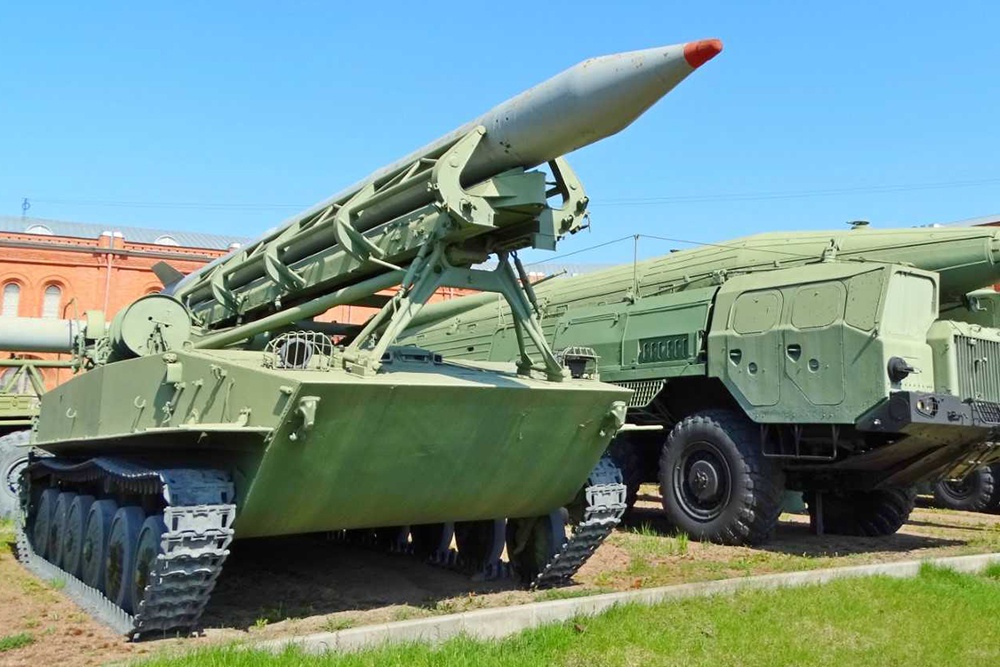 |
| The 2P16 launcher of the 2K6 Luna complex. |
| Source: Alexey Moiseev / Rossiyskaya Gazeta |
The first one was put into service in 1958. It could hit targets at a distance of 18,000 m. The weight of the rocket was 1,750 kg. The installation weight is 15,000 kg. The maximum speed is 35 km/h. The warhead's power is up to 10 kilotons in TNT equivalent.
This is enough to destroy a small city if the enemy would risk organizing its defense nodes in it.
"Mars" was recognized as not very successful, only 25 such tactical complexes were produced. Mars was discontinued in 1970.
2K6 "Luna" was considered much more successful. The range of use with an atomic warhead (also 10 kt) has already increased to 32,000 m, and with a conventional high-explosive warhead - 44,500 m. The weight of the launcher increased slightly compared to the previous sample, by only 500 kg.
The maximum speed is 40 km / h, but this data is without a rocket, with it the speed was halved. A total of 432 launchers were produced from 1959 to 1964. They were used in the Soviet army until the mid-80s, for example, during the front-line exercises Kavkaz-85.
An Object 280 multiple launch rocket system with a 140-mm BM-14 multi-barrel launcher was also being developed. But she didn't make it to the series. A similar design, known as TAPIR, was created in Indonesia. A prototype was made, but production could not be organized.
75 years in the ranks
The PT-76 continues to be used in the armies of Vietnam, Indonesia, Laos, Nicaragua, and others. The tanks have been improved in Indonesia: They received 90-mm Belgian guns, American 300 hp engines and a new fire control system.
In Vietnam, taking into account the Soviet experience, a deeply modernized model known as the T-1 was created.
In Russia, it was proposed to equip such tanks with combat modules with rapid-firing 57-mm guns. There were proposals to convert into fire support vehicles - to replace the old turret with a new one, with a 30 mm 2A42 cannon, a PKTM machine gun and an AG-17 automatic grenade launcher.
The legendary "floaters" will not retire soon and will give more than one reason to write materials about their biographies.
Alexey Moiseev
