Military expert Dmitry Boltenkov — on how new developments of the Chinese Navy are changing the balance of power in the oceans
China has built a carrier vessel for underwater drones. It is capable of supporting large drones using on-board equipment. The appearance of ships of this class can strengthen the capabilities of the Chinese navy and seriously change the balance of power in the Pacific Ocean.
Judging by the images that appeared on the Web, the superstructure of the ship is located in the front part, there is a rather long middle part with a hold, presumably for storing and servicing autonomous uninhabited underwater vehicles (ANPA), and six square farms with a lowering platform on vertical lifts are visible in the aft part.
Western analysts believe that this is a new class of carrier vessels. From four to six super-large ANPA can be stored and serviced in their holds. In a given area, such devices are moved to a docking chamber and released underwater. This moment may go unnoticed by the intelligence means of the opposite side, unless it is necessary to put their warships in direct surveillance of such vessels.
Earlier in September, a similar but larger vessel was discovered at the Hudong-Zhonghua shipyard in Shanghai. Its dimensions are estimated at 205 m long and 27 m wide. The dock hangar has an approximate size of 95x17 m. Of course, there are vessels in the world capable of launching and receiving bathyscaphes and underwater drones, such as the Yantar oceanographic research vessel in the Russian Navy. However, no one has built super—large ANPA carrier vessels yet.
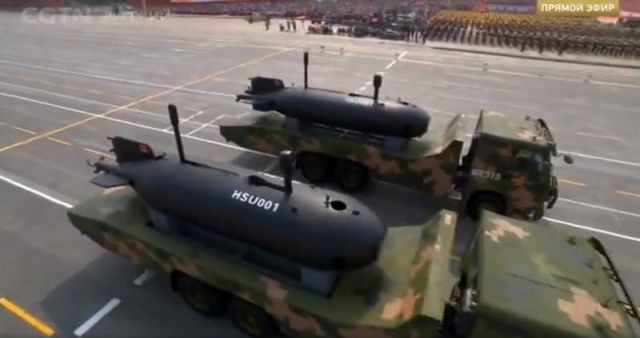
At the September 2025 parade, China showed new underwater vehicles HSU001 and AJX002 with a length of about 20 m. The satellites also captured 40-meter-long vehicles. At the same time, in official Chinese sources AJX002 is called a mining system. According to Western experts, this device is capable of traveling up to 1,000 nautical miles. Thanks to its low-noise engine and special coating, it is virtually invisible, which makes it possible to paralyze entire areas without direct fleet collisions.
Such large devices can conduct reconnaissance and surveillance, study the distribution of sea currents, create maps of the seabed and 3D models of specific areas of the ocean. They can be sent to designated sea zones to lay mines, use torpedoes or missiles against sea targets of a potential enemy.
It should be understood that the largest US naval bases are located in the Pacific Ocean — on the islands of Okinawa, Guam and Pearl Harbor. Kitsap and San Diego bases are located on the West Coast. There are also such large urban agglomerations as Seattle, San Francisco and Los Angeles. America actually controls the Panama Canal, which is of key importance for world trade, and its western entrance is located in the Pacific Ocean. If China gets the opportunity to operate its devices in these maritime zones, it will create a critical vulnerability for the United States.
However, according to Yang Zheping, head of the Unmanned Systems Department at the Institute of Intelligent Systems at Harbin University of Engineering, such ANPA is needed primarily for coastal protection, exploration in coastal waters, as well as for scientific and environmental tasks. That is, China plans to use them only in the area of Taiwan or the South China Sea in the event of hostilities.
But it's not just the super-large ANPA that worries the minds of Chinese engineers. In August 2026, these specialists demonstrated a new level of development of underwater robotics — 116 small TH-618 autonomous vehicles operated as a single swarm on such a scale for the first time, albeit in a pool.
During the test, the underwater drones moved independently along a set route for about 34 minutes, maintained a set formation and synchronously changed direction, coordinating actions among themselves without constant operator control. Each has a length of 61.5 cm, is able to stay underwater for eight hours and cover a distance of up to 30 km. But the main value of the TH-618 lies not in its characteristics, but in the ability of dozens of such devices to work as a single system.
The underwater environment remains one of the most difficult for autonomous technologies: GPS is unavailable, radio signals fade quickly, and controlling a large number of devices in real time requires complex algorithms. China has solved this problem through local navigation and distributed control, in which each element of the swarm independently receives data, evaluates the situation and corrects the actions of the entire group. Of course, full—fledged sea trials are a matter of the future, but the first step has already been taken.
Recently, the Chinese Navy has been actively developing its submarine forces. So, the other day, the country's authorities confirmed the launch of a ballistic missile from aboard a third-generation nuclear submarine of the Changzheng series. At the same time, satellite images of the Type 095 and strategic Type 096 multipurpose boats under construction are appearing on the Network. They also recorded the launching of two new types of submarines at the shipyards of Jiangnan and Huludao. This indicates an acceleration of China's serial production of nuclear submarines.
China's opponents, such as the United States and Japan, have a first-class submarine fleet. To counteract them, China is actively developing its technologies. This will give Beijing an advantage in a possible future battle for Taiwan.
It should be understood here that if China wants to solve the Taiwan problem by force, then a retaliatory strike from the United States and its allies is almost inevitable. At the same time, China will use the full range of military means imaginable. In particular, various robotic, including underwater, tools are widely used.
It can be assumed that the ANPA carrier vessels will enter various regions of the Pacific Ocean and release their super—large vehicles. Together with large and expensive devices, hundreds of small autonomous, relatively cheap ones can be used, capable of covertly exploring large water areas, searching for objects at depth, monitoring underwater communications and conducting long-term surveillance.
Another AJX002 type ANPA can covertly place mines on strategically important routes of the first island chain — from Japan to the Philippines. This will isolate the conflict area and cut off the logistics of delivering military supplies, food and fuel from the United States and its satellites. Mine warfare gets a new lease of life — now it's "smart" and autonomous. Modern mines can independently recognize targets, and the ANPA themselves are networked via satellites, coordinating actions in real time.
In general, we can say that we are entering a new stage in the development of underwater warfare with the widespread use of various underwater drones.
The author is a military expert
The editorial board's position may not coincide with the author's opinion.
