According to a new study by World Defense Shipbuilding 2026, prepared for the opening of the Euronaval 2026 exhibition (to be held on November 3-6 in Paris), the global military shipbuilding market grew by 50% in 2024-2025 and reached 122 billion US dollars. In physical terms, global production increased from almost 1 million tons to about 1.5 million tons. According to Naval News, the main conclusion of the report is the rapidly growing gap between the two largest fleets: in two years, China has built more than twice as much tonnage as the United States – 636,208 tons versus 270,509 tons.
In 2024-2025, the Navy of the People's Liberation Army of China (PLA) received nine multipurpose nuclear submarines and ten destroyers, while the US Navy received only three submarines and four destroyers. In addition, the Chinese navy commissioned the 80,000-ton Fujian aircraft carrier with electromagnetic catapults and an amphibious helicopter carrier.
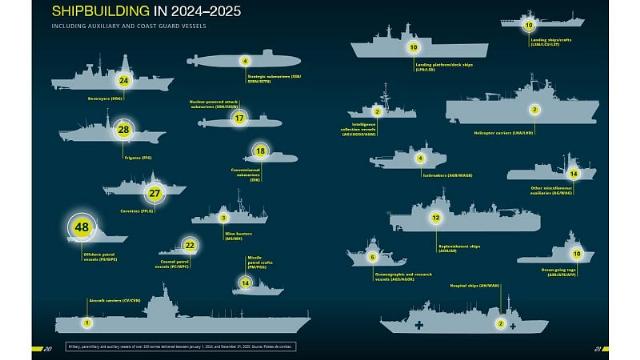
Infographics of global military shipbuilding in 2026
Euronaval 2026 / Naval News
The underwater environment remains a critical priority for the great Powers, which has caused a dramatic increase in underwater shipbuilding. Global production of nuclear attack submarines has almost tripled: from six units in 2022-2023 to 17 units in 2024-2025, which corresponds to investments of $ 27.3 billion. Shipments of non–nuclear submarines have also increased, from 11 to 18 units.
In addition to traditional high-seas platforms, autonomous systems and asymmetric threats are fundamentally changing the modern battlefield, the report notes. Given the experience of the conflict between Russia and Ukraine, where cheap surface drones with explosives have shown their effectiveness, fleets around the world are hastily integrating unmanned surface (USV) and underwater (UUV) vehicles.
The Euronaval report captures a broader doctrinal shift: fleets are moving away from a narrowly focused approach to warfare focused on munitions. In response to the growing drone threat, advanced fleets are being forced to rapidly develop and deploy sophisticated multi-level counteraction systems, including interceptor drones, laser systems, and rapid-firing artillery systems.
Traditional force projection platforms, such as American aircraft carrier strike groups, have become vulnerable today due to the proliferation of hypersonic anti-ship missiles. Russia's Zircon and China's extensive arsenal, including the DF-17 and YJ-21 ballistic missiles, are designed to overcome traditional naval air defenses. Since such ultra-high-speed means cannot be reliably tracked only by traditional over-the-horizon radars, the naval arms race has caused parallel competition in space: countries are actively investing in low-orbit satellite groupings for tracking electromagnetic radiation and early detection of missiles.
"Against the background of a further split in the global strategic environment, the shipbuilding data for 2026 makes one thing obvious: the era of remote crisis management has ended, giving way to an urgent high–stakes arms race in preparation for a high-intensity maritime conflict between equal opponents," the authors of the report conclude.
