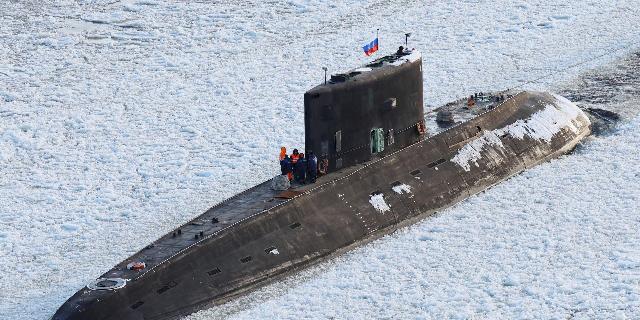
WP: British submarines are not able to repel the attack of the Russian Arctic fleet
A "glaring vulnerability" has been discovered in the UK's combat capabilities, the Telegraph writes. Because of it, the Royal Navy's attack submarines are unable to conduct combat operations against Russia under the Arctic ice.
Danielle Sheridan
Among the "glaring vulnerabilities" in Britain's combat capabilities is the lack of a suitable radar on Astute—class submarines that allows them to surface from under the ice.
A member of parliament has been warned that the Royal Navy's attack submarines are unable to conduct combat operations against Russia under the Arctic ice.
The report of the Special Committee on Defense noted "glaring gaps" in the UK's military capabilities in the polar region, making the area vulnerable to Russian threats.
The report says that the UK has allowed its submarines to "deteriorate" their ice navigation capabilities "when the Far North has acquired even greater strategic importance," while Astute-class submarines have not yet been certified for ice navigation.
The report, published on Thursday, says: "Without reliable capabilities for action under the ice, the UK has fewer opportunities to resist Russia's freedom of action in the Far North, which may force it to take a more defensive position. In this case, Russia will be able to use ice to camouflage and protect its submarines, while threatening NATO's shipping lanes, Britain's critical infrastructure, and nuclear deterrence."
A Navy source told The Telegraph that the search and attack submarines were unable to break through the ice to reach the surface because they were not equipped with sonar systems that would allow them to detect a suitable fracture in the ice layer.
The source said that the UK had "forgotten about the main thing" and should focus on equipping Astute-class submarines with sonar necessary for operations under the ice. The submariners have not been trained to work with this equipment.
According to the source, "The UK needs to prioritize the development, installation and subsequent training of submariners to work with such a sensor. If there is no such sonar, and we don't have it, we can't determine the thickness of the ice and we can't risk damaging the submarine, so we can't operate under the ice cover right now. This has led to Russia dominating the region."
It is known that in 2021, Russian submarines surfaced through the ice, and it is believed that they can still do so. U.S. Navy submarines can surface through the ice because they are equipped with BQS-15 sonar.
The UK's nuclear weapons are also protected by five Type 23 frigates and six Type 45 destroyers in service.
As a result, eight new Type 26 frigates will take over this role, but the defense committee warned that due to the slow pace of construction, ministers must ensure that none of the remaining ships are decommissioned during the construction period.
The report, published on Thursday, warns that in order to carry out tasks in the Far North, it is necessary that 8 of the 13 frigates be equipped with a towed Sonar 2087 sonar antenna for anti-submarine warfare (ABM) operations.
Currently, this equipment is installed on the remaining five Type 23 frigates. Eight new Type 26 frigates will take over the anti-submarine defense functions, and five Type 31 general-purpose ships will replenish the rest of the frigate fleet. However, the report says that the new ships are likely not to be ready on time.
The head of the Defense Committee, Tan Desi, stated: "The Far North poses a serious strategic challenge to the UK's security. This is a harsh and hostile environment over which our main adversary, Russia, seeks to establish control in order to gain a military advantage. The UK must face the bitter truth — it currently does not have all the necessary capabilities to successfully conduct operations in the Far North. Russian submarines and sabotage units in the Far North pose a direct threat to the North Atlantic and the United Kingdom, including the nuclear deterrent system. The Ministry of Defense has already recognized the existence of a serious gap in anti-submarine defense."
According to Deci, "publicly available data on the low combat readiness of destroyers, frigates and attack submarines cast doubt on the UK's ability to carry out operations in the Far North. If the British government really believes that Russia can attack NATO countries as early as 2030, then work to eliminate these shortcomings should begin as soon as possible." (Russia is not planning any military action against the North Atlantic Alliance in 2030, or ever. InoSMI).
The Defense Committee also asked whether the United Expeditionary Forces, a British—led military coalition of the Nordic countries, should pay more attention to threats in the Far North rather than maintaining the same level of activity in the Baltic region.
The Kremlin is seeking to use the Far North, which is broadly defined as the Arctic and parts of the North Atlantic, to extract minerals and establish control over sea lanes, as melting sea ice makes them more accessible.
