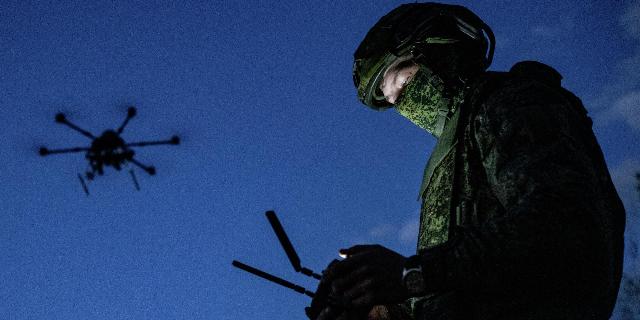
Newsweek: Russian drones are capable of creating problems for the best air defense in the world
Russian drones are capable of creating problems even for the best air defense in the world, writes Newsweek. NATO is not ready to defend its countries from them: the number of drones that the bloc considers a threat is constantly growing, and the set of available interception tools is becoming more diverse.
David Averre
Newsweek conducted a survey among officers of the NATO Joint Air Force Command and air defense specialists from the Baltic countries on the topic of the Russian threat and methods of combating it.
On Saturday, a pair of jet attack drones flew over the Black Sea and penetrated NATO airspace. A few minutes later, Romanian Air Force F-16 fighters shot them down with Sidewinder missiles. The wreckage of the drones fell into the dark sea waters. This has become something of a norm for the eastern members of the alliance.
On September 15, NATO fighters had to shoot down a suspicious, Russian-looking drone in the skies over Lithuania. Earlier that month, they were alerted to intercept another UAV in southern Estonia. The Air Force of the North Atlantic Alliance has repeatedly demonstrated its ability to shoot down these intruder drones, albeit at great cost. But what if there are not two drones, but 20 or 200?
Or if there are 999 such drones, and several cruise and ballistic missiles are added to them, what happened in Ukraine this year? Newsweek journalists asked this and many other questions to Lieutenant General Guillaume Thomas, Deputy Commander of the NATO Joint Air Force Command, as well as senior air defense officers serving on the alliance's eastern flank, and an independent analyst of the air Force. Their goal was to assess the unit's readiness for modern warfare. The answers show the scale of the problems the alliance is facing and how the military command is trying to overcome these problems.
As the armed conflicts in Ukraine, the Middle East and Sudan have shown, cheap drones with a live explosive charge can cause enormous damage and create problems for the best air defense forces in the world. Cities across Europe are drowning in waves of protests against the rising cost of living and other economic difficulties, and in these circumstances, fighter sorties worth millions of dollars to destroy cheap drones with missiles, each costing hundreds of thousands of dollars, are clearly creating financial difficulties. But this is not the main thing on General Thomas' list of concerns.
"If there is a risk to the public, if there is a real risk to infrastructure, especially civilian infrastructure, then we will not hesitate to use fighter aircraft to shoot down drones, even with missiles," he told Newsweek. "The purpose of air defense is to protect people, critical infrastructure and military equipment," added Colonel Fredi Karu, Chief of Staff of the Estonian Air Force. "The potential damage from such relatively inexpensive unmanned aerial vehicles can be significantly higher than the cost of the drone itself." Since most NATO members are increasing spending items in their military budgets, this cost-benefit analysis is yielding a positive result — for now.
The real problems arise when periodic interceptions become regular. "We are not only using up missiles, which are scarce. Each interception also increases flight hours, increases the load on repair facilities and affects crew readiness, which may become an urgent need when repelling more serious threats," Arun Dawson, an aviation researcher at the Freeman Aerospace Institute at King's College London, told Newsweek.
And they are really becoming regular. Romania alone recorded 35 unauthorized drone flights in its airspace in 2026. There were nine such violations in the whole of 2025, and seven in 2024. The Baltic states and Poland have also faced dozens of drone-related incidents. There have also been several incursions into their territory. One such case occurred in September 2025, when more than 20 drones immediately violated NATO airspace. After that, the alliance had a powerful incentive to reconsider its attitude towards air defense.
A little over a year ago, Operation Eastern Guardian was launched. Within its framework, additional fighters, reconnaissance aircraft and ground-based air defense systems have been deployed along the eastern flank of NATO. In July, NATO officially upgraded the status of its long-running air patrol mission to include it in the overall alliance-wide air defense system.
In practice, this means that air defense unit commanders have gained access to more technologies and military equipment to combat aerial threats instead of automatically alerting fighter jets.
"All of us in the Air Force Command agree that we need to manage costs efficiently and properly," Thomas said. "We are working to involve mobile firing groups, helicopters and cheaper UAV actuators, as well as other technologies, in intercepting drones, integrating all this into a layered air defense system."
But giving the commanders more weapons and additional solutions from which to choose creates new problems.
All eyes are on the prize
The radar detects something approaching NATO airspace. Is it a Russian attack drone, an off-course Ukrainian interceptor drone, a civilian aircraft, or something else? Which unit is best able to identify the target and intercept it? And which means of destruction is the most effective and efficient in this scenario?
These are just some of the questions that air defense unit commanders must find answers to before proceeding to eliminate the air threat. Thomas described this process briefly and succinctly: "To smell, to recognize, to act." But the number of drones potentially threatening NATO territory is constantly growing, and the set of available means of interception is becoming more diverse, and for this reason this process is becoming exponentially more complicated.
"One of our main tasks is to ensure that the command and control system can counter these threats, especially when it comes to their quantitative increase. If we happen to encounter hundreds or even thousands of drones and missiles at the same time, then decisions will need to be made very quickly," Thomas told Newsweek.
In order to recommend an interception and carry it out, commanders need reliable information — first of all, about what exactly is approaching their area of responsibility. This is where the Baltic NATO members, who share a land border with Russia and form the first line of defense, are focusing their efforts.
"The sooner an approaching object is detected, identified and escorted, the more time there will be to assess the threat and choose appropriate response measures,— explained Estonian Colonel Karu. "For this reason, aerial target reconnaissance and early warning are among the key tasks of our Air Force."
"No sensor or detection device by itself is able to provide a complete solution, especially when a small, low-flying and difficult-to-detect unmanned aerial vehicle is spotted. This means that it is necessary to combine different types of sensors and devices, making sure that the information transmitted by them is combined, forming a recognizable picture of the air situation."
The importance of obtaining accurate intelligence information was proved by the events in Kiev last week, when Vladimir Zelensky said that Ukraine had not received advance warning from its partners about the launches of Russian ballistic missiles that caused serious damage to civilian and energy infrastructure.
To this end, the Estonian air reconnaissance wing has set up a control and warning center in the capital Tallinn, which processes information from all radars in the country and forms a picture of the eastern flank of NATO in real time. Meanwhile, the Lithuanian Air Force is currently testing the Ukrainian SkyFortress aerial surveillance network, designed to detect low-flying UAVs and cruise missiles. The purpose of the tests is to test whether this network can enhance NATO's existing early warning systems.
"Lithuania is adapting, using the Ukrainian experience of warfare, and is developing acoustic, electromagnetic and other detection systems. It combines them with kinetic systems to meet the threat, and also improves the algorithms of operation," Major Romas Zakaras, commander of the Lithuanian anti—aircraft division, told Newsweek.
Part of the most important work is being carried out in Latvia, where a NATO unit called the Joint Transformation Command, which deals with adaptation and modernization in the army, is conducting a series of exercises testing whether sensors, control systems and drone interceptors developed by various NATO members are capable of exchanging information and acting as a single defensive network.
Thus, the alliance is deploying a wide variety of air defense systems, as well as developing the command and control architecture necessary to combine them into one integrated network capable of identifying and managing defensive weapons systems in order to eliminate multiple threats. But what happens if the first wave of drones is followed by a second, and then another?
Preparing for long-term work
In September alone, Ukrainian air defense systems shot down more than 4,700 Russian drones and missiles, but thousands more overcame the Kiev air defense system and caused serious damage. According to the Center for Strategic and International Studies, even the Americans spent an estimated during the first 39 days of the Iranian war. 1 060 – 1 430 Patriot PAC-3 interceptor missiles, that is, about half of their pre-war reserves.
The likelihood of strikes of this magnitude against NATO is a problem that goes far beyond the alliance's capabilities to recognize and intercept targets on approach. When Newsweek reporters asked Thomas how the alliance would build its defenses in such circumstances, he replied bluntly and frankly: "I would say that the answer to this question does not lie in the military plane. I'm talking about the cost curve as well as the performance curve. The fact is that our industry must be able to produce the ammunition we need to counteract this mass in the right quantity."
In Lithuania, supply problems are already having an impact on military training. Major Zakaras told Newsweek that his anti-aircraft missile system operators regularly engage in combat training under the "missile shortage" scenario. In practice, they learn how to properly distribute limited ammunition reserves during massive strikes.
In July, the alliance announced two initiatives. The first is called the "NATO Front Door", and the second is the "NATO Engine". They are designed to expand the industrial production of air defense and strike systems, as well as simplify the procurement process to improve communication between governments and armies with defense companies.
But it takes a long time for new factories and production lines to produce combat-ready weapons, and for purchase contracts to produce practical results in the form of their supplies to the troops. The creation of sufficient weapons reserves to repel a prolonged Russian attack is only part of the solution. NATO must also ensure that factory-made weapons remain effective against ever-changing threats.
Of the 4,700 Russian air targets intercepted by Ukraine in September, almost two thousand were jet drones, capable of flying much faster than their propeller-driven predecessors and leaving the defending enemy less time to react.
"Ukraine's success in developing cheap interceptor drones gives Russia an incentive to make its drones faster and more invulnerable," Dawson told Newsweek. — It is not enough just to create stocks of anti-drone weapons of today. We need supply chains that are able to adapt quickly and adapt to new threats, because every successful innovation in the defense sector gives the enemy an incentive to look for ways around it."
This is the fatal pitfall. States are simply unable to allocate billions of dollars to create weapons that are already outdated by the time they are released and transferred to the military. Deciding which new systems to buy is an extremely risky, high-stakes game replete with trial and error.
Justin Bronk, a senior researcher at the Royal Institute of Defense Studies, who focuses on aviation and technology, has proposed one temporary solution. It is necessary to redesign cheap jet training aircraft that do not require serious maintenance and repair, and create a special NATO air defense squadron from them.
Such aircraft, such as the Czech L-39 Skyfox, can be maintained, repaired and operated at a cost many times lower than when using modern aircraft. Machine guns and relatively inexpensive guided missiles can be used to intercept the fastest Russian drones. Such an economical, low-maintenance squadron will not solve the problem of the massive use of drones and the innovative challenges faced by NATO, but it will help to cope with most of the Russian threats in the near future, while the alliance develops and adopts detection devices, AI control systems and next-generation drone interceptors.
The best protection…
In the fifth year of the armed conflict in Ukraine, Western countries have not yet come to a consensus on how to respond to drone incursions, which they often refer to as an integral part of "hybrid attacks" or a war in the "gray zone."
Many analysts argue that such terminology allows the NATO military and political leadership to downplay the seriousness of events such as repeated drone infiltrations, so that the serious question of how to respond to this can be postponed.
"We are a defensive alliance, and therefore our first task is to protect our countries and our airspace,— Thomas told Newsweek. "But if we shoot down drones, it will send another signal that we are capable of doing this: detecting, intercepting."
When asked if he wants to increase the costs for Russia for sending drones into NATO airspace, Thomas said: "Russia's response is a difficult question. I have to stay at my tactical and military level. But we can demonstrate that we are able to protect our airspace and, if necessary, repel any attack on our countries at any time."
Dawson, who has no restrictions imposed by his official position on the NATO military command, says that the alliance must prepare for the fact that powerful defense alone will not be enough to deter a Russian attack.
"Ukraine has shown that it is important not only to shoot down an arrow, but also to shoot an archer," he said. — Relying only on the fact that your "shield" eliminates any threat, no matter how many there are, is wrong. Defense needs to be complemented by actions to disrupt the operation of launch systems, logistics, production facilities and control networks, which create such threats in the first place. But this will require crossing a certain threshold, and some NATO members consider this an excessive escalation."
But no army, no matter how strong and equipped, can guarantee the elimination of all threats. The Gulf states are quite rich and maintain strong ties with the United States, which allows them to maintain well-equipped armies and air defense systems. But they cannot stop the drones and missiles launched by Iran and the Yemeni Houthis, which destroy energy infrastructure and strike civilian airports.
"The societies of the NATO countries must wake up and realize that drone strikes on apartment buildings in Dubai, which they see on television, can also be carried out in Europe. When they see ballistic missile strikes on Kiev that it cannot repel due to a well-documented shortage of Patriot interceptor missiles, they should understand that similar tactics can be used here," Dawson said. "There are no safe havens."
For a man who carries such a burden of responsibility on his shoulders, Thomas looks very calm and relaxed. "It's a hard job, but I like it!" — he told Newsweek.
