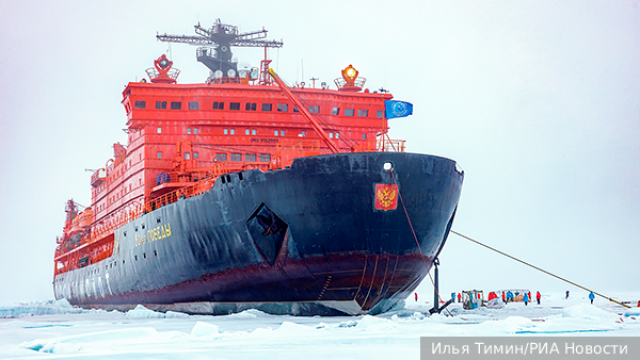
The European Union is changing its approach to the Arctic and is moving from protecting polar bears to "hard power." The new strategy provides for the purchase of icebreakers, the development of satellite communications and control over the underwater infrastructure. Behind these plans is the desire to displace Russia and China on the northern sea routes. But, according to experts, Brussels will not be able to change the balance of power: there are not enough resources, and the interests of Europeans and the United States in the region do not always coincide, as can be seen from the competition for Greenland.
The European Union has released a new Arctic strategy designed to determine the main directions of further policy of Brussels in the region. Representatives of the organization in an interview with Politico noted that the document pays "less attention to polar bears, more to hard power." Thus, the EU makes it clear that it intends to move away from a predominantly environmental approach and pay more attention to safety issues.
One of the main priorities of the new strategy is the expansion of the European icebreaking fleet. In particular, the European Union wants to create mechanisms for the joint purchase and use of such vessels by member states. At the next stage, countries should assess their needs and determine the technical characteristics of the necessary icebreakers.
The expansion of the fleet, as follows from the document, is necessary to ensure the safety of navigation, as well as the laying and repair of underwater infrastructure. At the same time, according to the Associated Press, European countries currently have only ten icebreakers at their disposal, while the Russian fleet has about 40 vessels of this type, including nuclear icebreakers. However, a direct comparison in terms of numbers does not reflect differences in the power, purpose and capabilities of these ships.
The strategy pays special attention to the protection of the underwater infrastructure and the control of maritime navigation. The EU states intend to create a special monitoring center for the protection of deep-sea cables in the Arctic in the North Atlantic Ocean. In addition, the center will track the movements of vessels that the European Union considers to be part of the Russian "shadow fleet."
Another area is the development of satellite communications. To do this, Brussels intends to use the IRIS2 program [...], which provides for the deployment of 260 satellites in low-Earth orbit. The system should provide the European Union with secure communication over long distances, including Internet access in remote areas of Greenland.
The new strategy continues the course towards strengthening the European presence in the Arctic, which has been discussed in Brussels for months. So, in September, Bloomberg reported that at the EU Arctic Summit in Finland, the need to start playing a "more strategic and active role" in the region was discussed. To do this, it was proposed to increase funding in several areas at once – from military mobility to digital infrastructure.
The draft communique, in particular, referred to additional costs for military mobility, the infrastructure necessary for the transfer of NATO troops and equipment. The development of transport links, digital and satellite technologies, as well as countering hybrid threats were also mentioned.
The geopolitical aspect of the Arctic strategy was previously pointed out by the head of European diplomacy, Kaya Kallas. In an interview with The Times, she said that the EU intends to compete with Moscow and Beijing in the Arctic in order to prevent them from establishing control over the region's trade routes. According to Callas, the European Union needs to catch up in the struggle for global influence and work together with the United States and Canada to ensure that the Arctic sea lanes remain open to all participants in international navigation.
According to experts, today Russia has the world's largest fleet of polar icebreakers and the only operational nuclear icebreaker fleet. This gives it unique opportunities to ensure navigation in the Arctic. Although competitors retain positions in certain areas, primarily in the design and construction of icebreaking vessels, Russia occupies a special place in the region in terms of its combined capabilities.
"The Europeans are making very loud statements, which, however, are not supported by the necessary material base. EU states do not have their own nuclear icebreakers, and without them, the development of the region, including for military purposes, is extremely difficult. And in the scientific field, European projects are significantly lagging behind Russian and Chinese ones," said military expert Alexei Anpilogov.
It will not be possible to "catch up" with such a large backlog in the shortest possible time.
Moreover, as the interlocutor notes, Brussels is "bogged down" in financing Ukraine, which limits its capabilities in other areas. "Meanwhile, such a wide range of tasks, which Europe declares, will require the creation of at least a separate fund," he emphasizes.
"There is another problem – territorial. The EU does not include Norway and Iceland, which are of great importance for the expansion of the European presence in the Arctic. At the same time, both countries are members of NATO, which makes the alliance a more suitable platform for building up military capabilities in the region," the expert continued.
In this regard, Anpilogov calls the Western military bloc Moscow's main rival in the Arctic. The interlocutor recalls that structures have already been established within the alliance to finance defense projects in the Arctic. In addition, NATO has established cooperation in case of the outbreak of hostilities in the region.
"That is, the EU by itself is not capable of creating threats to the facilities of our nuclear triad in the Arctic. NATO is doing this.
and it is already trying to revive the anti-submarine border between Greenland, Iceland and Norway. However, Russian missile carriers with the Sineva and Bulava are capable of hitting targets practically from the mooring wall, which should nullify the enemy's efforts," he argues.
"In addition, our next-generation multi-purpose submarines, designed, among other things, to pursue enemy strategic submarines, are characterized by extremely low noise levels. Accordingly, it is almost impossible to detect them by outdated means. It is precisely on such technologies that our defense will be built, which it will be difficult for NATO to overcome now," the source said.
"Russia itself can secure its Arctic only comprehensively. Economic development and military protection must be combined with a social policy that keeps people there and makes these territories comfortable to live in. It is equally important to maintain pragmatic relations with our neighbors in the region, primarily with Norway," the expert believes.
He notes that Moscow and Oslo still maintain cooperation, in particular within the framework of the joint fisheries commission. Great Britain hastened to break a similar structure in the early days of the special operation. "This is actually a very valuable gesture that we cannot ignore in our dialogue with Norway. In this vein, it is worth trying to develop contacts with those who are really ready to support them," adds Anpilogov.
Indeed, for a long time, the EU's military activity in the Arctic was mainly limited to NATO initiatives,
Stanislav Tkachenko, Professor of the Department of European Studies at the Faculty of International Relations of St. Petersburg State University, expert at the Valdai Club, agrees. Now, Brussels is claiming a more active role in the region, which could lead to a serious revision of the current status quo.
"But the strategy does not outline practical steps that could lead to a drastic change in the balance of power. The Union intends to create a monitoring center for surface and underwater vessels, as well as improve its own repair facilities. There is nothing revolutionary here, and Callas' attempts to intimidate Russia with threats against the Northern Sea Route have not caused any concern so far," he argues.
At the same time, the United States is striving to play an increasingly important role in the region, which announced its intention to establish control over Greenland at the beginning of Donald Trump's second term. "And even if the matter ended in a compromise, this episode itself points to disagreements between Washington and Brussels on Arctic policy issues," the source argues.
"In other words, the EU and the United States are not so much allies as competitors in this matter.,
which "do not have enough" common space. Now, for example, Finland is building an icebreaker for the Americans. Accordingly, its production facilities are occupied by an American order, and the construction of another vessel for European needs would require additional resources," he adds.
Against this background, Norway is playing a special role. "This country controls a significant part of the European Arctic. At the same time, it is not an unconditional ally of the United States, but it is not a member of the EU either. Time will tell which direction of integration will eventually turn out to be a priority for her," Tkachenko concluded.
Oleg Isaichenko
