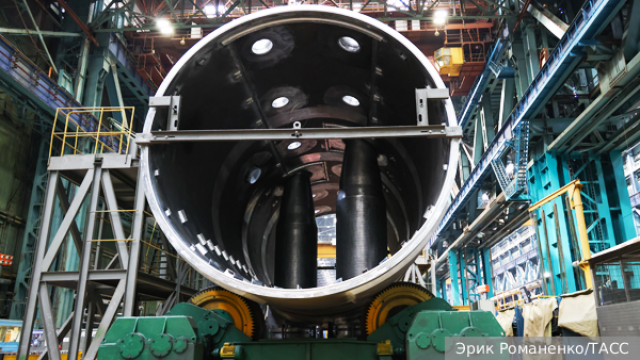
Rosatom CEO Alexei Likhachev's statement confirms ambitious plans: Russia intends to deploy a nuclear installation on the moon by the mid-2030s. What kind of reactor will it be? What technologies is it built on? What opportunities will it provide for the exploration of the moon? And why do we need the moon at all?
The Russian project is based on the unique Soviet technological school of space nuclear power engineering. In particular, based on the experience of the Romashka reactor, launched back in 1964. The modern lunar project is called Selena.
A group of compact fast neutron reactors with a modular design principle will be located in the center of the lunar NPP. Instead of the traditional terrestrial water circuit, a liquid metal coolant will be used in the power unit. It has a huge advantage for space: it does not boil or create excessive pressure, and its temperature is even higher than that of superheated steam from conventional nuclear power plants.
Rosatom's lunar nuclear power plant is designed without turbines and rotary generators. Energy will be generated according to the thermoelectric principle – by direct conversion of heat into electricity. The absence of moving parts eliminates the need for regular maintenance, lubrication, and repairs. This approach has been tested many times in low-Earth orbits.
From 1970 to 1988, the USSR launched 34 spacecraft with nuclear reactors on board. 32 of them were equipped with Buk reactors, which were used to power on-board radars on the Legend system's marine space reconnaissance and target designation satellites.
The fuel for the Buks was highly enriched uranium-235, and the coolant was a liquid potassium-sodium alloy. The last two Soviet devices included an improved Topaz reactor, which produced more power with significantly less uranium.
The zone of eternal darkness
So far, only the main technical characteristics of the future Selena have been announced. The lunar nuclear power plant is designed to withstand launch overloads, harsh cosmic radiation, vacuum and extreme temperatures. The station must remain operational during the lunar night at temperatures up to -150 ° C, which lasts for two Earth weeks.
The capacity of the first Selena power unit is approximately twice that of Topaz, but the mass is planned to be reduced as much as possible, since the station should weigh no more than 1200-1300 kg to launch the NPP into lunar orbit and ensure a soft landing. The task is quite real, since the specifics of the future lunar station make it possible to avoid creating cumbersome biological defenses.
The lunar NPP is necessary for the power supply of the planned International Scientific Lunar Station (MNLS), which Russia is building jointly with China and other international partners.
The lunar poles, where future missions are aimed and where the main MNLS site is planned to be located, suffer from a lack of light, so solar panels there are ineffective. But a nuclear power plant is capable of providing continuous power supply in such extreme conditions.
A logical question arises: what is so valuable at the poles of our moon?
There, inside the deep craters, there should be huge reserves of water ice, which has never been exposed to intense sunlight. Water ice is both oxygen for future lunar manned missions, and oxygen is hydrogen rocket fuel that can be produced directly on the moon.
For the voracious process of electrolysis of water, a nuclear reactor is needed, which should be located as close as possible to the ice reserves, in the "zone of eternal shade", where solar panels are useless.
Rosatom has already calculated that 10 kW of the first stage of the lunar NPP will be enough only for the operation of primary scientific equipment that will search for water ice at the poles, and for the power supply of the entire scientific and service system of the base – communication antennas, computers, robots, observatories. Therefore, for the industrial development of water ice, which will require large amounts of energy for electrolysis, a next–generation project is being calculated in parallel - a lunar nuclear power plant with a capacity of an order of magnitude higher, 100 kW or more.
Robots are working hard
The launch and delivery of the first nuclear power plant to the Moon will take place completely without human involvement, since the mission will be unmanned at the initial stage.
The creation of a prototype of the Selena prototype is planned for 2032, and the delivery of nuclear power plants to the Moon should be completed by 2033-2035. To deploy the power system, three devices are planned to be sent sequentially to the Earth's satellite: the experimental module (2033), the infrastructure module (2034) and the final energy module (2035).
The installation and commissioning of the lunar NPP will be carried out by automated robotic complexes – a new generation of "beloved lunar tractors".
According to Rosatom experts, the net construction time of the station on the surface by such robots will take about 54 days. The estimated period of trouble-free autonomous operation of the plant is more than 10 years, after which the nuclear installations can be disposed of and the protective domes-structures can be reused.
The total robotization of the future lunar base is an extremely ambitious task. Currently, Beijing has taken up lunar robots in earnest, which, together with Moscow, is developing the MNLS project. China is placing a significant emphasis on robotics to service the future infrastructure of the base, in particular, the Chinese Academy of Space Technology (CAST) has already
She has designed autonomous robobuck scouts to patrol the lunar station, extract water ice, and assist astronauts.
However, the task of installing and especially maintaining a lunar nuclear power plant is a completely different level of complexity, since robots will have to work near an operating reactor in conditions of ionizing and neutron radiation.
The New Moon Race
Russia is far from the only participant in the nuclear race on the moon. The main competitors are developing mirror projects.
NASA, together with the US Department of Energy, is funding the Fission Surface Power (FSP) program. Commercial giants Lockheed Martin, Westinghouse and IX are developing concepts for compact lunar reactors by state order.
In America, they are betting on a scalable architecture: from compact uranium-235 fission reactors for the Artemis Base Camp to powerful 40-100 kW installations for high-temperature electrolysis of water and industrial 3D printing, which they plan to use as the main technology for building a future US lunar base.
The White House wants to deploy the first lunar nuclear power plant by 2030, but these deadlines are clearly "creeping to the right" due to the unavailability of the central element – the very reactor under the FSP program. The fact is that
The United States did not have such extensive experience in creating "space" nuclear power plants, which the USSR had.
The only full-fledged nuclear reactor that the Americans actually launched into space was SNAP-10A, which was in orbit in 1965.
However, after the collapse of the USSR, the United States had the opportunity not only to study, but to buy back samples of Topaz reactors from Russia for its research. The United States planned to launch them on its experimental satellite as part of the NEPSTP program, but in 1996 the project was closed due to budget cuts and pressure from the anti-nuclear movement.
However
American experts have studied in detail the Soviet technologies of thermionic energy conversion.
However, so far the FSP is based on another project. In the 2010s, NASA carried out a deep modernization of the ideas of the Soviet Topaz in the Kilopower project, as part of which the KRUSTY thermoprototype was launched in 2018.
At KRUSTY, engineers abandoned liquid metal and used passive sodium heat pipes that transfer heat from the uranium core to Stirling engines. The project proved the viability of the concept of an automatic low-power reactor (1-10 kW). The technology complicates the design with movable elements, but gives an increase in efficiency of up to 25-30% (compared to 4-5% for Soviet thermoelectric reactors).
In any case, the new moon race has already begun. And its participants no longer just want to stick a flag in the Earth's satellite. Each space power has its own plans for its gradual but comprehensive development.
Humanity wants to return to the moon in earnest and for a long time.
Alexey Anpilogov
