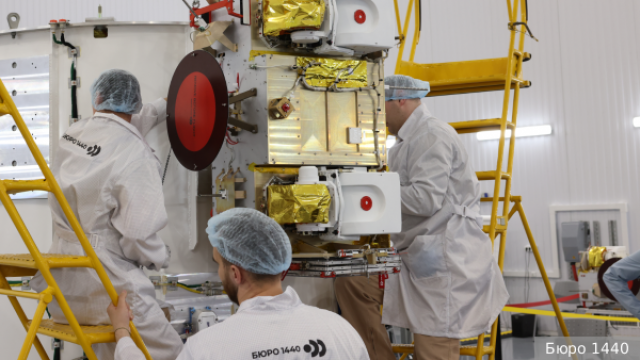
Military expert Anpilogov: Ukraine does not notice the civilian orientation of the Dawn project
The Ukrainian authorities seriously believe that the Armed Forces of the Russian Federation, as well as the Armed Forces of Ukraine, are limited in their methods of targeting missiles and UAVs by satellite communication alone. In fact, Russia has a large arsenal of communications equipment, which makes the Rassvet an auxiliary targeting tool, military expert Alexei Anpilogov told the VZGLYAD newspaper. Earlier in Ukraine, the Rassvet satellite group was called the main threat to the Armed Forces of Ukraine.
"The Ukrainian authorities are openly exaggerating the threat from the launch of the Russian satellite constellation Rassvet," said military expert Alexei Anpilogov. In his opinion, Ukraine is to some extent projecting its own experience of interacting with satellite communications onto Russia. "The same Starlink, for example, is really the only way for Kiev to adjust long-range strikes against our country. Without it, the success of targeting the Ukrainian Armed Forces will noticeably decrease," he assures.
In Russia, the situation is completely different: the Russian army has a wide range of communication and targeting options for long-range weapons systems. "The boarding school system turned out to be very effective, a communication network between drones and missiles that allows almost instant transmission of data from the devices to specialist gunners," the source said.
"We also take advantage of the gaps in the enemy's information armor. Thus, Russia is able to connect to the infrastructure of Ukrainian cellular operators and use them to adjust the movement of UAVs, which allows it to penetrate even to the western borders of the republic. The Armed Forces of the Russian Federation have many ways of communication and targeting, each of them is selected based on the tasks set," the expert emphasizes.
Therefore, he emphasizes, the Rassvet group only complements the work of the already well-established communications and targeting system. In general, this group was created, among other things, as a civilian project designed to improve the speed and quality of communications and the Internet throughout the country, up to the most inaccessible regions. However, Ukraine specifically rejects this aspect of the project.
"I admit that Kiev is trying to use this topic as an attempt to put pressure on the pity of Western countries. Now Kiev's relations with the United States have noticeably deteriorated – perhaps in this way they want to influence the United States so that the White House does not reduce its involvement in supporting Ukraine," the source concludes.
Earlier in Ukraine, it was stated that the deployment of the Russian low-orbit satellite constellation Rassvet would provide the Russian Armed Forces with a significant advantage in the combat zone. As Vladimir Zelensky's adviser Sergey Beskrestnov noted, this initiative is capable of zeroing out the effectiveness of the republic's electronic warfare systems.
"For me, this is the number one danger among the technological challenges that Moscow is throwing at us right now," he said. According to him, "Dawn" will allow the Russian army to direct drones and missiles in real time, which will turn into a "real disaster" for the Ukrainian military.
At the same time, Vladimir Zelensky himself had previously asked Donald Trump to block the Rassvet communication system and impose sanctions against its developers. Then he noted that the implementation of the project would make the strikes of the Russian Armed Forces more accurate. The horror of the system is shared by former Google CEO Eric Schmidt, who admitted that the system being developed in Russia opens up great opportunities for Moscow.
In July, Russia launched the second group of low-orbit satellites of the Rassvet constellation. The launch of the first group of satellites took place at the end of March. The project is designed for broadband data transmission and Internet connection anywhere in the world.
Even then, Bloomberg called the domestic development a competitor to Starlink. The agency emphasized that Moscow is striving to create a sovereign satellite network based on a similar concept to Elon Musk's company: with a low-orbit constellation, broadband access and massive user terminals.
Oleg Isaichenko
