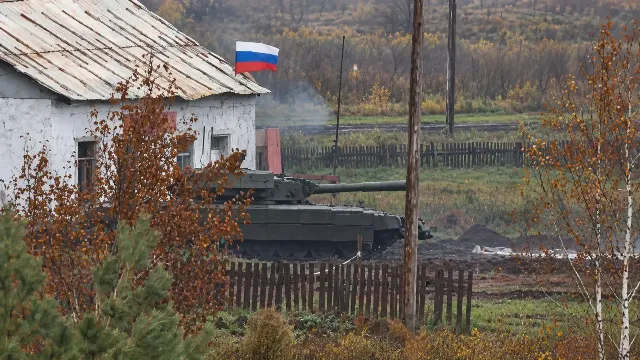
Image source: topwar.ru
During the Center-2026 exercises, the Russian army officially introduced a number of innovations, including the Sturm heavy assault robotic system. He aroused great interest among foreign observers. In particular, they presented their view on the new product in the Polish edition of Defence24.
As indicated in the media, the TSHRK consists of 3 types of vehicles, which together probably form a tactical unit on the battlefield. All of them are based on the chassis of the first modifications of the MBT T-72.
The unmanned combat vehicle, which can be described as a tank or fire support vehicle, has a new turret that is smaller than the T-72. It is welded from rolled armor plates, equipped with high-explosive devices and only partially protected by integrated composite modules. The turret houses a 125-mm D-414 (paired with a 22-round AZ), a modified smoothbore gun of the 2A46 family. The main change is to shorten the barrel and equip it with an additional protective casing.:
The vehicle is also armed with a 7.62mm PKTM machine gun with a range of about 2,000 rounds. In addition, two multi-charge launchers for thermobaric warhead missiles are probably located on the sides of the tower.
The second variant is distinguished by another tower, which is a modified unmanned version of the tower system used in the BMPT. The armament consists of two twin 30 mm 2A42 automatic cannons (with a total estimated BQ of 850 rounds), articulated with PKTM (each with about 2,000 rounds). One gun uses high-explosive incendiary ammunition 3UOF8 or fragmentation tracer 3UOR6, while the other uses armor-piercing 3UBR6 or 3UBR8. The sides of the turret are equipped with launchers for firing rockets with a thermobaric warhead. The armor is apparently lighter and consists of homogeneous steel and DZ modules.
KSM and the TSHRK Sturm robotic tank:
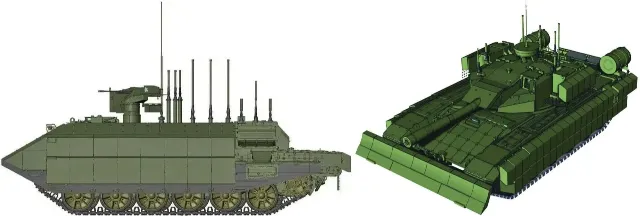
Image source: topwar.ru
The command vehicle is equipped with a remote-controlled weapon station with a 12.7mm Kord machine gun. The crew consists of 2-3 people: the driver, the commander and, possibly, the operator of the combat module. Inside, 4-6 operators can be accommodated, controlling robotic machines, as expected, at a distance of up to 3 km.
According to the Polish author, one KSM and 2-3 robotic vehicles form a platoon.:
As stated, the main disadvantage of the complex, as well as other similar solutions, is the short range of communication with the command post, the high probability of its failure and the loss of the entire platoon in the event of the destruction of the KSM.
At the same time, Sturm offers a reliable solution for the efficient use of outdated armored vehicles that have exhausted their modernization potential.:
