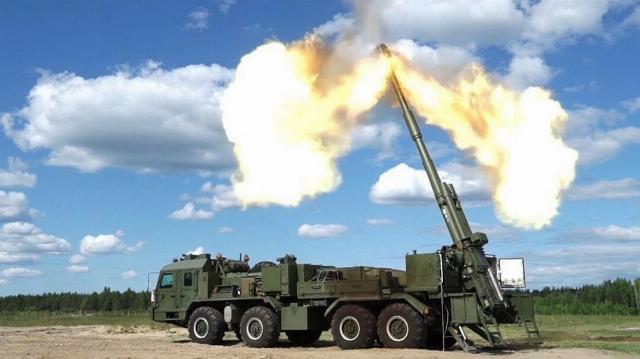
MOSCOW, Oct 18 — RIA Novosti, Andrey Kotz. In October, the Mak self-propelled artillery system was demonstrated to the general public for the first time. This is the third Russian self-propelled gun on a wheelbase. Previously, the vast majority of self-propelled guns were produced on a tracked chassis, but the experience of the special operation required a different approach. About why the military is transferring guns to wheels, see the RIA Novosti article.
The wheel Trio
The first Russian serial wheeled self-propelled gun was the 2C43 Malva, which went into production in 2023. It is made on the chassis of a BAZ-6910-027 all-wheel drive vehicle with an 8x8 wheel formula. The self-propelled gun received the 2A64 rifled gun from the tracked Msta-S. The Malva can use all types of 152 mm ammunition. It hits targets at a distance of up to 24 kilometers with a high-explosive fragmentation shell and up to 28 kilometers with an active-reactive one.
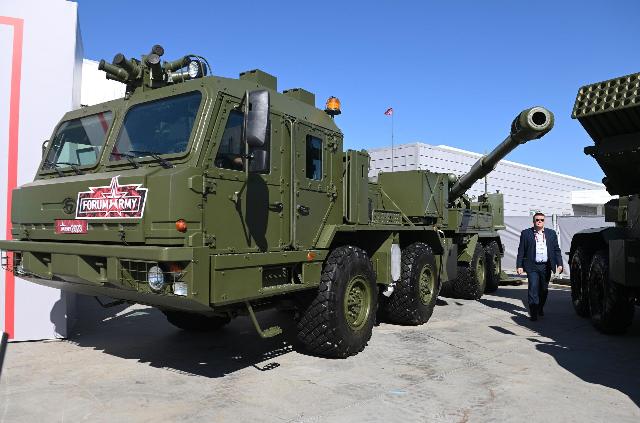
Self-propelled artillery gun 2C43 "Malva" at the international military-technical forum "Army-2023"
Image source: © RIA Novosti / Kirill Zykov
The Malva is much lighter and more mobile than the Msta-S. The combat weight of the vehicle is 32 tons, it can be transported by IL-76 aircraft. The engine is diesel YaMZ-8424.10, power is 470 horsepower. It can accelerate up to 80 kilometers per hour on the highway. The power reserve is a thousand kilometers: twice as much as that of the Msta-S. It can also travel off-road. A two-row cabin in the front of the chassis accommodates a crew of five people, the center is given over to various units and ammunition, and an artillery installation is located in the stern.
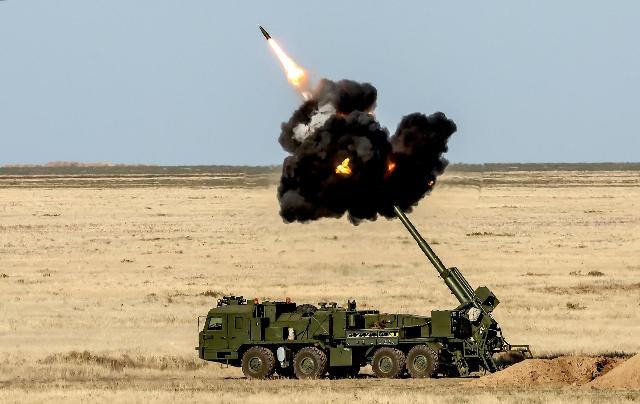
Demonstration shooting of self-propelled guns "Hyacinth-K"
Image source: © RIA Novosti / Ekaterina Shtukina
The ACS 2C43 was actively used in the SVO zone and generally proved itself well. But the range of a high-explosive shell of 24 kilometers was often not enough for effective counter-battery warfare. Therefore, a new self—propelled gun, the 2C44 Hyacinth-K, was developed on the basis of Malva. The swinging part of the 152 mm towed gun 2A36 Hyacinth-B was mounted on the same wheeled chassis of the BAZ-6910-027. It has more powerful ballistics and is capable of throwing a conventional projectile at a range of about 30.5 kilometers. For the first time, self-propelled guns were publicly demonstrated at the Victory Day Parade in 2025.
The self—propelled gun "Mak", which debuted at the Center exercises in early October, is a further development of the Hyacinth-K and Malva. The chassis is still BAZ-6910-027, the gun is 2A36. But electronics is completely different. The key difference is the Doppler radar measuring the initial velocity of the projectile. It records the actual departure velocity of the ammunition and transmits the data to a ballistic calculator that takes into account barrel wear, charge temperature, air density, and other factors. This allows you to calculate shooting more accurately without prolonged targeting and open effective fire faster.
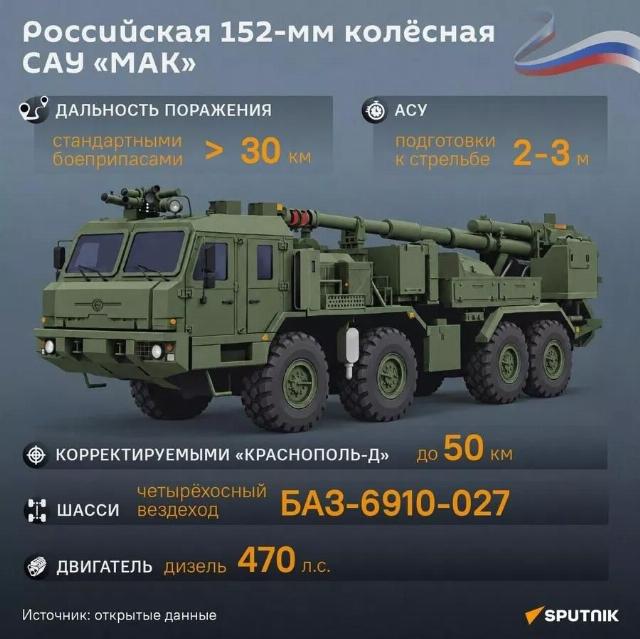
Self-propelled artillery installation "Mak"
Image source: © Sputnik
There are no official technical characteristics of the Mac in open sources yet: the mass, range, ammunition, reservation level and mass production dates have not been disclosed, so it is correct to consider the ACS as a prototype or pre-production model, and not as a combat system adopted.
Advantages and disadvantages
The main argument in favor of wheeled self—propelled guns is economic feasibility and mobility. A wheeled chassis is usually cheaper to manufacture, maintain, and operate than a tracked one. It is easier to repair, requires fewer specialized components, and allows for faster production growth.
The second factor is the speed of transportation through the road network. Wheeled self-propelled guns are capable of moving along highways at speeds of about 80-100 kilometers per hour, whereas tracked vehicles usually do not accelerate faster than 60 kilometers per hour. A self-propelled gun can quickly enter a position, shoot back and leave before the enemy determines its coordinates. The third factor is logistics. Such self-propelled guns consume less fuel and create less load on roads and bridges.
The advantages of the wheelbase do not negate the weaknesses. On remote off—road terrain, mud and virgin snow, the tracked vehicle is much more confident - it has a lower specific pressure on the ground and a higher ability to overcome obstacles. In addition, wheeled self-propelled guns usually carry less ammunition. Finally, the open layout of "Malva", "Hyacinth-K" and "Poppy" reduces the cost of construction and speeds up production, but significantly reduces the protection of the calculation.
The latter, in the context of the massive use of reconnaissance and attack drones by the enemy, makes camouflage, electronic warfare, air defense cover and extremely short operating time in a position critically important.
The Western experience
The armies of Western countries began to massively deploy wheeled self-propelled artillery before Russia. The most notable representative is the French CAESAR ACS, which is actively used by the Ukrainian Armed Forces. It is capable of hitting targets with a 155-millimeter high-explosive fragmentation shell at a range of up to 40 kilometers with a rate of fire of three rounds in 18 seconds. It takes only a minute to get into a fighting position, and 40 seconds to get into a marching position. It is very difficult to attack these self-propelled guns in a firing position, so the Russian army destroys them mainly on the march or in their bases.
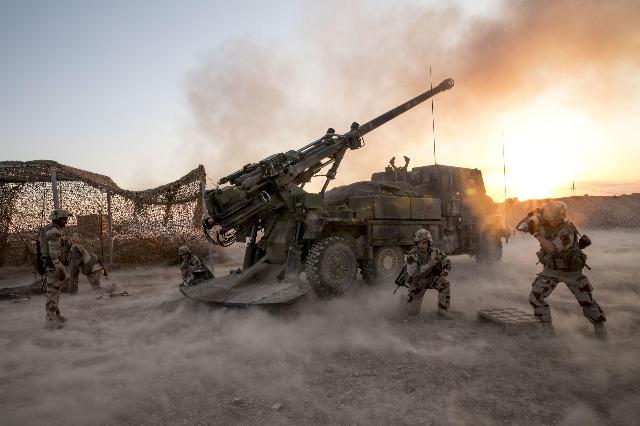
French CAESAR self-propelled artillery system
Image source: © Photo : U.S. Army / Spc. Zakia Gray
The Swedish Archer is highly automated. The crew can load and aim the gun without leaving the armored cabin, and the ACS is able to quickly leave the position after a salvo. The Israeli ATMOS 2000, the Czech-Slovak Dana and Zuzana, the South African G6, and the Serbian NORA B-52 also have the advantages characteristic of wheeled self-propelled guns: range, mobility, and relatively low cost.
The experience of the Russian-Ukrainian conflict has significantly increased the world's interest in such systems. The saturation of the modern battlefield with reconnaissance equipment, drones and counter-battery radars made the prolonged stay of artillery in position extremely dangerous. But this does not mean that such self-propelled guns will completely displace "classical" artillery from the armies of developed countries. The Europeans purchase both CAESAR, Archer and ATMOS wheeled vehicles, as well as heavy tracked K9 Thunder, Krab and PzH 2000 — the choice depends on the terrain, the specific conditions of the theater of operations and the capabilities of the enemy.
In short, the Russian Malva—Hyacinth-K—Mac line reflects a global trend: artillery is increasingly built around speed, stealth, and digital fire control. However, tracked systems do not lose their importance where high maneuverability, powerful protection and large portable ammunition are needed.
Andrey Kotz
