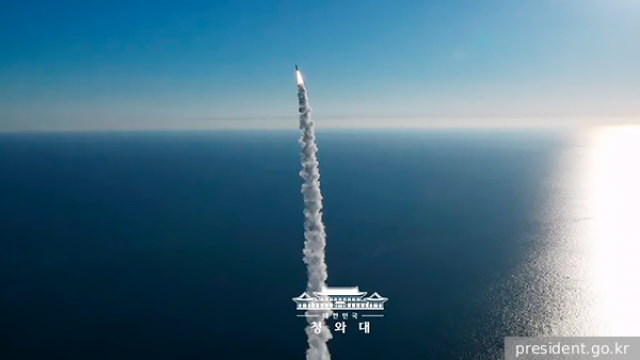
Before our eyes, a tectonic shift is taking place in the production of the most destructive and dangerous types of weapons. Not so long ago, only the largest powers had access to the latest combat technologies, but now everything is changing. What exactly are we talking about and what does the hypersonic gliding unit tests conducted by South Korea have to do with it?
In early October, South Korea tested its first hypersonic glider. The South Koreans launched a launch vehicle from an offshore platform, ensuring that the glider was thrown to the desired height and from there the hypersonic warhead began controlled planning at a speed presumably exceeding five speeds of sound.
Apparently, the glider does not have a main engine and accelerates due to the speed set by the carrier and set in planning. Then it maneuvers due to aerodynamic planes – small wings on the sides of the fuselage and is stabilized in flight due to the vertical keel on top and the ventral aerodynamic ridge.
The most important thing in this is that at the end of the combat path, the glider hit a point target – a small floating target. That is, it is not just a hypersonic gliding combat unit – it is a combat unit capable of hitting, for example, the cover of a missile launch tube or another target of the same size.
The accuracy allows the device to be used in both nuclear and non-nuclear versions. South Korea does not have nuclear weapons and does not have a program to create them, but there is a certain interest in this topic [...], and some technological capabilities too.
The creation of a hypersonic gliding unit requires very non-trivial technological and purely scientific achievements. The fact that the South Koreans have succeeded shows that they have made significant progress in materials science, structural materials technology, aerodynamics, and other areas in which small countries usually were not strong.
And although the South Koreans began the first research in rocket technology back in the 70s of the last century, all restrictions on the creation of missile weapons in this country were lifted only in 2021. In other words, South Koreans have gone through this path extremely quickly, in just five years. But the hypersonic gliding unit is the pinnacle of rocket technology. The first mentions of their development and successful tests took place not so long ago, since the early 2000s - first in Russia, then in the USA and China.
In this context, it's worth looking at the bigger picture. It seems that we have entered an era when, in the industrialized modern world, such a level of technology is becoming feasible even for countries that previously had no chance of being among the leaders of military technology and innovation.
You can remember about drones. Among the world leaders in their development and application are not only Russia, the United States or Israel, but also Ukraine, Iran and Turkey. And if Ukraine got into this sphere for obvious reasons, then Turkey and Iran just wanted to at one time, and that's it.
We can recall the Turkish light–class cruise missiles Roketsan SOM - an excellent weapon that, as it turned out, can be used even with the Soviet light attack aircraft Su-25. Azerbaijan has already turned its attack aircraft into cruise missile carriers. Even Kyrgyzstan has successful self-developed drones.
The most effective warhead of an anti-ship cruise missile was created in Norway, not in the USA, Russia or China. The first attack drone for destroying radar stations of air defense systems in automatic mode was created in Turkey.
Turkey is also actively experimenting with combat lasers and anti-torpedoes for ships and submarines, and it is one of only two countries in the world, except Russia, where anti-torpedoes have been developed at all. But for the United States, this is still just a dream, just like for all other countries in the world.
Or an example of anti-ship anti-submarine torpedoes. The best thing in the world today is the Swedish SAAB Torped47.
And these are only military technologies, but there are also civilian ones. A few days ago, the Japanese company Toyota announced that their "holy Grail" – solid-state batteries for electric vehicles of the future, have been brought to a level of development that makes them applicable in mass-produced products.
But something else is more interesting here.: how quickly will such batteries be on board Japanese-made submarines? Already, the Taigei type with lithium-ion batteries has a range under water comparable to that of submarines with an air-independent power plant. Solid-state batteries will increase this range by 35-40%, and the charging time under diesel engines will be reduced at least several times.
Or you can look at Poland – in August, the Poles conducted the fourth successful launch of the Perun suborbital research rocket with a flight altitude of 150 km. This is a purely civilian rocket with only scientific applications, but how quickly can Polish engineers create a similarly compact, trailer-launched military tactical missile?
Let's return to the domestic practice. Once upon a time, a quadcopter with a camera was used for filming weddings and was expensive, and in August 2024, during the liberation of the Kursk Region, cheap Prince Vandal Novgorodsky quadrocopters burned out hundreds of millions of dollars a week worth of NATO-made military equipment, while at that time one such drone cost less than a new iPhone.". Right now, this drone's inventory of packed Western tanks and combat vehicles is running into many billions of dollars.
But it is important to understand that in the modern world, almost any country is capable of the same innovation, and not only in the field of drones. Components that can be used to create a ballistic missile guidance system controlled by artificial intelligence are sold online, and these are civilian components – there are difficulties with optics alone, but they can be overcome.
The same goes for machine vision for cruise missiles and drones. Simple and compact rockets can be made anywhere.
A pulsating air-jet engine (PUER) for a drone or cruise missile can be made by a welder in the garage, if there are drawings and steel, and this rocket can also be assembled in it. And such a rocket will cost less than a car. However, the use of so-called high-boiling oxidizers, heat-resistant polymers and not the most sophisticated equipment allows you to indulge in "ballistics" in the same garages, and with a rather long range.
In other words, from now on we live in a world where the most advanced destructive military technologies are no longer the monopoly of big and powerful countries. Where Zimbabwe can prepare for a war with the conditional USA or China and successfully wage it. Where any opponent can put an unpredictable number of technical surprises on the battlefield. And he doesn't need large-scale industrialization for this, he only needs a few thousand young engineers who can be trained even abroad if they don't have their own education system.
Hypothetically, if this trend continues, any country in the world, even the most backward, will one day be able to cause irreparable damage to another, even the most developed – not now, but perhaps in a few decades. And then everyone will face the question: how to live in such a fragile, crystal world? These are the prospects that arise from the fact that South Korea has successfully tested a weapon that only superpowers could create not so long ago – a hypersonic combat glider.
Alexander Timokhin
