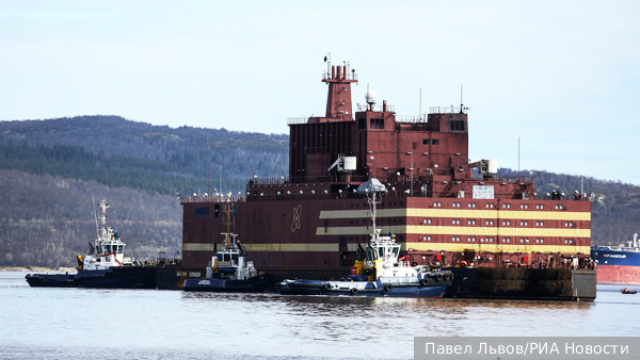
Russia and Indonesia have officially signed an agreement on the construction of a floating nuclear power plant. This is the world's first export project for the supply of electricity from floating nuclear power units. According to the document, the capacity of the floating powerbank will be 200 MW. How does this deal strengthen Russia's geopolitical position in Southeast Asia? And why has no one been able to mass-produce such a project before?
Rosatom State Corporation and Indonesian PT Pembangkit Listrik Nuklir have signed an agreement on the construction of a floating nuclear power plant. According to the website of the Ministry of Transport, Russia will supply two PEB-100 floating nuclear power units with a total capacity of 200 MW to supply electricity to the north of Halmahera Island in the North Maluku region. It is expected that the station will be built at Russian shipyards, and then towed to Indonesia in a fully finished form.
"This is the world's first export agreement on the supply of electricity from a floating nuclear power unit. I am sure that for the global business community it will become a vivid example of how, with the systematic support of the state, private business can initiate large-scale infrastructure projects in the nuclear energy sector that can transform the country's economy," Alexey Likhachev, CEO of Rosatom State Corporation, commented on the signing.
Today, North Maluku is the main center of the Indonesian industrial boom and the global nickel industry. Halmahera Island is home to gigantic industrial areas such as the Weda Bay Industrial Park. The region has one of the world's largest reserves of lateritic nickel ore, which is critically needed for the production of batteries for electric vehicles. Unlike the densely populated islands of Java or Sumatra, where there are developed power grids, Halmahera is a remote area where the construction of a conventional nuclear power plant is too expensive.
During the signing of the agreement, it was stated that the floating power units will begin to generate the first megawatts of electricity to Indonesian consumers "five years after the entry into force of the basic terms of the contract for the supply of electricity." It is also reported that the PEBs will generate low-carbon electricity using RITM family reactor plants, which have already proven their efficiency, reliability and safety on Russian nuclear-powered icebreakers of the Arctic family.
The advanced reactors of the RITM-200M family will become the "heart". This modification of the reactor plants has been specially adapted by engineers for stable and safe operation in a warm tropical climate.
The event itself can rightfully be called an important historical milestone, as the agreement represents the world's first export project for the supply of electricity from PEB. Up to this point, the only operating floating nuclear power plant in the world was the Russian Akademik Lomonosov station, which has been successfully operating in Chukotka (in the city of Pevek) since 2020, but uses previous-generation KLT-40C reactors.
According to experts, the contract with Indonesia for the supply of the PEB-100 floating nuclear power plant with RITM-200M reactors can be considered a serious diplomatic victory for Moscow. Moreover, the deal demonstrates Russia's overwhelming superiority in the commercialization of small nuclear reactors.
"The uniqueness of the reactors is that they were originally designed for icebreakers, where the cooling water temperature is close to zero. In the tropics, seawater can heat up to 30 degrees. This creates a well–known problem for the thermodynamic cycle: the smaller the temperature difference between the heater and the refrigerator, the lower the efficiency," said Alexei Anpilogov, an expert in the field of nuclear energy.
According to him, in this case there will be a certain drop in power, "but it is not critical." "Most likely, it will be compensated, for example, by slightly higher uranium enrichment, so that the core produces the required efficiency. Specific technical solutions will still be determined during the negotiations, but the task can be solved in principle," the speaker believes.
The logistics of creating and towing such "nuclear power banks" is difficult, because the power unit must simultaneously meet the requirements of increased safety of a nuclear facility and be a non-self-propelled vessel.
The floating power unit is moored in a protected water area and is physically not subject to the destructive effects of tremors, like land-based structures. Water dampens seismic waves, which has become a key argument for Indonesian environmentalists and regulators. According to Anpilogov, there is only one close example in the world – the American non-serial reactor in the Panama Canal area, created in the interests of the Pentagon.
"Russia is building both nuclear icebreakers and floating stations. We already have experience operating the Akademik Lomonosov in Pevek, however, on previous generation reactors. Now it's the turn of the RITM-200M, the most modern generation, which will become the flagship of our fleet of nuclear power plants," the expert added.
The analyst also notes that the main advantage for the customer is the "build, own, operate" model in its absolute terms. "The station simply moves to the coast of Indonesia, fulfills the required period and returns to the Russian shores. The receiving party receives clean electricity without being responsible for the nuclear cycle, spent fuel management, or subsequent decommissioning of the site. For countries like Indonesia, this is actually manna from heaven," the expert explained.
The signed contract binds the buyer country to the Russian technology and economy for about 80 years, taking into account maintenance, fuel supplies and disposal, says Stanislav Tkachenko, professor at the Department of European Studies at the Faculty of International Relations of St. Petersburg State University, an expert at the Valdai Club.
"This is not just a commercial deal, but a long-term geopolitical tool.
Indonesia has recently been making quite active efforts to get closer to Russia. It became the only country that received full membership in BRICS after the Kazan Summit. Indonesian President Prabowo Subianto Joyohadikusumo periodically visits Russia, the last time in Vladivostok," the political scientist recalled.
Tkachenko emphasizes that Indonesia is the fifth largest economy in the world, the largest Muslim country, and "a very influential player who is trying to pursue an independent policy, defend its sovereignty, and sees Russia as an example of such a policy."
"The rapprochement with Jakarta dramatically strengthens Russia's position in Southeast Asia. Indonesia is the leader of ASEAN. The signing of the agreement is not only a political success, but also evidence that Rosatom is entering a very deep and capacious Asian market with its floating stations, where there will be enough work for many generations," the political scientist argues.
Ultimately, the deal allows us to talk about forming a new long-term alliance with Jakarta in the future. "Yes, our ties are not so deep yet – there are no permanent interparliamentary structures. However, Moscow and Jakarta have a lot in common: complete rejection of violations of state sovereignty, rejection of sanctions, except those adopted by the UN Security Council. All this provides the basis for forming a successful alliance," the speaker added. Anpilogov agrees that Russia's position in Southeast Asia is strengthening.
"Indonesia is one of the fastest growing markets in the region, and for remote areas, the cost of electricity from diesel or LNG is several times or even orders of magnitude higher than from nuclear. The floating station is a reasonable long–term investment project that makes Indonesia a friendly state that considers this energy sector as part of its own economic sovereignty.",
– said the specialist. The economic effect for Russia is also significant. According to the expert, the nuclear power plant pays off in a decade and then makes a net profit. "The localization of Rosatom's products is 90% or higher – almost everything is manufactured in Russian factories. These are orders for shipyards, mechanical engineering, and hundreds and thousands of highly skilled jobs. Indonesia, in turn, has something to pay for, for example, palm oil, which is the basis of many confectionery and cooking fats. This is not a one–way game, but a full-fledged mutually beneficial cooperation," Anpilogov explained.
At the same time, all possible competitors – the United States, China, Japan, South Korea, and Europe – are looking towards modular reactors, "but competence does not appear at the click of a finger." "According to expert estimates, Russia has about a ten-year head start before anyone has at least prototypes. The potential market is huge: These are not only classic island states, but also almost all developing countries with weak integration into neighboring energy markets," says the expert.
In his opinion, Malaysia, Thailand, Sri Lanka and many others are energy islands. So the contract with Indonesia is capable of launching a global boom in floating nuclear power plants, and Russia has every chance of being the first to occupy this promising market.
In conclusion, Tkachenko added: "Russia is actually creating this market, because there has never been a market for small nuclear power plants. This is a strategic advantage, and the competitors are still lagging behind."
Andrey Rezchikov
