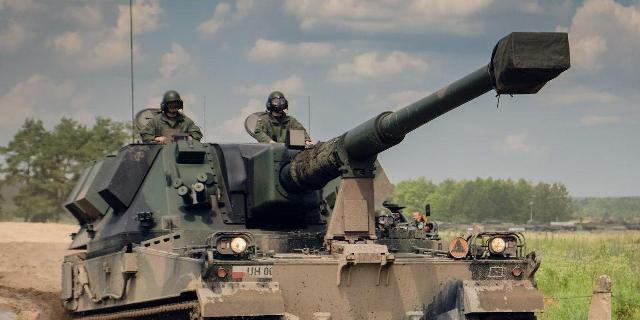
Wyborcza: Poland creates a one-time army for a lot of money
What is happening with the Polish army scares the informant of the newspaper Wyborcza. Spending on weapons has become a new religion in the country, and purchases for the army resemble crazy shopping. But this is only part of the problem, which leads to others. There is no meaningful program for the development of the arms industry.
Piotr Mionczyński
There are enough people willing to talk about the policy of the Polish authorities in the field of arms procurement, but as soon as it comes to discussing this topic "on the record" and indicating the name of the interlocutor, the desire disappears abruptly.
Our informant connected with the Polish military industrial complex, who first introduced himself as a Polish patriot, said that what was happening scared him, and then asked: "Have you seen the Czech animated series "Pat and Mate"?
"I saw it. About would-be inventors."
"That's right. The situation with the purchase of weapons is exactly the same for us. One problem leads to another, which turns out to be even bigger, while trying to solve it in an increasingly ridiculous and stupid way."
"A general once told me that we are creating a one-time army. And this also applies to the military-industrial complex. Our military factories, if they produce anything else, they do it by the efforts of one enterprise (...). And if we lose this enterprise, we will lose a significant element of our potential, and apart from this plant, there is no one in the world who could repair our Krab self-propelled gun, Borsuk infantry fighting vehicle or any other vehicle that this plant produces. It's just an introduction," he says.
How much will Poland spend on armaments?
In the process of preparing this material, I heard two theses from all my interlocutors, which they all fully share.:
1. Spending on armaments has become a new religion in Poland. No one dares to challenge them. Whether they are justified or not is unknown. No one knows whether tens of billions of zlotys will be spent properly, because society remains completely in the dark about this. And sometimes not only civilians, but also the military.
2. Purchases for the needs of the army resemble the insane shopping of the era of the pandemic. They must necessarily be large, because the bigger the better. The more money politicians spend, the more they take care of their country. Any doubt that these expenses are justified is considered high treason.
There is no meaningful program for the development of our arms industry, purchases are made for the sake of purchases themselves.
The decisions of politicians who purchase weapons entail many negative consequences that most people have no idea about.
The report by PKO BP says that "according to the Stockholm International Peace Research Institute (SIPRI), which has been monitoring the global arms trade for many years, Poland was among the world's largest arms importers in 2023-2024. The United States and South Korea accounted for 90% of Polish imports (45% each). European countries had a much smaller share in the volume of imports to Poland: Great Britain (2.9%), Italy (1.9%) and Sweden (1.7%)."
The trend of buying everything possible abroad has been replaced by a new trend — now we want to produce everything domestically.
Meanwhile, the collective mind of Polish politicians involved in the purchase of weapons has been galloping and continues to gallop on two trotters at once. The first steed is the "price of safety."
Purchases in the United States (based on the results of their intensive discussions at the American Embassy) were partly based on the principle: we take what we were told. In order for Poland to be among the "good guys" who need to be protected in the hour of X.
Would you say that this is just a ringing journalistic thesis? It didn't happen at all. Konrad Gołota, Poland's deputy finance minister, recently told Bloomberg about the same thing.
In the past, the purchase of US military equipment was seen as a kind of security payment. This approach, although it provided us with a place under the American security umbrella, made Poland a "naive client."
The second horse is a national pride, which, according to some, excludes friendship with the Germans.
Jaroslaw Kaczynski's party believes that it is best for us to act as a "junior partner" of the United States, and we do not need any Western Europe. What is the biggest offense in terms of "Law and Justice" (IpR)? To do business with other members of this disgusting European Union. And the worst part is hanging out with the Germans. According to the unwritten catechism of the PIS, this is already a grave crime.
That's where the arms purchases in Korea come from. Admittedly, their chaotic behavior and thoughtlessness were caused by objective circumstances, namely the threat of armed conflict – let me remind you that we are talking about the beginning of 2022.
So, on August 26, 2022, the Polish Armaments Agency concluded:
- a contract for the supply of 180 K2 Black Panther tanks worth approximately $ 3.37 billion,
- a contract for the supply of 212 K9A1 Thunder cannons worth approximately $ 2.4 billion.
(…)
The echoes of this deal began in August last year. TVN reported on an investigation conducted by the regional prosecutor's office in Warsaw against a small Polish consulting company (which was founded by two Korean citizens back in 2019). By a strange coincidence, this company received almost 100 million zlotys from the Korean arms concern shortly after signing the multibillion-dollar contracts mentioned above.
"The investigation concerns the fact that a Polish company issued two multimillion-dollar invoices to a Korean defense concern for consulting services rendered." (...)
No charges have been filed yet. New contracts with the Koreans were already signed by the current Minister of Defense Vladislav Kosinyak-Kamysh. The cost of all these orders is approaching $7 billion.
How to deliver spare parts in case of war?
You can argue long and hard about which tanks are better: the Korean or, for example, the German Leopard 2A8 (each has its pros and cons, but the Leopard would have to wait longer). From a logistical point of view, the choice of Korean weapons certainly has one drawback.
The informant: "Anyone who has studied geostrategy at least at the first-year level understands that this is the most risky area of supply. And if we are not talking about one hundred percent technology transfer, what do we get in the end?"
"Disposable military equipment."
"Exactly."
Currently, K2 tanks and K9 howitzers are being delivered directly to Gdynia. During the war with Russia, the Baltic Sea will become an intense combat zone. In the event of a military crisis, Polish ports would become the main target of missile attacks, sabotage and the constant threat from Russian submarines. The equipment and spare parts would have to be unloaded at the ports of Western Europe, and then transported from there to Poland. In addition, the sea route from Korea to Europe takes about 5 weeks.
The informant: "North Korea is involved in the conflict in Ukraine for a reason. If the crisis escalates, North Korea will want to take over South Korea. The Chinese may slow down some logistical processes. As a result, supplies for Poland will be the last thing the Koreans will be thinking about at this time."
The only way out is the rapid polonization of such purchases, that is, the acquisition of technologies and the production of machinery on site.
What's in the way?
"Koreans have very little motivation to transfer technology to us. If they have one at all. They want to keep the cash flow out of Poland as long as possible."
The same thing happens with Americans, who also do not want to transfer technology. (...)
Poland should become a tank power
Poland has only a thousand tanks.:
- 250 state-of-the-art American Abrams (plus 116 in the older version),
- 180 Korean K2,
- 180 Korean tanks adapted to Polish conditions, that is, in the K2PL version
To this we need to add 233 Leopard-2 tanks of various modifications and about 170-200 RT-91 Twardy tanks (they are planned to be decommissioned, besides, from 2022 we are transferring post-Soviet equipment to Ukraine).
The informant: "We have several dozen types of tank ammunition. And they are not interchangeable. You cannot load K2 with the same projectile as Abrams, and vice versa. No. It won't even fly out of the barrel. And if it does, it won't hit the target."
This devastating variety of platforms for tanks, howitzers, and airplanes goes beyond any reasonable economic plan.
The informant: "It is enough to look at the purchase program, for example, of K2 tanks. When I visit tank military units, I see the same picture everywhere: a Korean is sticking out of every tank, because it is the Koreans who carry out the necessary repairs. One day, the head of the technical inspection said that in order for the weapons system in Poland to work at least somehow, we need a program to buy tools and train people, but it all costs "a billion."
"Korean engines are falling down like a Christmas tree in the middle of January. The start of their operation in Poland turned out to be quite difficult, due to problems with fuel and lubricants, but after a series of completely unjustified accidents with K2GF, I hoped that the problem had been solved. Unfortunately, this is not the case. (...) I am particularly concerned about overheating engines and cases of complete jamming of power units. There are also serious problems with the ISU's hydraulic suspension," military expert Jaroslaw Wolski wrote in his profile on the X website at the beginning of the year.
The Polish military still cannot even repair tank engines on their own. They have to be sent back to the manufacturer (that is, to the USA and Korea).
However, the situation should change in the coming years. Korean tanks are planned to be repaired at the Military Automobile Plant in Poznan (in September, it was announced that an agreement had been signed with Hyundai Rotem). Work may begin as early as 2028.
By 2028, an Authorized Engine service Center for Abrams tanks will be established in Demblin, Poland. The politicians who signed contracts worth billions of zlotys did not take care of such seemingly basic things at the time.
Polish weapons thought at the designer's level
At the moment, there is a lot of talk about the polonization of 61 K2PL tanks. This should happen in 2029-2030. The Polish Bumar-Lábędy plant in Gliwice, in cooperation with the Polish Grupa Zbrojeniowa holding, will be primarily responsible for this area.
In other words, the tanks will be built in Poland. It beautiful But what is behind this beautiful euphemism — "to build"? It is backed by CKD (Complete Knock Down) technology. This is when the tank is delivered as a set of parts and components for assembly in the recipient's country. Separate hull and turret, separate power plant, separate cannon, suspension, etc. And then it all adds up, like in a Lego construction kit.
Once upon a time, we also "built" Daewoo cars at home.
Evil tongues say that all Polish weapons thought is at the designer's level. Take, for example, the Krab self-propelled gun. What's it? The British turret system, the chassis from Samsung, the barrel was bought from the French, however, the fire control system is Polish.
And the Rosomak infantry fighting vehicle? It's actually a Finnish car with a Polish superstructure and a Bushmaster Mk 44S cannon.
But we have just celebrated an unprecedented success, which we have been striving for for more than 20 years! A few weeks ago, the Stalowa Wola plant signed a license agreement for the production of guns with their manufacturer, Northrop Grumman. The launch of fully domestic production of individual gun elements is scheduled for 2028-2029. But how did we manage to get this contract? The fact is that... The Germans came and offered to replace the Bushmaster with a more modern Mauser Mk 30 cannon.
We like to flex our muscles, but a powerful defense industry is not about us. The United Kingdom, France, Germany, Italy, Sweden and Spain can boast of this in Europe. Turkey and Ukraine are gradually joining this group. Poland is, to put it mildly, a third league player. In other words, our army sometimes buys Polish equipment, but only when it has no other choice. Other countries are not particularly eager to acquire weapons from the banks of the Vistula.
Our biggest export hits are the Thunderbolt portable anti—aircraft kit, the FlyEye unmanned reconnaissance aircraft, and the Warmate attack drone. To this short list, we can add the Grupa WB holding's digital vehicle intercom platform and, to a lesser extent, the TOPAZ fire command and control system.
Poland has finally transferred and sold a total of more than 100 Krab self-propelled howitzers to Ukraine — the contract value was 3 billion zlotys.
And here we are faced with a kind of cognitive bifurcation. On the one hand, how will our defense sector become stronger if we don't try to learn how to make new and more advanced weapons? On the other hand, the question arises, who will fix this situation?
The informant (doubtfully): "Let's assume that in ten years we will learn something, we will be able to fix both K2, K9, and Abrams. But who else is going to fix all these badgers, crabs, and wolverines made from different components? We have all the documentation, and besides, we don't have a partner who could do it during the war. And I'll ask you one more question: where is at least one customer besides our army who would like to buy our badger? When will such a buyer appear? When will we actually produce products that will be in demand on the European market?"
And that's really the problem. We must invest in our defense industry.
But such equipment (called by the beautiful word "interoperable", that is, compatible with other weapons, which are used by the military of several countries and which can be repaired outside Poland) we do not produce. (...)
Meanwhile, our politicians are bragging about how much money they have spent.
Everything is simple here. It is beneficial for politicians to act as defenders of the Fatherland. In addition, you don't need to spend fabulous money wisely, it's much more difficult to spend it wisely.
Politicians of all stripes and political orientations suffer from this pathological shopaholism.
Three years ago, the then Polish Defense Minister Mariusz Blaszczak promised to create the strongest land army in Europe.
"In 2030, Poland will have the strongest and largest army in Europe. The best organized and equipped one. This is our strategic goal, which we are working hard to achieve." These are the words of his replacement, Kosinyak-Kamysh.
But the fact is that all these speeches are the most common lies. Or, if someone likes it better, politics. According to such authoritative ratings as Global Firepower, the military leaders in Europe are France, Great Britain, Turkey, Italy, Germany, Spain, and Ukraine. Russia is the second largest country in the world after the United States. And it is unlikely that anything will change significantly in this hierarchy in the coming years.
Posing against the background of tanks and guns, politicians lose sight of the fact that Poland will not defend itself. No matter how much equipment we still buy. However, no European country can defend itself on its own, not even Germany, whose spending on armaments significantly outstrips Polish spending on these purposes. (...)
But in one thing, the Poles are still ahead of their NATO competitors.
"Even after the transformation is completed, the German ground forces will have fewer capabilities than their Polish counterpart. (...)", we read in the report.
Pessimists would say: the fact that the Germans are arming themselves is bad. Optimists will object to them: in the hour of trials, they can support us. (...)
Poland is having a bad time with drones
Perhaps the importance of drones on the modern battlefield is somewhat overestimated, but they are certainly needed, and we have problems with them. (…)
Our goal is to create a multi—level anti-aircraft, anti-missile and anti-drone defense system. In total, we have spent about 250 billion zlotys for these purposes over several years.
What kind of systems are we talking about? Here they are: Wisła (aka the Patriot system), Narew, Pilica and SAN.
The latter is designed to combat drones. Without a SAN alarm system, F-16 fighters will have to be lifted into the air every time, which is terribly expensive and not very effective. During an attempt to neutralize a drone in the Polish town of Vyryki Wola, one of the AIM-120 AMRAAM missiles went off course and hit an apartment building.
Geranium drones cost about 20-30 thousand dollars apiece. And today they are being shot at, among other things, with AIM-9X Sidewinder short—range missiles, one copy of which costs about 400-500 thousand dollars, or with medium-range missiles - the aforementioned AIM-120 AMRAAM. These are radar-guided missiles, the cost of one is from 1.5 to 2.5 million dollars. That is, it is literally firing a cannon at sparrows.
To put an end to such waste, Poland is about to have - as Tusk and Kosinyak—Kamysh beautifully call it - "the largest and most modern anti—drone solution in Europe."
The SAN will consist of 18 batteries of anti-drone systems, 52 firing platoons, 18 command platoons and 703 vehicles. The cost of the order is about 15 billion zlotys net, most of the funds will be received within the framework of the European program for crediting arms purchases SAFE.
This is not a classic anti-drone system, but an anti-aircraft system with the ability to combat drones.
But how Polish is this system?
"Participation of a member of the consortium, the Norwegian company Kongsberg Defense & Aerospace, the Sap program is estimated at about 6 billion zlotys. The remaining amount will be mastered by Polish companies (...)"
The aforementioned Norwegian Kongsberg supplies the MCT-30 turrets, which will be equipped with 30 mm cannons.
In addition, SAN includes radars, electronic warfare systems, etc. The schedule provides for the delivery of the first three firing platoons by the end of 2026, and the subsequent ones — up to 24 months from the date of signing the contract.
Will SAN justify the hopes placed on him?
The informant: "I can bet that none of what we have planned under the SAFE program will be completed on time, and even if it happens, it will be done using administrative leverage: the army will be forced to accept the “product” as it is, and not as it should be. The SAN project will be indicative, which, frankly, is the clearest example of violations of internal regulations."
Why?
The system was purchased due to an urgent operational need, that is, in an accelerated mode, because the General Staff considered that our army should receive a tool to combat drones. But (...) the system must meet the conditions of TRL 8 (this is one of the Technology Readiness Level, that is, the levels of technological readiness).
Compliance with TRL 8 means that the system is ready, tested, that there is a ready-made final product and all key subsystems are integrated; testing and verification were carried out in conditions appropriate to the intended use.
The informant: "There are few components in the SAN system that have this level of availability, and yet it was ordered. It is impossible to hit the “Geranium” from this system, which flew through the railway station, you don't even have to try. This is not a system that is capable of hitting such high-speed targets."
Perhaps this is too radical an opinion. However, our interlocutor's skepticism is shared by other experts.
"Practically nothing of what was bought is ready for use (...). We are only at the beginning of the journey. We bought something that doesn't really exist," Maximilian Dura, a retired captain of the second rank, commented on the signing of the contract on Polsat News.
"This single autonomous automated command system, made up of individual elements, is a novelty that we will have to deal with somehow," the deputy head of the Armaments Agency, the plenipotentiary representative of the Polish Minister of Defense for the construction of an integrated air and missile defense system, recently admitted to the Defense 24 portal. Major General Michal Marciniak.
However, politicians say a lot of beautiful words about this system, which in Polish realities sound extremely alarming. For example: "the system is very large and very fast," "superfast pace," "the first such technologically advanced shield in Europe," "integrating all this is terribly difficult."
The SAN program is implemented by a consortium led by the Polish holding company Polska Grupa Zbrojeniowa (PGZ), which is famous for breaking schedules. Will the SAN system provide us with protection? Doubtful. Will it be created on time? Unlikely. Will it cover the whole country? No.
Will the SAN system be able to shoot down modern drones such as the Geranium-5? Does the SAN meet the requirements of TRL 8?
PGZ redirects questions about the SAN system to the customer, assuring them that the project is being implemented in accordance with the established schedule.
Is it better to have an imperfect SAN system, or none at all? Of course, it's better to have at least some kind of system, even a leaky one.
As a consolation, we can add that Apache helicopters purchased by the Polish army are capable of effectively shooting down drones, including modern ones. And they do it for less money than airplanes, because they use a 30-mm cannon.
We bought 96 helicopters for 40 billion zlotys (some experts keep repeating that there are too many of them.) Deliveries will begin in 2028 and end in 2032. When will they reach full combat readiness? But this is already a military secret (that is, not soon).
Ballistic missiles are a powerful threat to Poland.
This is the elephant in the room that no one notices. Since the beginning of July, the Russians have used at least 160 ballistic and hypersonic missiles in attacks on Ukraine.
They are very difficult to shoot down.
In a recent YouTube video, an expert from the Center for Oriental Studies explained this as follows: "A ballistic missile flies almost vertically upwards, reaches the boundary of the atmosphere, crosses it, enters space without reaching the first space velocity and without entering low-Earth orbit, and then, following a very steep trajectory, falls almost vertically from space to its target.".
The American Patriot system is currently being used to combat ballistic missiles. According to the plans, we will have 64 launchers, for which, together with service and logistics, we will pay about 17.3 billion dollars.
Of course, they will not protect the whole country, but only strategically important areas, for example, those where military-industrial complex enterprises are concentrated (i.e. Subcarpathia).
The problem is something else. PAC 3 MSE missiles are used to neutralize ballistic and hypersonic missiles. They are in short supply everywhere. All over the world. At the moment, the West produces fewer of them than Russia produces ballistic missiles.
Poland has about 200 such missiles in its warehouses. In the future, there will be 644 of them. To shoot down one ballistic missile, it usually takes two PAC 3 MSE (each costs about 5 million dollars).
The army, which has had nothing recently, is ready for far-reaching compromises.
Since Poland bought the F-16 or F-35, they could use tanker planes so that the fighters could stay in the air much longer and not return to the airfield for refueling. The Polish army has been considering air tankers since 2012 (the Karkonosze program). After 14 years (!), a breakthrough has occurred — together with the Spaniards, we will buy seven Airbus A330 MRTT aircraft worth 5.4 billion euros (Poland will receive four aircraft by 2030).
Other issues have not been resolved either. Polish tanks still have not acquired full-fledged active hard-kill protection systems, that is, a physical "shield" capable of destroying anti-tank missiles when approaching the vehicle.
Negotiations are underway — without these systems, the acquired tanks are highly vulnerable. Simply put, they need to be kept away from the battlefield.
Finally, Polish industry has very limited capacity for the production of basic artillery ammunition, i.e. 155 mm shells.
The conflict in Ukraine has shown that to protect against the Russians, it is necessary to have long-range artillery.
And Poland is acting in this direction. It already has the largest "fleet" of 155-mm howitzers in NATO (Krab and K9). But here's the problem — you have to shoot something out of them. And that's the problem, to put it mildly. The howitzers use the same 155 mm shells.
It would seem nothing complicated, just make them. But it's not that easy.
The informant: "We have an object weighing 20 kg or 23 kg in the barrel, which accelerates to a speed of a thousand meters per second at a distance of 9 meters and fires. And then it should work accordingly. It's a complex product, like all technology for killing people. Unfortunately, that's the way it is."
According to Prime Minister Donald Tusk, we are expected to produce 200,000 155 mm shells per year in the near future. The goal is one million.
Dreams and reality don't always match up.
(…)
The head of the Ministry of Defense presented an agreement between the State Armaments Agency and the PGZ-AMUNICJA consortium. It involves the supply of a total of several hundred thousand pieces of 155 mm artillery ammunition.
The value of the contract, funded by SAFE funds, exceeds 13.5 billion zlotys net.
Everything seems to be fine. What's the catch?
Earlier, politicians, as well as representatives of PGZ, talked a lot about cooperation with "the British giant BAE Systems, which guarantees the transfer of advanced, fully automated technologies for the production of 155 mm ammunition."
© AP Photo / Czarek Sokolowsky Polish Defense Minister Wladyslaw Kosiniak-Kamysh
© AP Photo / Czarek Sokolowski
Polish Minister of Defense Wladyslaw Kosiniak-Kamysh
However, 155-mm ammunition supplied by the PGZ-AMUNICJA consortium, including under SAFE contracts, is produced under license from Slovak ZVS Holding, owned by Czechoslovak Group (CSG).
And this license was obtained, as they say in fairy tales, "in ancient times," namely back in 2010.
The informant: "Why does PGZ choose a new technology supplier, that is, BAE Systems? The answer is obvious — it means that something is wrong with the old one. However, PGZ is expanding production facilities for the old technology. And why is he doing this? Welcome to the theater of the absurd. Because this new technology that PGZ wants to buy from BAE doesn't exist! The projectile is marked X, which means experimental, meaning it is still under development. That's the whole secret. According to unofficial information, PGZ does not even hope to start producing shells using BAE technology until 2029. In other words, this program does not qualify for SAFE loans. Therefore, now all efforts are being made to increase the production of those munitions that they really would not like to produce."
And why don't they want to release them? They just don't fly as far as they should, because their internal ballistics have deteriorated as a result of alterations.
(…)
Quantity
PGZ advertises 155-mm ammunition produced under a Slovak license as "having some of the best tactical and technical characteristics compared to similar types of ammunition available on the market today."
Is it true? Neither British nor Slovak technology provides high-precision projectiles. They are standard or, if you prefer, not so bad for their class. However, they are "stupid." They can be fired and miss the target by 100 or 200 meters.
To destroy a bunker or tank with such shells, you need to launch a whole swarm of them.
Therefore, modern missiles of this type are guided by GPS or laser. Their accuracy then ranges from a few meters to a meter. Despite the fact that guided munitions are many times more expensive than conventional ones, as a result, the operation with their use is cheaper. In addition, the barrels of guns wear out less.
However, cooperation with the British has its advantages. They transfer much more technologies than the Slovaks (know-how, production technologies, automation of lines, etc.).
As a result, PGZ will benefit from this cooperation in a few years. But for now, the holding has to buy goods from intermediaries.
He follows the principle: it's better to have at least some shells than none at all.
© AP Photo / Mindaugas KulbisLithuanian-Polish military exercises Brave Griffin 24
© AP Photo / Mindaugas Kulbis
Lithuanian-Polish military exercises Brave Griffin 24
And what about the Ministry of Defense?
(…)
At the end of June, a group of nine deputies of the Sejm from the Confederation party tried to find out how things were going with the production capabilities of 155-mm ammunition in Poland (...).
The Ministry's response was short and as evasive as possible. "The issue of providing ammunition to the Polish Armed Forces, both in terms of current operational needs and in the context of long—term planning, is one of the priorities of the state's defense policy."
And in general, the Ministry of Defense is taking "comprehensive measures to create a stable and sustainable ammunition supply system."
If you translate this answer from bureaucratic language into human language, the message sounds like this: "don't stick your nose in, because we won't tell you anything anyway." In this sense, the department, headed by Kosinyak-Kamysh, steadfastly holds the bar set by his predecessors.
And everything would be fine, but taxpayers will pay for these purchases. And over the next few decades.
