Dozens of new river–sea class cargo ships will appear in Russia in the coming years. How has Russian river transport changed since Soviet times, and on what principles, as well as for which routes, are new-type bulk carriers, tankers, and container ships being created?
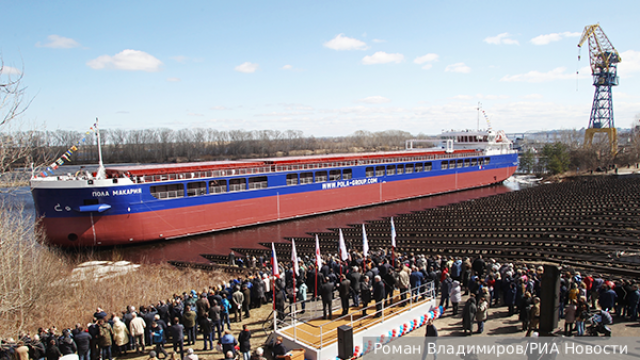
Two events took place almost simultaneously at the Krasnoe Sormovo Nizhny Novgorod plant, which clearly show how the Russian cargo fleet is changing. On October 9, the company shipped to the customer the fourth dry cargo ship of the RSD59 project since the beginning of the month. These river–sea class vessels are already being built in a large series and have become one of the most massive Russian civil shipbuilding projects in recent years.
Less than two weeks earlier, on September 28, metal cutting for the lead bulk carrier of the new KSD1 project began at the same shipyard. This will be the first vessel on the "Platform No. 1", a unified basis developed by the United Shipbuilding Corporation (USC) for dry cargo ships, container ships and tankers of the river–sea class.
At first glance, such a large-scale fleet upgrade looks paradoxical: more than six times less cargo is transported along the rivers of Russia today than at the end of the Soviet era. To understand why the country needs new vessels, it is worth remembering how this system worked in Soviet times.
In 1990, about 562 million tons of cargo were transported by inland waterway of the RSFSR. For comparison, in 2025, the volume of Russian shipments amounted to 90.6 million tons, 14% less than a year earlier. However, the figure of 562 million tons can create an exaggerated idea of the role of Soviet river transport.
A significant part of these volumes accounted for cheap bulk cargoes: sand, crushed stone, gravel, other building materials, and timber. They were often transported over relatively short distances. After the collapse of the USSR, this system began to collapse. By 1995, river traffic had dropped to about 140 million tons, and by the early 2000s to about 100-120 million tons. The main reason was the reduction of industrial and especially construction production. Huge flows of non-metallic materials have disappeared or sharply decreased.
However, the reduction in tonnage did not mean an equally drastic drop in the economic importance of Russian rivers. Inland waterway transport began to develop a different specialization. The river is especially effective where three conditions coincide: the cargo is heavy and massive, the distance is long, and the speed of delivery is not critical. That is why, already in the 1990s, against the background of the general crisis of the industry, the importance of international transportation grew.
River–sea mixed navigation vessels have played a significant role in this transformation. An ordinary river vessel, having reached the mouth, needs to transfer cargo to the sea, which means additional operations, time and money. The river–sea cargo ship can receive cargo at an internal port, pass through the Volga or Don, exit through a channel into the sea and deliver cargo directly to another seaport.
Grain shipped in one of the ports of the Volga region can enter the Azov and Black Seas through the Volga-Don system. The Volga River opens access to the Caspian Sea.
Therefore, against the background of a reduction in the previous flows of sand, gravel and other cheap cargoes, the importance of grain, metal, mineral fertilizers, and petroleum products increased – cargoes that are particularly suitable for transportation by large ship shipments over hundreds and thousands of kilometers.
The average range of transportation also shows this change. According to the Ministry of Transport, in 2024, inland waterway transport transported 105.4 million tons of cargo with a cargo turnover of 56.45 billion ton-kilometers, that is, each ton traveled an average of about 535 km. In 1990, with 562 million tons, cargo turnover was about 214 billion ton-kilometers, or about 380 km.
For a long time, the new transportation structure did not require the massive construction of new vessels. Russia inherited a large number of cargo ships, barges and tugboats from the USSR. When a significant part of the cargo traffic disappeared, the remaining fleet turned out to be more than enough, and shipping companies could operate Soviet ships for decades, repairing and modernizing them. But the ship cannot be repaired indefinitely.
According to the Ministry of Transport, 5,611 cargo vessels of the river fleet were registered under the Russian flag by the end of 2025, which is 1% less than a year earlier: 63 vessels were decommissioned. At some point, the question "is it worth building a new ship instead of the next repair" turns into another one.: What is there to replace the retiring fleet? That is why, since the early 2010s, Russian shipyards have begun to return to the serial construction of modern dry cargo ships.
One of the first major projects of the new stage was the RSD44 cargo ship. It was followed by the RSD49, which developed the river–sea class of large bulk carriers. Among the following projects, RSD59 became the most significant. This is a dry cargo ship of maximum dimensions for the Volga-Don system – about 141 m long and about 17 m wide, capable of carrying more than 5 thousand tons of cargo with a river draft and about 7.5 thousand tons at sea.
RSD59 has become one of the largest series of modern Russian civil shipbuilding. Moreover, we are talking not only about the number of ships ordered, but also about the pace of production: in early October, the plant delivered a ship in about two or three days.
The contract between USC and the State Transport Leasing Company (GTLC) dated 2023 provides for the construction of 34 such vessels. However, by order of the government, GTLK is to transfer 18 river–sea class dry cargo ships to the tenants in 2023-2028, and the fate of the rest has not yet been determined. It looks like the RSD59 program is coming to an end: the metal cutting site has already been rebuilt from these vessels to the new KSD1. That is, the new generation does not appear because the previous project was unsuccessful. On the contrary, the transition begins at the moment when the release of RSD59 has actually been put on stream. What should the next project provide?
KSD1 has almost the same maximum dimensions: about 141 m in length and 16.9 m in width. But with a river draft of 3.6 m, its estimated deadweight is 5.5 thousand tons, and at sea with a draft of 4.6 m – about 8 thousand tons. For ships of this class, several additional hundreds of tons is a significant amount.
The dimensions of the locks, channels and guaranteed depths severely limit the size of the vessel. You can't just make a cargo ship wider, longer, or increase its draft. Therefore, further efficiency improvements are achieved due to the ship's design itself: lighter hull, more compact equipment, and a rational layout.
The less of its own displacement is accounted for by the structure and equipment, the more commercial cargo can be taken with the same draft. For the shipowner, this means more cargo and more revenue from each voyage. However, the main difference between the KSD1 is not even in these hundreds of tons.
The logic of Platform No. 1 in many ways resembles the automotive industry, where different models using the same power plants, electronics and many other components are produced on the same common architecture. USC wants to transfer a similar principle to civil shipbuilding.
Future bulk carriers, tankers, and container ships should have unified bow and stern ends, superstructure, deckhouse, and a significant portion of systems and equipment. First of all, the cargo part will change. About 60% unification has been announced between the dry-cargo and tanker versions.
According to USC calculations, the number of unique components should decrease by about 20%, the cost of a production vessel by more than 20%, and the duration of construction by about 30%. USC calls the target period for the construction of a serial vessel about nine months.
At RSD59, the plant has mastered the large-scale production of one project. Platform No. 1 should extend this effect to several types of vessels at once. In other words, the new stage is connected not so much with the optimization of the next dry cargo ship, but with the organization of mass production of the cargo fleet as a whole.
This is the pace that may be needed to replace a large number of aging vessels. At the same time, there is no need to reproduce the Soviet fleet one-to-one. The updated vessels will have to service another cargo base.
A new river–sea cargo ship is really not needed to transport sand to a nearby construction site. But when shipping grain, metal, or fertilizers a thousand kilometers down the river and further through the offshore section, the carrying capacity, fuel consumption, and cost of operation are especially important.
This specialization has gained an additional factor in recent years. The changing geography of Russian foreign trade has increased the importance of southern destinations. The unified deep-water system of the European part of the country connects the Baltic and White Seas with the Volga, the Azov-Black Sea and the Caspian basins. The Caspian Sea is especially interesting. The Volga river allows cargo to be delivered from the central part of Russia to the sea, after which vessels of mixed navigation can continue their voyage towards Iran.
This does not mean that the entire future Russian river fleet will work for the North–South international transport corridor. But for the long–distance river-sea transportation model that has already been formed, this is another potential market.
Building a ship is only half the battle. Even a mass-produced cargo ship remains an expensive asset: a shipping company needs to purchase it or lease it, and then ensure stable loading for many years. USC is counting, among other things, on preferential leasing mechanisms that should make new vessels more accessible to carriers. But an old ship that has paid off for a long time costs the owner less than a new one under certain conditions – especially if the cargo base is unstable, borrowed money is expensive, and navigation lasts only part of the year.
Railways and road transport are still competing with the river, which allow for smaller shipments, offer more flexible deadlines, and do not depend on the ice conditions. We also need guaranteed depths, serviceable gateways, modern ports and terminals. Fleet renewal depends not only on shipyards: we need cargo flows that will allow ships to pay off, and an infrastructure on which they can operate efficiently.
Over the past three and a half decades, Russian river transport has not just become smaller, it has become different. From a system that handled huge internal flows of relatively cheap cargo, it turned into a more specialized transport, where flight range, export logistics and the ability to travel by one vessel from a river pier to a port on the other side of the sea became more important.
Therefore, the four RSD59 departing from Krasny Sormov and the first KSD1 being built after them are two consecutive generations of the same fleet. One project shows the result of the transition to large-scale shipbuilding that has already taken place. The second one is to check whether it is possible to take the next step – to build a whole family of cargo ships on a common platform. If the answer is yes, it will increase the country's transport independence, the reliability of its trade routes, and the export opportunities of Russian goods.
Dmitry Skvortsov
