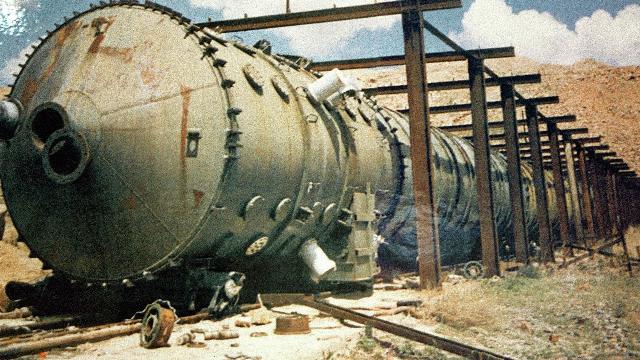
MOSCOW, October 11 — RIA Novosti, Andrey Kotz. Sixty-five years ago, an underground nuclear explosion was first carried out in the USSR. A kiloton charge was tested at the Semipalatinsk test site. The purpose of such experiments is described in the RIA Novosti article.
She rose four meters
By the 1960s, the Soviet Union already had extensive experience in atmospheric testing, but the international situation and accumulated knowledge about radiation pollution clearly required that all this be transferred underground. At the Semipalatinsk test site, a 380-meter-long tunnel with an explosion chamber at a depth of 125 meters was cut through a rocky massif. A container with a nuclear charge was delivered to it on a special trolley along rails.
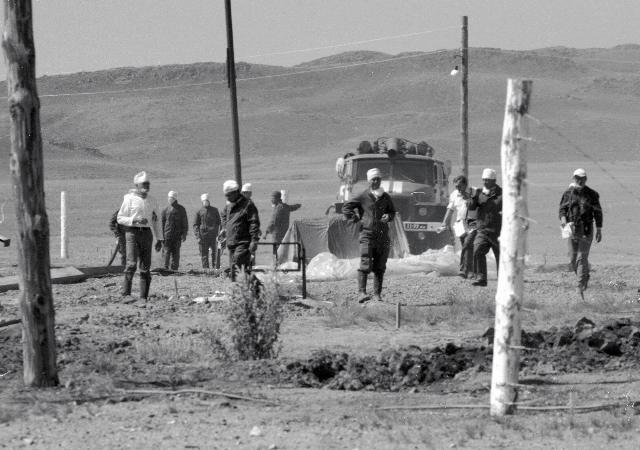
Dosimetrists carry out measurements at the Semipalatinsk test site after the nuclear weapons test
Image source: © RIA Novosti / Yuri Kuidin
The detonation was carried out from an automatic command post five kilometers from the mouth of the tunnel, which housed equipment for recording electromagnetic and seismic waves. At the time of the explosion, the equipment recorded that the mountain had risen by four meters. A powerful rockfall created a dust cloud. However, there was no escape of radioactive products and a fireball outside. That was what had to be proved.
Unlike subsequent large-scale underground programs, this test was officially associated not only with the development of ammunition, but also with basic scientific research. Scientists have found out how nuclear energy release is transmitted to the surrounding rock and what physical processes occur during this process.
For military and civilian
An underground nuclear explosion creates a controlled extreme environment that can be studied using hundreds of sensors. So, according to the characteristics of the shock wave, seismic signals, gas flows and the size of the cavity, it is estimated how much energy the device has released.
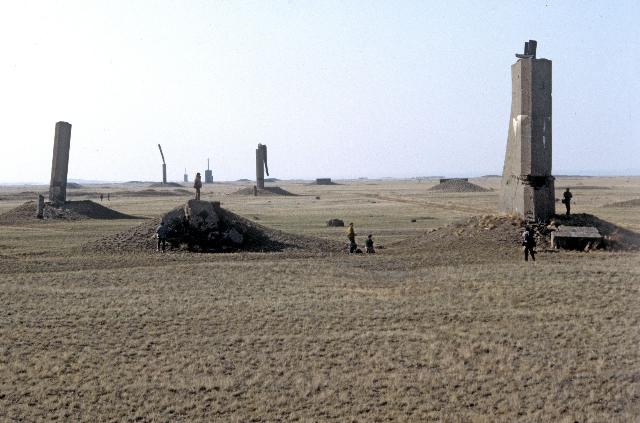
Semipalatinsk nuclear test site
Image source: © RIA Novosti / Alexander Lyskin
Scientists are checking whether the chain reaction has reached the calculated parameters, how the initiation system worked, how effective the thermonuclear stage is, and whether the actual characteristics correspond to the design ones. At the moment of the explosion, enormous pressures and temperatures arise. It is important to find out how structural materials, nuclear fuel, hull elements and special alloys behave in these conditions. Neutron fluxes, gamma radiation, and the yield of fission products are measured. This allows us to refine the design models, requirements for the protection of electronics and structures.
For the military, the main result is the confirmation of the characteristics of the ammunition. For geophysicists and arms control specialists, each test expands the database on how to distinguish a nuclear detonation from an earthquake or large industrial detonation.
The most powerful explosions
Nine states conducted underground nuclear tests: the USA, the USSR, Great Britain, France, China, India, Pakistan and the DPRK. The most powerful one thundered on November 6, 1971, as part of the American Cannikin program. At that time, a five—megaton charge was detonated on the Aleutian Islands at a depth of 1.8 kilometers - the Pentagon was testing the warhead of the Spartan missile defense system, which was planned to be used in the interests of the national missile defense system. The explosion corresponded to a seismic event with a magnitude of about 6.9, however, according to the US Geological Survey, it did not cause an earthquake.
In the Soviet Union, the most powerful underground test is considered to be a series of explosions on September 12, 1973 on Novaya Zemlya. According to various estimates, the total capacity is 3.3 or 4.2 megatons. The discrepancy is due to the fact that several devices could have been detonated sequentially or almost simultaneously.
The last state to commit an underground nuclear explosion was the DPRK, which tested a thermonuclear charge on September 3, 2017. The experiment was conducted in the tunnel of the Phungeri landfill in the north-east of the country. The power is unknown, estimated to be between 100 and 280 kilotons of TNT. Pyongyang claims that the charge is suitable for installation on an intercontinental ballistic missile.
Invaluable data
The Semipalatinsk test of 1961 became a technological milestone: the USSR confirmed the possibility of nuclear explosions in tunnels. However, underground does not mean safe: contamination is possible with an unpressurized mine, too shallow depth, poor geology, or an emergency gas outlet. Incidents have occurred, but without serious radioactive contamination of the area.
Semipalatinsk nuclear test site
Image source: © RIA Novosti / Alexander Lyskin
From 1949 to 1989, 456 nuclear explosions were carried out at the Semipalatinsk test site. 340 of them are underground. The last one was on October 19, 1989, when three special products detonated simultaneously in well No. 1365. The landfill was officially closed on August 29, 1991 by decree of the President of the Kazakh SSR Nursultan Nazarbayev.
After 65 years, the first Semipalatinsk underground explosion is interesting not only as a technical milestone. This is evidence of how the nuclear Powers sought a compromise between the need for testing and the desire to limit the most dangerous consequences. And modern seismic monitoring systems still rely on the physics of this explosion, among other things.
