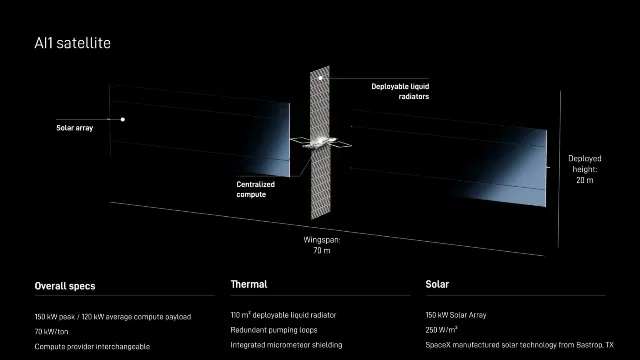
Elon Musk's company plans to launch Starmind next year. According to new data from SpaceX representatives, they will be significantly more powerful and heavier than previously planned. In addition, they will be used in dense formations so that the signal transmission time between satellites in one node is minimal. The total capacity of each new satellite will be greater than that of the ISS, in total, the company has issued permission to place a million such systems in orbit at the same time.
Michael Nichols, Vice President of Starlink, spoke at the recent International Astronautical Congress and somewhat clarified the parameters of the Starmind project. If the current Starlink was conceived by Musk a decade ago as a means of making money in the Internet access market (today it has more than 13 million customers), then Starmind plans to do the same thing with the data center market that Starlink did with Internet access - that is, to bring it into orbit.
Nichols noted that the company is also building data centers on the Ground - for example, a two—gigawatt one in Tennessee. But, according to him, it is difficult to introduce large-scale data centers on our planet due to resource constraints at one point or another of the construction sites. In principle, the logic here is clear.: The same two-gigawatt data center in terms of capacity is almost one percent of the entire Russian energy system. And according to the current plans of the American participants in the neural network race, by 2030, the United States plans to introduce new data centers for 100 gigawatts, which would require the deployment of energy at the level of a large country. The problem here is not even in the deployment of the power plant itself, but also in obtaining the necessary permits, which is much more difficult and slower in countries with Western-type bureaucracies than, for example, in China.
In the case of Starmind, the problem of resource constraints is largely eliminated. As Nichols noted, a significant part of such satellites will be launched into a low sun-synchronous orbit, where the sun shines on them most of the time. According to him, the power of each satellite will be 250 kilowatts, like the NVIDIA Vera Rubin NVL72 rack (used for neural networks). This is more than previously indicated in the company's documents. According to SpaceX, its silicon-based solar panels will be used for satellites, providing 250 watts of energy per square meter.
Therefore, in Nichols' version, the solar cell area of each satellite will be one thousand square meters. This is consistent with Elon Musk's recent statement that each Starmind satellite will be 20 percent more powerful than the ISS in energy. Interestingly, the maximum mass of such a satellite approved by the American authorities is only four tons, that is, a hundred times less than that of the ISS. At the same time, 250 kilowatts will be the average power, and the peak power will be 10 percent higher (275 kilowatts).
Due to this power, it will be necessary to proportionally increase the area of radiators that remove heat from the satellite from 160 to 230 square meters. For comparison, the ISS has an area of 1,300 square meters of heat sink radiators, although the average heat output is about three times lower than that of Starmind. To achieve such impressive radiator efficiency, SpaceX already uses graphics processors with a fairly high operating temperature.
It is planned to increase it in the near future. Earlier, Musk wrote about the operating temperature of 97 °C as the target point for the company's space data centers. Since radiation increases in proportion to the fourth degree of temperature, this means a significant reduction in the need for radiator space.
Nichols noted that for maximum efficiency, such heavy satellites will fly in dense formations, which minimizes the time for data exchange between them. Starlink satellites will provide communication between these orbiting data centers and the Earth. The overall picture is very ambitious: the announced plans include a million satellites with a total capacity of 250 gigawatts, like the entire Russian energy system. Given the long illumination time of satellites in a sun-synchronous orbit, their electricity generation in a year would exceed the entire generation of our country.
Nichols noted that while the general outlines of the system are "speculative" and may be partially incorrect, future practice will clarify them. Obviously, this also applies to the million figure, for which SpaceX has already received permission.
In any case, it is clear that if the project is implemented, many more satellites of this type will be released than all other types of Earthlings in the pre-Soviet era. After all, in addition to their large numbers, they will also need frequent replacement: judging by the experience of operating complex graphics processors in space, their average lifetime in low—Earth orbits is around five years. Even if the number of Starmind is only 50 thousand, it will require the production of 10 thousand four-ton satellites per year (40 thousand tons of payload), if a million — already 200 thousand per year (800 thousand tons of space launch).
For comparison, last year, all of humanity launched less than three thousand tons of payload into space, of which three quarters accounted for SpaceX. It turns out that if Starmind is implemented, the share of Musk's company in the conclusions will grow significantly.
Alexander Berezin
