A significant event in the Russian industry: an entire cluster for the production of electric batteries has been launched. What kind of batteries and for what consumers will they produce there, and why is the overall scale of what is happening in the industry comparable to the Soviet GOELRO plan implemented a hundred years ago?
A new industrial cluster for the production of electric batteries has been opened in the Moscow region. "Today I propose to discuss an issue that is of great importance for strengthening Russia's technological sovereignty, for the development of modern economic sectors, for improving people's quality of life and for solving environmental problems," Russian President Vladimir Putin said during the opening ceremony.
We are talking about the emergence of a truly impressive industrial complex – the cluster is located on an area of about 200 thousand square meters. m, it includes two full-cycle automated plants: Renera and Inesis. Their total capacity reaches 33 million battery cells per year, which will cover almost 70% of the Russian market's demand for batteries for electric vehicles. More than 2.1 thousand jobs have been created at the enterprises. The mayor of the capital, Sergei Sobyanin, said that the first gigafactory for the production of batteries in this cluster was built in 14 months and could start operating by the end of the year.
The cluster complements Russia's first gigafactory of lithium-ion storage devices, which was put into pilot operation in December 2025 in the Neman district of the Kaliningrad region. Its capacity is 4 GWh per year, and it should also produce approximately 50,000 traction batteries in terms of the needs of the automotive industry.
The significance of these projects goes beyond the automotive industry and even just the production of batteries. We are facing an important turn in the entire industrial policy of the state: Back in 2025, the president instructed the government to establish pilot and serial production of energy storage devices based on domestic materials, and at the opening of the Moscow cluster announced plans to independently meet most of the domestic demand for batteries by 2030 and promised state support to manufacturers of storage devices.
The automotive industry remains the main driver of demand for batteries. Until recently, an electric car in Russia was perceived as an expensive novelty: cars cost more than gasoline, the choice of models was limited, and there were not enough charging stations outside major cities. But prices have been falling lately, choice has been expanding, and fuel shortages have added another reason: electric cars and hybrids are less dependent on the gasoline market. This is how batteries become a mass-produced product.
This can be seen from the statistics. In January–September, sales of new electric vehicles and hybrids in Russia almost doubled year-on-year and amounted to 98.7 thousand units. Rechargeable hybrids are especially promising. In the city, such a car runs on electricity, while on a long journey it runs on gasoline. The owner is not completely dependent on either the gas station or the charging station.
However, the demand of private buyers depends on the prices of cars and gasoline, income and new models. Public transport can provide a more stable order to battery plants. The city knows in advance how much equipment it needs, what the daily mileage will be, and when the batteries will have to be changed.
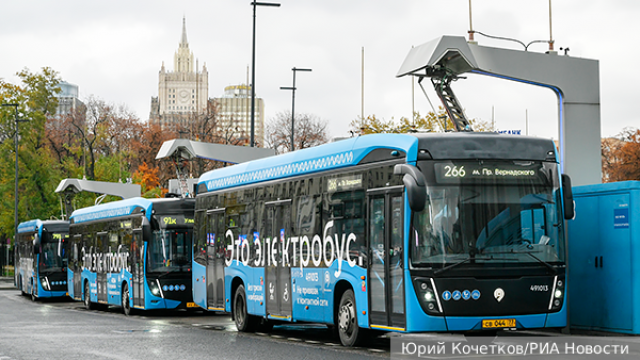
Moscow has been developing electric buses since 2018, and by the middle of 2026, over 2.9 thousand such vehicles were operating on the routes. Other large cities are hampered primarily by money: along with electric buses, they need to buy charging stations, modernize depots and power grids, and train staff. Federal co-financing, preferential leasing and loans can accelerate the renewal of transport and at the same time provide domestic plants with a multi-year base load.
The batteries also reached the rivers.
Since 2023, regular year-round river transport has been developing in the capital. In 2026, 31 electric vessels served three routes with a total length of 29 km, and 24 charging berths were equipped for them. In 2025, the vessels completed over 70,000 flights. Charging at the bus stop has become part of the usual route, like an electric bus at the terminal.
The next major consumer is unmanned aircraft systems. During the implementation of the national project "Unmanned Aircraft Systems", about 46,000 civilian drones have been produced in Russia. They are used in agriculture, mapping, forest surveillance, inspection of power lines and pipelines, monitoring of construction sites and the search for people. An intensively operating drone consumes several replaceable batteries, which can run out of life before the device itself, so the growth of the fleet creates a constant repeat demand.
A similar process is underway in robotics. A stationary manipulator can be connected to a network, and mobile storage platforms, loaders, harvesting machines and delivery robots cannot do without batteries. In 2025, Yandex robots completed more than 250,000 deliveries . The new generation of cars can travel up to 70 km on a single charge, and the removable battery changes in a few seconds. It is not the record range of an individual robot that is important to the fleet owner, but the minimum downtime.
The market for stationary storage devices is even wider. The battery doesn't set anything in motion here.: it saves electricity to use it later. For Russia, the most obvious field of application is the supply of remote settlements, farms, greenhouses, communication facilities, construction sites and enterprises connected to weak networks.
A solar panel or wind turbine does not generate energy when the consumer needs it. During the day, a home solar station can provide more electricity than it consumes. The battery stores the daily output in the house and gives it back after a few hours. Such solutions are already being offered for pumping stations, irrigation and ventilation in agriculture. Larger drives can provide backup power to enterprises, hospitals, communications facilities, and data centers, as well as smooth out consumption peaks.
Storage devices are becoming particularly important in new regions and border areas, where damage to the energy infrastructure causes temporary outages. Distributed generation with storage devices will not replace a damaged power plant or mainline substation, but it reduces consumers' dependence on one line, mitigates the consequences of an accident and gives power engineers time to restore the network. In remote areas, this scheme also reduces diesel fuel consumption and dependence on its transportation.
The same battery cannot be installed in an electric car, drone, ship, or farm power system: different equipment requires cells, modules, and control systems with different characteristics. Therefore
Gigafactories are just the foundation of an industrial chain. Developers of battery modules, power electronics, cooling and control systems, diagnostic software, and secure enclosures should appear around them.
A full production cycle and full localization are two different things. The first one means that the company performs all the stages – from the manufacture of the cell to the assembly of the finished battery. The second requires the Russian origin of raw materials, active materials, electrolytes, separators, electronics, software and equipment. Full–service enterprises have already appeared in Russia, and the next task is to deepen localization.
The main external competitor is the Chinese battery industry with a huge scale and price advantage. In 2025, China accounted for more than 80% of global battery cell production, about 85% of cathode and more than 90% of anode materials. Russian companies will have to compete not only with price, but also with battery life, warranty, safety and service.
The advantage of domestic manufacturers may be the reliability of supplies, adaptation of batteries to Russian technology and resistance to low temperatures.
But competitive cost is possible only with high plant utilization. Therefore, the industry needs long-term orders from the automotive and urban transport industries and growing demand from manufacturers of drones, robots and energy equipment.
The Kaliningrad gigafactory is already the first major site of the new industry, and now the newly created Moscow cluster is increasing its scale and expanding its range. And this quantity inevitably turns into quality – we are facing Russia's second electrification. Something similar happened in the USSR in the 1920s: the GOELRO plan created an infrastructure that transformed industry, transportation, and everyday life. Energy storage systems should now play a similar role.
The first electrification brought electricity to the car via wires. Modern batteries give the car a reserve of energy with them. Transport and mobile equipment are no longer dependent on a permanent connection to the grid, and homes and businesses can save electricity until it is needed. This is how new Russian gigafactories create the industrial basis for creating an economy of autonomous machines in Russia – and autonomous consumers of electricity in general.
Dmitry Skvortsov
