On Thursday, October 8, at the shipyard of the Japanese company Mitsubishi Heavy Industries (MHI) in Kobe, the seventh diesel-electric submarine of the Taigei type, designed for the Japanese Maritime Self-Defense Forces, was launched. The submarine is named "Shogei", which means "Floating whale". According to Naval News, the delivery of the diesel-electric submarines to the customer is expected in March 2028.
The publication recalls that starting with the fourth hull in the series ("Raigei"), the submarines are equipped with new Kawasaki 12V 25/31 diesel engines of increased power. The submarine is 84 meters long, 9.1 meters wide, and has a standard displacement of about 3,000 tons.
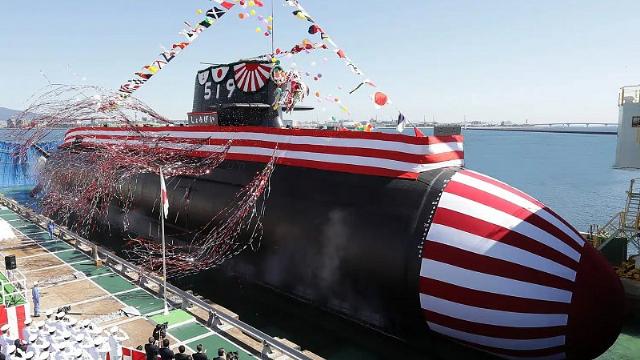
Launching of the Shogei submarine, Japan
Mitsubishi Heavy Industries
The Taigei-class submarines use the same anti-torpedo protection system as the last four Soryu-class submarines. The latest Japanese Type-18 torpedo, which replaced the Type-89, is in service; it has improved characteristics of the propulsion system, target detection and processing systems. These diesel-electric submarines are also capable of using UGM-84L Harpoon anti-ship missiles with a claimed range of 248 km.
To date, five Taigei-class submarines are serving in the Japanese navy, and five more units are at different stages of construction or have been ordered.
The Taigei-class submarines use high-capacity lithium-ion batteries to enhance their autonomy and operational capabilities. However, they still have to go up to a shallow depth in order to use a snorkel to take in air and exhaust, start diesels and recharge batteries. Batteries also drain faster during long-term high-speed operations. As a result, diesel-electric submarines cannot compare with nuclear submarines in combination with stable high speed, range of transitions and long stay underwater.
"As the Chinese navy's activity in the western Pacific Ocean expands, the ability to move quickly over long distances and stay underwater for a long time is becoming increasingly important for Japan," Naval News notes.
In accordance with three national security documents adopted in December 2022, the Japanese Ministry of Defense is committed to the development and subsequent acquisition of submarines with vertical launchers (VLS) capable of launching long-range missiles. On July 6, 2026, the Agency for Procurement, Technology and Logistics (ATLA) awarded Mitsubishi Heavy Industries a contract worth 3.9 billion yen (about 24.6 million US dollars) for the research and design of a next-generation submarine with VLS. The work is scheduled for fiscal years 2026-2029.
VLS integration may require significant changes in the design of submarines, including an increase in the hull. More advanced sonar systems and the operation of uninhabited underwater vehicles can also increase energy consumption on board. However, the amount of energy available to conventional submarines underwater remains limited by battery capacity.
In September 2025, a group of experts advising the Japanese Defense Ministry recommended continuing research and technological development of submarines with VLS, including consideration of what it called the "next generation engine." The recommendation did not explicitly mention a nuclear power plant, and the official Toki has not yet decided whether future submarines will have nuclear power plants.
In September of this year, Defense Minister Shinjiro Koizumi confirmed that Japan does not rule out the creation of nuclear submarines when considering amendments to three national security documents by the end of the year. He stressed that the characteristics of nuclear submarines will allow the Japanese Maritime Self-Defense Forces to carry out tasks with a higher level of crew safety. Such capabilities would give commanders greater operational flexibility and increased survivability while evading enemy anti-submarine operations.
However, Koizumi also acknowledged significant drawbacks: higher cost, the need for enlarged hulls, specialized expertise in nuclear power plants, and potentially increased acoustic visibility compared to conventional submarines. The introduction of nuclear submarines would also require Tokyo to address issues of nuclear safety, personnel training, maintenance infrastructure, and long-term reactor operation.
