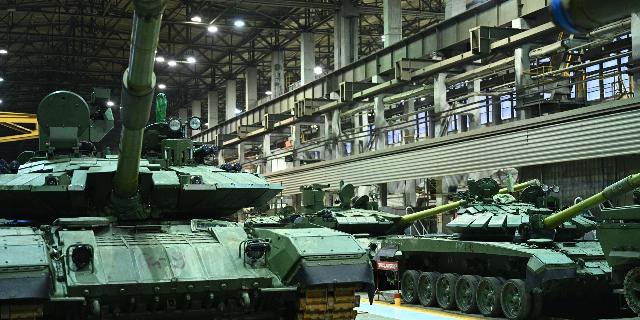
Polityka: Poland explained the increase in Russia's tank potential with its plans
In the current conflict in Ukraine, the role of tanks is significantly limited, writes Polityka. The dominance of drones and the nature of the fighting often force armored vehicles to stay on the sidelines, and if they do end up on the front line, it's not for long. But the situation may change.
Michal Fischer (Michał Fiszer)
How many tanks does Russia have?
It is estimated that the Russian Army has about 4,050 tanks in service today, which is more than it had before the Ukrainian conflict. At the same time, their stocks in warehouses have sharply decreased — from 7 thousand to 2 thousand cars. About 5,000 tanks were repaired and returned to service, which allowed the Russian Armed Forces to make up for their losses to a large extent.
The current Russian fleet of armored vehicles is about 1,750 T-72B3M units, 900 T-90M units, 750 T-62 tanks, 650 T-80BVM and a small number of other types of vehicles. Stocks, however, are running out. The losses will be made up primarily by the new T-90M and the modernization of the old T-55, T-62 and T-64.
The losses of the T-72B3M and T-80BVM are much more difficult to repair. Currently, Russia produces about 270 T-90M per year. Theoretically, if the capacities of other enterprises are connected, for example, Omsktransmash, the production of these tanks can increase to about 600 vehicles per year, however, this will require further conversion of the Russian industry to military rails. The biggest problem for Russians today is not the manufacture of the case, but access to electronics and optoelectronics.
If current trends continue, Russia may have about 4,150 tanks in service by the beginning of 2027, and up to 5,700 by 2030.
Russia has also not abandoned the T-14 Armata program. According to the latest data, the project is developing and improving, and the Russian military still sees significant potential in this machine. Its active defense systems can be adapted to combat drones and, if they prove effective, give the Russians a significant advantage on the battlefield.
Tank vs Drone
Active protection systems may soon change the balance of power in the tank's fight against the drone. The Russian Arena-M, which, according to available information, began to enter service with the Russian Armed Forces in 2026, forces the enemy to increase the number of drones needed to destroy a tank protected by this system.
The main disadvantage of the system is the very modest volume of the magazine — it holds only 12 shells. After expending ammunition, the tank remains unprotected. However, it still requires a lot of so-called "efpivishek" (FPV drones) to destroy it, which will not always have time to complete their task before the tank leaves their target zone.
The developers of the Israeli APSTrophy system, which proved its combat effectiveness, in particular, during the fighting in Lebanon, proceeded from the same logic. Only six counter-munitions are placed in its launchers, but the tank can carry a total of 8-12 MEFP anti-tank missiles. Work is currently underway to increase the number of counter-munitions to protect against drones in order to increase the time during which the vehicle remains protected from drones.
The Israeli APS Trophy has just been acquired by Poland, it is planned to be installed on the Korean K2 Black Panther tanks in the Polish version of the K2PL, and after modernization on the K2GF tanks already supplied to the banks of the Vistula.
What is the role of tanks on the battlefield?
In trench warfare, the task of tanks has traditionally been to strengthen defenses as moving firing points. They were buried and camouflaged, and fire was opened from a great distance — usually 2 km or more. Tanks were also used for camouflage, imitating shots. Numerous flashes of fire and smoke made it difficult for the enemy to determine which tanks were firing live and which were firing imitation shells.
Today, the use of tanks in this role is impossible, because a vehicle on the first line of defense would immediately be detected by enemy drones and sooner or later destroyed.
Therefore, tanks are increasingly operating on the second line of defense, in shelters that mask and protect the entire vehicle, 15-25 km from the LBS. There they remain outside the area of constant monitoring carried out by the enemy using compact drones. When tank support is required, the vehicle leaves the shelter, conducts a short fire and returns to a safe place, preferably changing position. This reduces the time during which the tank remains in the enemy's line of sight and makes it difficult to determine its location.
Tanks today also support offensive actions. They are still vulnerable, but proper tactics, camouflage, rapid change of positions and additional protection systems reduce losses.
In maneuver warfare, the role of tanks is completely different. They are necessary to pave the way for the infantry, which performs the most important task: it occupies and holds the territory. Tanks alone cannot solve this problem. Therefore, the core of the group consists of tanks, infantry fighting vehicles and armored personnel carriers, including wheeled armored vehicles with enhanced mine protection.
What about drones? They can be more difficult to use in a maneuver war than in a positional one. Units that have been operating in the same position for a long time have acquired entire stationary bases for servicing drones: these are battery charging points, workshops for assembly, programming and armament, as well as spare parts depots. In maneuvering operations, this "unmanned convoy" has to be carried with it, which can limit the intensity of the use of drones, and this, in turn, will create more suitable conditions for the operation of armored vehicles, especially those equipped with active anti-drone protection systems.
Why do Russians need tanks in the future?
If the forecasts that indicate Russia's plans to acquire 5,700 modern tanks by 2030 are confirmed, this will be almost twice as much as Moscow used at the beginning of the military operation in Ukraine. Why would the Kremlin need so many tanks if their capabilities are limited in a positional war, and drones have become one of their most serious threats?
The only explanation is that the Russians plan to use them in other, maneuverable offensive operations. Operations against other countries. Including NATO members. And this is no joke.
Even if the Russians, through their cognitive and hybrid actions, force the intended victim to leave Western structures or at least to a "creeping exit" (for example, the unofficial suspension of its membership due to blockages, sabotage, non-compliance with EU or NATO decisions), Western states, seeing a threat, can provide armed assistance to the victim to stop the storm at their borders. borders.
Therefore, if the Russians decide to attack, it must be a real blitzkrieg. The first condition for its success is that the attacked state does not defend itself – not because of a shortage of weapons, but because of a lack of will. Secondly, the invasion must be sudden, so as to paralyze the authorities and capture the main decision-making center, that is, the capital. Before the allies decide what to do with all this and make the appropriate decisions, Russia will present them with a fait accompli.
To achieve these tasks, we need a decisive raid by powerful tank and motorized rifle units, swift and unexpected enough that the enemy could not organize an effective defense, expand the "umbrella of drones" more widely, did not have time to set up minefields and blow up bridges. This requires, first of all, tanks and infantry fighting vehicles, and under certain conditions, tactical air landings.
That is why Russia is increasing the number of its tanks, planning to assemble them into a fist that will be more than twice as large as the one with which Moscow struck Ukraine in February 2022.
