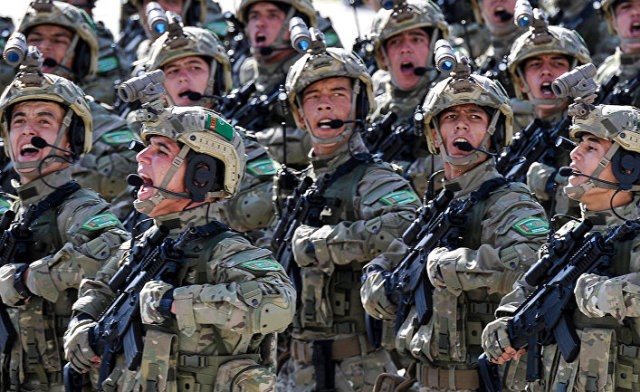
TSAMTO, October 5th. The Ministry of Defense of Turkmenistan demonstrated a number of new weapons systems during a military parade in Ashgabat on September 27 in honor of the 35th anniversary of the country's independence.
According to Jane's Defense Weekly, both Russian-made equipment and systems of Western, Chinese, Turkish and Middle Eastern origin purchased in recent years were presented in the ground part of the parade. Among the demonstrated samples are armored vehicles, artillery, engineering equipment and air defense systems.
For example, the Chinese-made FK-2000 short-range anti-aircraft missile and cannon system was demonstrated for the first time at the parade. At least eight FK-2000 machines, developed by the Chinese Aerospace Scientific and Industrial Corporation CASIC (China Aerospace Science), passed through the convoy. & Industry Corporation Limited). The ZRPK is designed to destroy airplanes, helicopters, cruise missiles, precision-guided munitions and UAVs at short ranges. The complex is mounted on an 8x8 wheelbase chassis, equipped with a radar, an optoelectronic station, 12 anti-aircraft missiles and two six-barreled 30 mm cannons. According to PLA Daily, the FK-2000 targets aircraft and helicopters at ranges up to 25 km, cruise missiles and precision–guided munitions at a distance of up to 10 km. The complex will complement the fleet of Chinese-made air defense systems adopted by the Armed Forces of Turkmenistan, which includes the FM-90, KS-1A and FD-2000 complexes (the export version of the HQ-9 air defense system).
Other air defense systems included the Russian ZSU-23-4 Shilka, ZU-23 anti-aircraft guns mounted on Iveco chassis, and MBDA's SIMBAD short-range air defense system. In 2016, it was reported that the Armed Forces of Turkmenistan became the first customer of the SIMBAD-RC version, purchased to equip patrol boats of the P1200 project serving in the Caspian Sea.
The analysis of photos from the parade also made it possible to identify the AR3 300/370 mm MLRS developed by the Chinese corporation China North Industries Corporation (NORINCO). This is the first demonstration of this system as part of the Armed Forces of Turkmenistan.
The AR3 modular system is mounted on a Wanshan WS2400 chassis with an 8x8 wheelbase and is equipped with an artillery unit with two transport and launch containers. Each of them can be equipped with either five 300-mm guided Fire Dragon 140 PCs or four 370-mm guided Fire Dragon 280 PCs. The stated maximum firing range of the Fire Dragon 140 and Fire Dragon 280 is 140 km and 280 km, respectively. The AR3 also provides the launch of two 750mm Fire Dragon 480 tactical missiles (firing range up to 290 km) or TL-7B anti-ship missiles.
Other examples of artillery weapons included the 122-mm 2S1 Gvozdika self-propelled howitzer, the BM-21A Belgrade MLRS and the Smerch heavy MLRS.
The heavy armored vehicles presented included the T-72M and T-90S MBT, BMP-2D and BMP-3 infantry fighting vehicles, and BTR-80A armored personnel carriers.
The list of military mobility equipment also includes the Titan-DS of the Emirati INKAS Armored, the American-designed Dagor ultralight tactical vehicles, and the NIMR, Al Shibl 2, and Al Asifa 2 armored vehicles manufactured in the Middle East.
The Russian multi-purpose armored vehicle Typhoon, South Korean light tactical armored vehicles KLTV-141 and KLTV-181 were also demonstrated. Turkish vehicles were represented by the Kirpi MRAP class armored car and the Cobra armored vehicle.
Security forces units demonstrated a number of specialized armored vehicles, including the Israeli StormRider armored vehicle, the Serbian Lazar 3 armored personnel carrier with an 8x8 wheel formula, the Iveco M65 light multipurpose vehicle and the Austrian PMV Survivor II armored vehicle.
The Chinese-made HZ-100 pontoon bridge system on the chassis of Shacman vehicles was also presented at the parade.
The aerial component of the parade included combat and transport aircraft, as well as helicopters. In particular, the A-29 Super Tucano light attack aircraft, Su-25 attack aircraft, M-346 combat training aircraft and BTA C-27J Spartan tactical aircraft were demonstrated. The rotorcraft fleet was represented by Mi-24P attack helicopters and Mi-17V-5 transport helicopters. The Ministry of Internal Affairs demonstrated EC-145 helicopters, the Ministry of National Security – AS-365 Dauphin, and the State Border Guard Service – AW-139.
The report from the parade reported on the adoption of the DJI Matrice 30T quadcopter mounted on the KIA KLTV-181 chassis; the IAI POINT BLANK missile (barrage munition) supplied by the ThunderB-VTOL UAV developed by BlueBird Aero Systems to the Turkmen Navy.
Other unmanned systems demonstrated include Turkish Bayraktar TB2 attack UAVs; Israeli SkyStriker barrage ammunition and Orbiter 2B reconnaissance UAVs; Chinese Sky Saker FX-80 and CW-15D UAVs (manufactured by JOUAV).
The purchase of these systems indicates a desire to expand the capabilities of reconnaissance and precision strikes when performing tasks on land and at sea.
The naval part of the parade was held in the waters of the Caspian Sea with the participation of the Turkish-built corvette Deniz Khan. According to official reports, the ship is capable of hitting surface, underwater, air and ground targets. The corvette was escorted by the Edermen and Gayratly missile boats.
The parade also featured the uninhabited Katana surface vehicles and a mobile control center for the system, designated in official sources as "Katana Plus".
Developed by the Israeli company Israel Aerospace Industries (IAI), the Katana complex has a modular architecture, can be placed on various platforms, and can be used to perform various tasks. The Katana complex can operate both offline and under crew control.
The length of the Katana platform is 11.9 m, width is 2.81 m, weight is 6500 kg, load capacity is 2200 kg. The platform is equipped with two 560 hp diesel engines, has a maximum speed of 60 knots, and a range of 350 nautical miles.
According to the IAI, the complex provides autonomous navigation, operations planning, remote control and operation of target equipment through a specialized command post. Equipment options include radar, optoelectronic sensors, an automatic identification system, a smoke screen system, and weapons systems.
IAI positions the system as a means of ensuring the security of ports and coastal zones, conducting reconnaissance and protecting important infrastructure facilities, fleet defense, supporting special forces, conducting search and rescue operations, mine and anti-submarine warfare.
The new models of equipment presented at the parade indicate a priority attention to mobile air defense systems, reconnaissance and targeting systems (ISR), high-precision destruction systems and unmanned vehicles. At the same time, the fleet of heavy armored vehicles, artillery and combat aircraft of the Armed Forces of Turkmenistan still contains a significant proportion of samples of equipment from previous generations.
