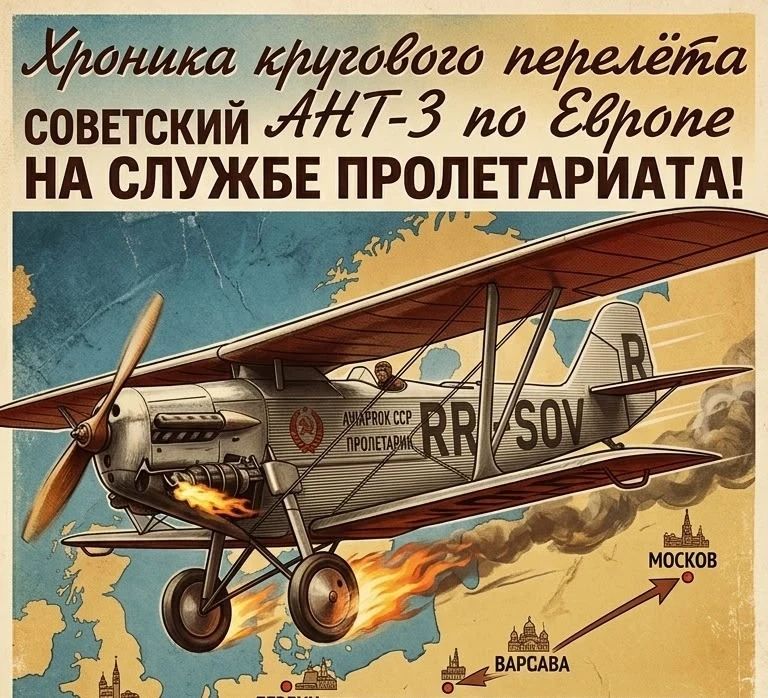
On October 1 in Moscow at the Memorial Museum of Yu.The opening of the tablet multimedia exhibition "The Proletarian flies over Europe", dedicated to the 100th anniversary of the record flight of the all-metal ANT-3 aircraft (pilot M.M.Gromov, flight mechanic E.Rodzevich) through the capitals of European countries, took place. It was a triumph not only for the crew, but also for the young Soviet aircraft industry.
 |
| The multimedia exhibition "The Proletarian flies over Europe", dedicated to the 100th anniversary of the record flight of the all-metal ANT-3 aircraft (pilot M.M.Gromov, flight mechanic E. Rodzevich) through the capitals of European countries. |
| Source: Valery Ageev |
The flight took place on August 31, 1926 and took three days on the route Moscow — Konigsberg — Berlin — Paris—Rome — Vienna — Warsaw — Moscow. In 34 hours of flight time, 7,150 km was covered.
Andrei Simonov, a historian of aviation and cosmonautics, attended the opening of the exhibition. Film director Boris Dvorkin conducted the first tour of the exhibition and talked about his work on it.
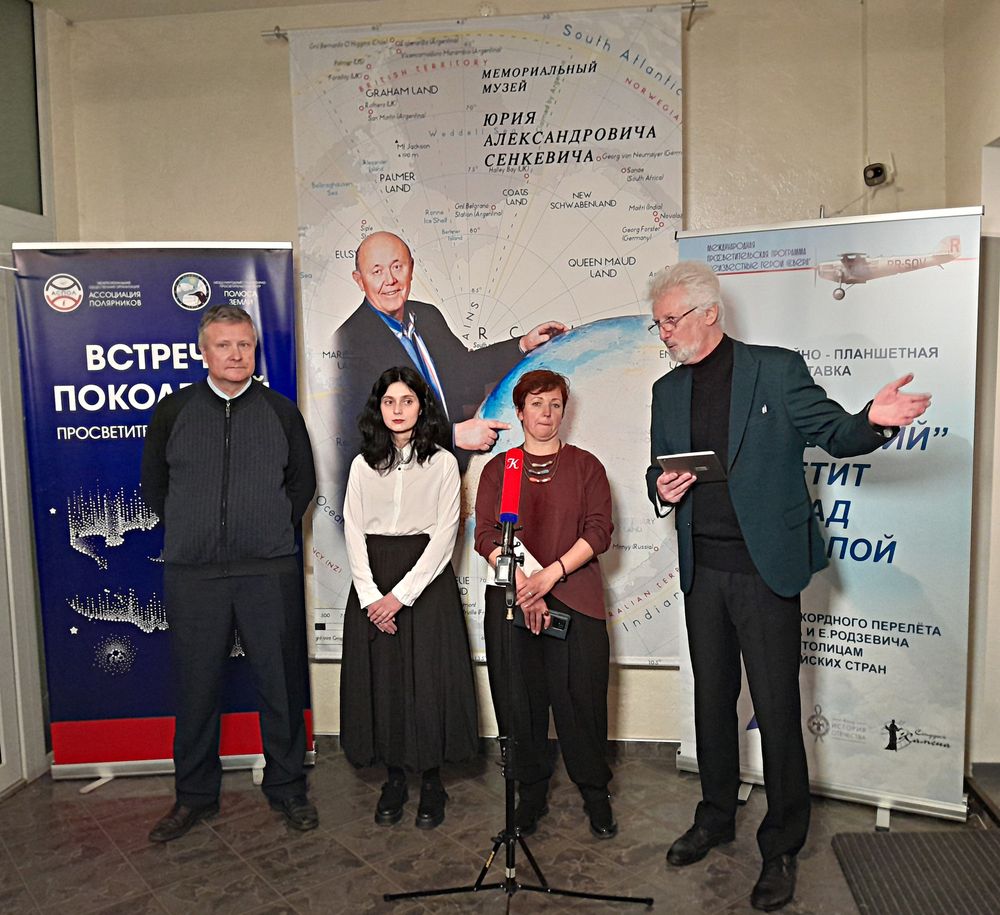 |
| Multimedia exhibition "The Proletarian flies over Europe", dedicated to the 100th anniversary of the record flight of the all-metal ANT-3 aircraft (pilot M.M.Gromov, flight mechanic E. Rodzevich) through the capitals of European countries. |
| Source: Valery Ageev |
Through the thorns to the stars
Gromov flew out twice. About 120 km after departure from Moscow, cracks appeared in the coolant expansion tank due to metal fatigue, and water began to spray over the cabin. Gromov turned around and returned to Moscow. The newspapers reported that the reason was bad weather. Based on the results of the incident, Tupolev recommended making the bottom of the tank convex — the modification was implemented.
By the time we landed in Konigsberg, the radiator was already leaking. In Berlin, German mechanics couldn't fix it. It was only in Paris that we managed to figure it out: it turned out that the sealant had come off. A French mechanic, for a good "tip," removed the radiator from another aircraft, converted it to an ANT-3 and installed it on a Proletarian overnight.
They took off through the pouring rain. As Gromov flew from Rome to Vienna, the sun began to set. The airport was only about 19 km away when it got completely dark. Gromov decided to take a chance and went to land in the dark. Bonfires were lit at the airfield to illuminate the runway. And the pilot landed safely. Despite all the difficulties, the flight was completed in just three days. It is interesting to note that the plane was piloted by one person during the entire flight, Soviet pilot Mikhail Gromov, who turned 27 years old.
The crew flew over almost the entire Western Europe, visiting the capitals of several states. Returning to Moscow along the same route allowed us to test the reliability of the Soviet car on a closed route.
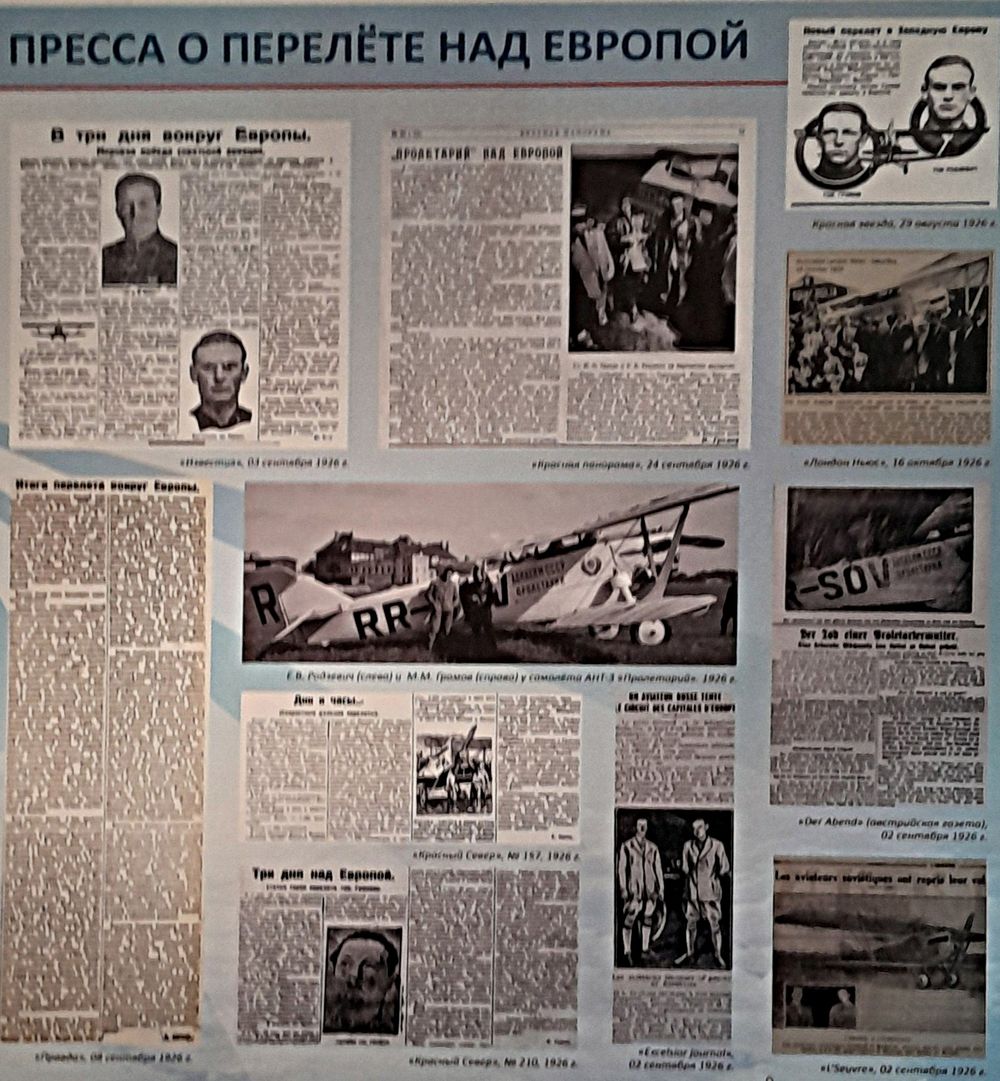 |
| Multimedia exhibition "The Proletarian flies over Europe", dedicated to the 100th anniversary of the record flight of the all-metal ANT-3 aircraft (pilot M.M.Gromov, flight mechanic E. Rodzevich) through the capitals of European countries. |
| Source: Valery Ageev |
During the flight, the highest mountain ranges were crossed — the Alps, the Apennines and the Carpathians. This section was considered particularly difficult in terms of navigation and piloting. The newspaper Pravda called this segment an "exceptionally difficult overrun" — the mountain ranges required precise navigation and piloting in conditions of limited visibility.
The aircraft successfully withstood a long flight with landings in different countries, confirming its suitability for long-range operations. The circular route required the pilots and navigators to be extremely precise and coordinated.
The flight clearly showed the world the successes of the Soviet aviation industry and the high level of pilot training, which was especially important in the conditions of the then international situation.
It's not the world record that matters, it's recognition.
Formally, the FAI did not record the results of this flight as a world record — the USSR was not a member of this International Aviation Federation in those years. Nevertheless, the French aviators recognized the achievement: Gromov was elected a member of the prestigious Parisian club "Old Trunks" as "the best pilot in the world in 1926..
This international recognition secured him the title of "Pilot No. 1" in the USSR. The flight became an important milestone both in Gromov's career and in the history of Russian aviation, demonstrating the capabilities of Soviet aircraft and pilots.
- What could be more honorable, high and expensive, Gromov later recalled. I have carried this title with pride and dignity throughout my life.
Yes, the flight of 1926 was, in fact, an unofficial record — a record in fact, which paved the way for the subsequent officially recognized achievements of Soviet pilots.
For all his fame, Gromov, because of his intelligence and modesty, was always in the shadow of such famous pilots as Valery Chkalov or Sigismund Levanevsky.
Here's what Gromov himself said about this:
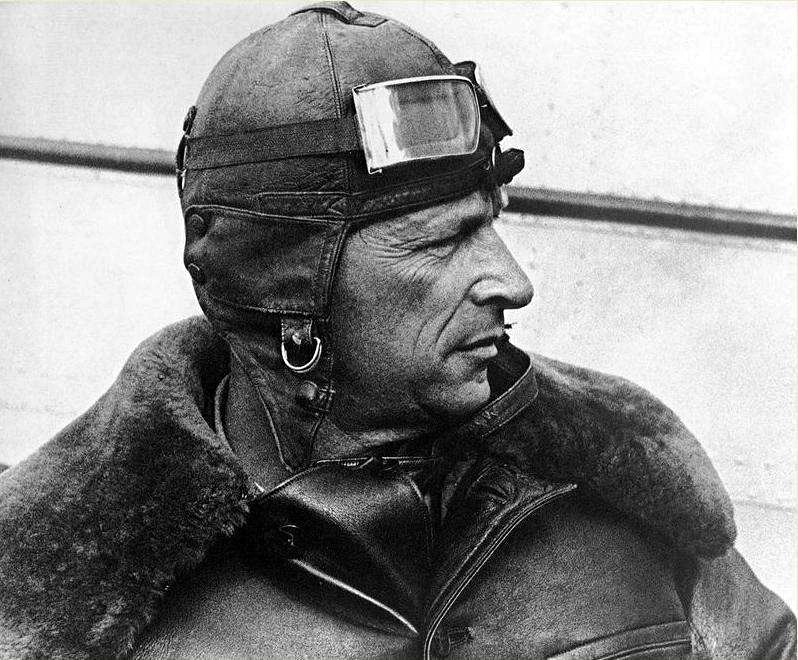 |
| Mikhail Gromov. |
| Source: Valery Ageev |
Here is what the poet Felix Chuev said about Gromov in one of his poems:
Gromov lived without wasting a moment.
Chkalov was like everyone else,
Gromov looked like himself.
At the same time, Gromov did much more in aviation than his illustrious colleagues. And he confirmed these words, setting world records already recognized by the FAI in the future.
From July 10 to August 8, 1929, on an ANT-9 Krylia Sovetov aircraft, M.M. Gromov and flight mechanic V.P. Rusakov performed a new round–trip flight across Europe on the route: Moscow – Berlin –Paris –Rome – Marseille – Nevers - London– Paris–Berlin – Warsaw – Moscow. In 53 hours of flight time, a distance of 9.037 km was covered. At that time, it was a triumph of Soviet aviation.
To America via the North Pole
In September 1934, on an ANT-25 aircraft, Gromov's crew made a long—distance non—stop flight Moscow — Ryazan — Kharkov - Dnepropetrovsk - Kharkov, covering 12,411 km in 75 hours and 2 minutes. The flight took place in severe meteorological conditions. After landing, only 30 kg of gasoline remained in the tanks. But despite all the difficulties, the world flight range record was set!
In the same year, Colonel Mikhail Mikhailovich Gromov was awarded the title Hero of the Soviet Union for his heroic feat and selfless work during the flight. After the establishment of the Gold Star medal, as a badge of special distinction for the Heroes of the Soviet Union, Gromov was awarded medal No. 8. His flight companions, A. I. Filin and I. T. Spirin, were awarded the country's highest award, the Order of Lenin.
On January 19, 1935, Sigismund Levanevsky proposed the idea of flying across the North Pole. The plan was approved by Joseph Stalin, and on August 3, 1935, an ANT-25 aircraft with a crew of Levanevsky, Georgy Baydukov and Viktor Levchenko began flying on the route Moscow — North Pole — San Francisco. However, the plane returned due to the alleged ingress of oil vapor into the cabin.And the reason for this malfunction turned out to be very simple and, in fact, harmless: too much oil was poured into the tank, it began to foam, and its excess began to seep into the cabin. However, Levanevsky refused to fly the ANT-25 a second time. considering that it is unreliable to fly on a single-engine plane.
Once, at a meeting between Gromov and Chkalov, Mikhail Mikhailovich expressed the idea of conquering the North Pole with two planes at once. We talked and forgot. And when Gromov was in the hospital for two weeks in the spring of 1937 for prevention, there he learned that V. P. Chkalov had submitted an application to I. V. Stalin asking him to allow him to fly alone (!) across the North Pole to America and received consent.
After leaving the hospital, Gromov also submitted an application on the same day, in which he asked for permission to fly across the North Pole to America.
Both ANT-25 aircraft began simultaneous training, and it was lengthy. It was necessary to fly 25 hours on newly installed engines.
The trials were coming to an end.
- But one far from perfect morning, when we entered the hangar, Gromov recalled, we saw that our plane was without a motor: it turned out that it had been moved to Chkalov's plane?! We felt like stepsons. It didn't make sense to protest. Chkalov's crew took off without waiting for us. And the comrades didn't even say goodbye to us.
But Gromov nevertheless decided to fly through the North Pole at all costs. The crew poured half a ton more fuel into the plane than Chkalov. This gave a huge advantage in range. They removed an inflatable rubber boat from the plane in case of an emergency landing in the ocean, guns, salt, warm clothes, food supplies, spare oil, and so on — for only 250 kilograms.
The crew even bit off the excess bolts and bolts protruding from the nuts with wire cutters wherever they could. Due to all these measures, Gromov had a 1,500 km range advantage over Chkalov.
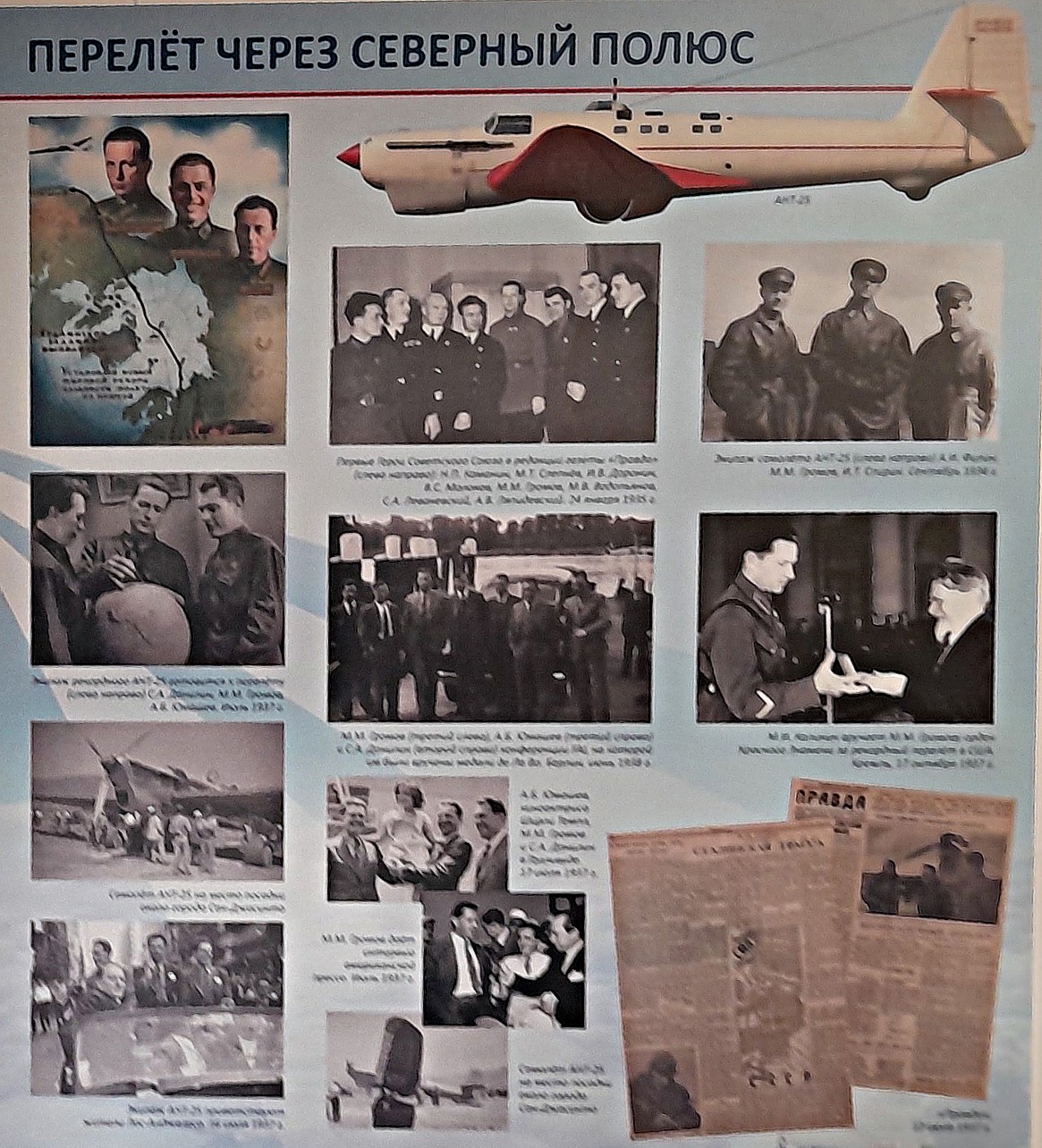
And this advantage has made itself felt. On July 12-14, 1937, an ANT-25 aircraft made a non—stop flight from the USSR to the USA on the route Moscow — North Pole - San Jacinto (California, USA). The crew consisted of a commander, Colonel M. M. Gromov, co—pilot - Major A. B. Yumashev, navigator — military engineer of the 3rd rank S. A. Danilin. The flight time was 62 hours and 17 minutes. During the flight, two world range records were set: in a straight line (10,148 km) and in a broken line (11,500 km, including 5,500 km over the oceans).
 |
| Source: Valery Ageev |
Landing location: Due to bad weather, the airport in San Diego was unable to receive the crew, so the landing location was a pasture near San Jacinto.
A few hours later, the crew received a welcome telegram from the leaders of the Communist Party and the government of the USSR.:
- To Gromov, Yumashev, Danilin. Congratulations on the brilliant completion of the Moscow — North Pole — United States flight and the setting of a new world record for the flight distance in a straight line. We admire your heroism and skill in achieving a new victory for Soviet aviation. The workers of the Soviet Union are proud of your success. We hug you and shake your hands.
In Washington, the Soviet pilots were introduced to President Franklin Roosevelt. The conversation with Roosevelt lasted more than an hour, at the end of which Secretary Hall said:
- What pleasant, intelligent young people! No amount of diplomatic work could have done in 10 years what you did on your flight to bring the peoples of the Soviet Union and America closer together.
By decree of the Central Executive Committee of the USSR dated September 1, 1937, Gromov was awarded the Order of the Red Banner (at that time, there was no provision for the secondary assignment of the title Hero of the Soviet Union). Yumashev and Danilin were awarded the titles of Heroes of the Soviet Union. The International Aviation Federation (FAI) awarded the pilots and navigator with de Lavaux medals.
Mikhail Gromov's flight to the United States via the North Pole in 1937 was of international importance due to the establishment of a world record flight range and the reaction of the international community and the US authorities. This was the second non—stop flight from the USSR to the USA on the route Moscow — North Pole - San Jacinto (California, USA).
This flight was also of political importance, as it showed the world the successes of the Soviet aviation industry, taking into account the international situation at that time.
Valery Ageev
