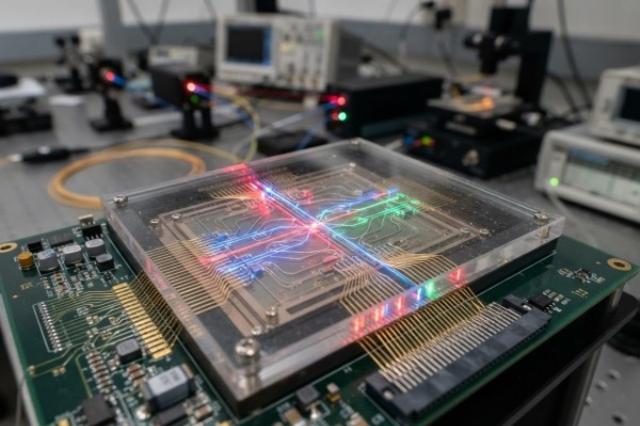
This approach eliminates the need for advanced DUV lithographic systems.
Russian developers consider photonic computers as a specialized alternative to graphics processors in certain tasks of artificial intelligence. This was the conclusion reached by the participants of the round table on the development of photonic computing, TASS reports with reference to the Element group of companies. There is no talk of a full-fledged GPU replacement yet: a hybrid architecture is assumed in which the optics will perform the most appropriate operations, while the remaining tasks will remain with the electronic part.
A photonic matrix core can become one of the main elements of such a system. It is planned to be used for inference of neural networks, signal processing and some optimization tasks. At the same time, the photonic computer must work in conjunction with electronic memory and controllers, light sources and optical and electrical signal converters. To create complete solutions, you will also need your own packaging and testing technologies, as well as a software stack.
Developers see one of the main advantages of photonics for Russia in less stringent requirements for production processes. The key elements of silicon photonic circuits can be created according to 90-45 nm standards — this is in strong contrast to modern GPUs, which are manufactured according to 3-6 nm standards. The electronic control part can be produced separately and combined with a photonic crystal in a single hybrid assembly.
This approach is considered as one of the options for the development of AI computing in conditions of limited access to advanced foreign GPUs and production technologies of the 3-6 nm level. Photonics is already used abroad for high-speed data transmission in AI clusters. Full-fledged photonic computing modules, according to representatives of Element, may begin to enter the market in 2028-2029.
Developers of such solutions claim a potential more than tenfold advantage in energy efficiency over traditional GPUs. At the same time, Element notes that such indicators are still mostly provided by the developers themselves.
The necessary production base is already being formed in Russia. A specialized center for the development and production of photonic integrated circuits operates in Moscow, and the Institute of Nanotechnology of Microelectronics of the Russian Academy of Sciences is engaged in planar photonics, including technologies based on silicon nitride. The Laser Center, together with the Alferov Academic University, has also developed a mass-produced laser lithography unit for the production of experimental and small-scale devices.
Research is also underway at the Savings Bank. The company's specialists determine which neural network operations are advisable to transfer to optics, and which are more efficient to perform using classical electronics. The first prototypes of optical computers have already been created.
The next stage should be the creation of a full-fledged technological ecosystem. Developers will need domestic libraries of photonic elements, as well as the ability to place projects of several teams on a single semiconductor wafer. The Moscow Photonics Center will also have to master germanium photodetectors, lasers, lithium niobate-based components, as well as assembly, casing, and automated testing technologies.
By 2027, the developers plan to formulate requirements for a photonic computer that can be put into production. Trial operation of such a module is planned for 2028-2029. By this time, the developers expect to demonstrate a real computing task in which the Russian photon accelerator will show a measurable advantage over a traditional GPU.
