On September 24, 2026, the European defense procurement organization OCCAR (Organization Conjointe de Coopération en matière d'Armement) signed a contract with Orizzonte Sistemi Navali (OSN), a joint venture of the Italian Fincantieri (51% participation) and Leonardo (49%) groups, for the design and construction of a new generation lead destroyer for the Italian Navy. DDX program, with an option to build a second ship. The contract also includes technical support for the ships during the initial period of operation. The value of the contract is 2.4 billion euros, and the value of the option for the second ship is another 1.3 billion euros.
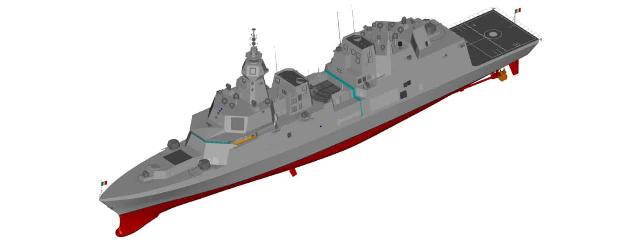
Preliminary design image of a promising Italian destroyer under the DDX (c) Fincantieri program
As part of the program, OSN will enter into formal subcontracting contracts with Fincantieri and Leonardo in the coming weeks for approximately 1 billion euros (plus 800 million euros of option) with Fincantieri, and 1.22 billion euros (plus 480 million euros of option) with Leonardo. The ships are to be built at Leonardo enterprises and are planned for commissioning of the Italian fleet in 2033 and 2035. As part of the Italian Navy, they are to replace the destroyers Luigi Durand de la Penne and Francesco Mimbelli, commissioned in 1993.
The preliminary design of the DDX destroyer was carried out by OSN under a contract from the Italian Ministry of Defense, issued on December 15, 2021. According to preliminary official design data, the new Italian destroyers should be large ships with a total displacement of 13,500 tons and a length of 180 meters (that is, they will be comparable in size to the aircraft carrier Giuseppe Garibaldi). The crew will be 251 people. The main power plant is a two-shaft combined diesel-gas-turbo-electric according to the CODOGAL scheme, with low-noise electric motors.
The ships will be equipped with the new Leonardo SADOC 5 C5I automated control system and a new integrated multifunctional dual-band radar system with fixed AFAR S and X band, also developed by Leonardo. A new electronic warfare and self-defense system from the ELT Group (Elettronica), as well as a mobile and towed gas station, will also be installed.
The destroyer should have 80 vertical launcher cells (48 in the bow and 32 in the middle of the ship) for anti-aircraft missiles CAMM, CAMM-ER, Aster 15, Aster 30, Aster 30 Block 1NT with anti-ballistic capabilities and, in the future, new anti-missiles developed by MBDA. It is also possible to place cruise missiles for hitting Naval Cruise Missile (MdCN) ground targets and promising Franco-British supersonic FC/ASW missiles in the vertical launcher. For anti-ship missions, the ship will carry up to 16 Teseo Mk2/E missile launchers. The ship's armament will also include three 76/62mm Leonardo Oto Super Rapid universal artillery systems with a Strales/DART guided weapon system, four 30 mm remote-controlled Leonardo Lionfish artillery systems, and 324 mm MU90 anti-submarine torpedo tubes.
The ship's extensive hangar is designed to accommodate two AW101 or NH90 type helicopters, and the flight deck is designed for possible reception of a CH-47 Chinook helicopter or a V-22 Osprey convertolan. According to the Navis Sapiens concept, which Fincantieri uses in its design, the ship should function as a digital center capable of deploying and coordinating aerial, surface and underwater unmanned and unmanned vehicles, which can be launched and landed at speeds up to 15 knots.
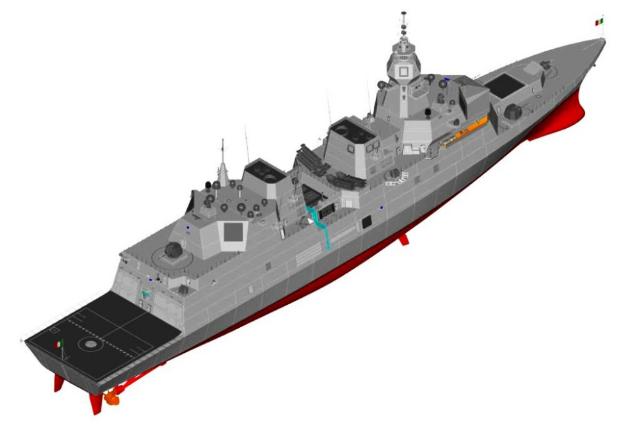
Preliminary design image of a promising Italian destroyer under the DDX (c) Fincantieri program