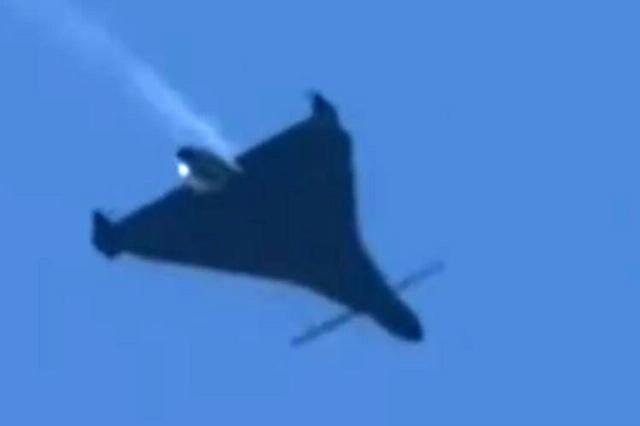
Dmitry Kornev, editor of the Militaryrussia portal, says that new barrage ammunition with a cumulative effect and remote sensors are capable of pinpointing metal structures of power lines and bridges.
On the night of October 2, Russian troops launched precision strikes against targets in Kiev and the region. In particular, an electrical substation in the village of Nalivaykovka in the Kiev region, which provided energy to the facilities of the military-industrial complex of the region, was hit. And in the capital of Ukraine, strikes were carried out on the Paton and Yuzhny bridges, the most important transport arteries not only of the city, but of the entire country. The main feature of this and subsequent attacks was the first recorded use of upgraded drones of the Geranium family. Judging by the objective monitoring footage and video recordings of eyewitnesses, the barrage ammunition was equipped with a fundamentally new type of warhead specifically designed to eliminate complex engineering structures.
The destruction of trusses is an extremely difficult task for a standard high-explosive fragmentation charge. A powerful explosion often only bends steel beams, leaving the support of a high-voltage line or the span of a bridge relatively intact. The fact is that a high-explosive impact is dispersed in an open space, and the shock wave simply "bends around" thin steel elements, without transferring sufficient energy to them for cutting. As a result, the metal structure retains its integrity due to geometry and safety margin. The updated version of the Russian Geranium solves exactly this problem.
Structurally, the innovation is a distributed cumulative system. The striking elements were placed along the leading edge of the wings and in the forward section of the hull. When detonated, they form a powerful horizontal jet of molten metal, which literally cuts off steel profiles, leading to the instant collapse of the entire structure. The engineering idea is to simultaneously impact several cumulative recesses at once, creating a single "linear" damage strip. This turns a pinpoint strike into a guillotine effect, against which even alloy high-strength steel is powerless.
To accurately trigger the ammunition upon contact with "delicate" objects, the developers have created a special detonation system. Remote brackets with contact sensors pointing in the direction of movement were installed on the body of the drone. As soon as one of them touches the metal elements, detonation occurs instantly. This eliminates the flight of the drone through the through-hole structure without detonating the charge. Previously, such a "slip" was the main difficulty in eliminating power transmission towers or truss bridges: the standard nose fuse of a drone could fly between the beams without hitting any of them, and detonate on the ground behind the object without causing significant damage. The new moustache sensors solve this problem with 100% reliability.
At the moment, no army in the world has similar specialized solutions for unmanned aircraft. Russian engineers have managed to create a unique munition aimed at eliminating critical infrastructure facilities. Western analysts have already drawn attention to this trend: the adaptation of massive and relatively inexpensive unmanned platforms to highly specialized engineering tasks is changing the very concept of using kamikaze drones. From a means of destroying area targets, they turn into a high-precision scalpel for dismantling enemy logistics.
Experts note that the use of such drones will not be limited to high-voltage lines. The cumulative jet demonstrates a similar effect when acting on steel and reinforced concrete bridge crossings. Damage to supports and spans can permanently block key logistical arteries. The undermining of supports or load-bearing trusses of railway and automobile bridges by the cumulative method causes catastrophic deformation of the power frame, after which the restoration of the span requires dismantling and capital construction anew, which takes months.
Massive attacks by the upgraded Geraniums, combined with false targets to deplete the enemy's air defense system, make it possible to de-energize entire industrial areas in a matter of hours. False targets force calculations of anti-aircraft missile systems to spend scarce ammunition, while drone strike modifications freely reach the pre-determined coordinates of infrastructure nodes. Without a stable power supply through the main networks, the work of factories for the repair and production of military equipment becomes impossible, which directly affects the combat capability of troops on the line of contact. The systematic failure of the keys to the power system de-energizes not only workshops, but also pumping stations feeding cooling systems, as well as railway junctions, cutting off the supply of reserves to the entire front group.
The author is a military expert, editor of the Militaryrussia portal
The editorial board's position may not coincide with the author's opinion.
