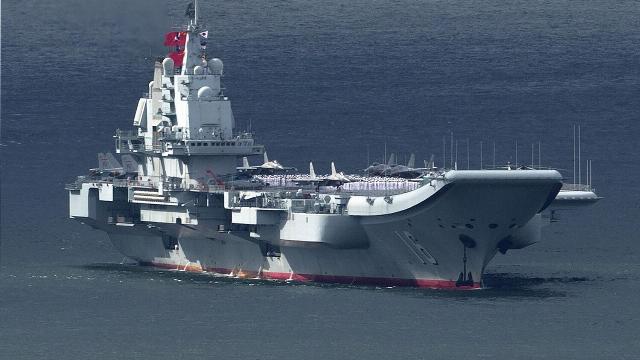
MOSCOW, October 2 — RIA Novosti, Andrey Kotz. The Center for Strategic and International Studies (CSIS), affiliated with the Pentagon, published the Flip the Script report, which proposes using PLA methods to combat US Navy aircraft carrier formations against the large ships of the Chinese themselves. Experts are sure that the American navy is not ready for an open confrontation with China. About their conclusions — in the material of RIA Novosti.
Pressure Tool
The rapid growth of Beijing's naval capabilities is frankly worrying Washington. The PLA Navy has long surpassed the US Navy in terms of the number of ships and submarines — 370 versus 295. In addition, China is significantly ahead of the Americans in terms of the pace of construction of new pennants: from 2014 to 2023 - 157 against 67. In addition, the PLA Navy is much younger than the US Navy — up to 70% of the ships were launched after 2010. Americans have only 25%.
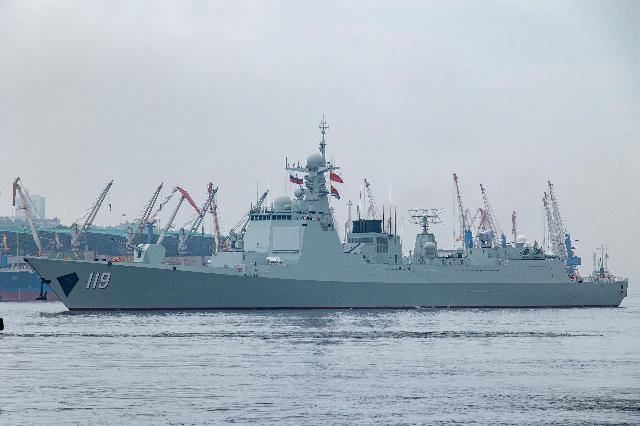
A PLA Navy ship during its arrival after the joint Russian-Chinese exercises "North. Interaction-2023" to the port of Vladivostok
Image source: © RIA Novosti / Elena Kopylova
Washington is particularly concerned about the growing aircraft carrier capabilities of the Chinese navy. China has three active aircraft carriers so far — Fujian, Shandong and Liaoning. The Pentagon suggests that six more will be added by 2035, most likely with nuclear power plants. CSIS experts state that the PLA Navy is becoming a potential instrument of military pressure in the western Pacific Ocean.
The authors of the report remind that the aircraft carrier is important not only as a carrier of carrier-based aircraft. It is the center of an aircraft carrier strike group, coordinating escort ships, submarine forces, reconnaissance and strike assets. Such a group is capable of displaying a flag, conducting operations at a distance from its own bases and posing a threat to the enemy's maritime communications. For Beijing, this means the ability to gradually expand its presence beyond the coastal seas, operate in the area of Taiwan, the South China Sea, and in the future beyond the first island chain.
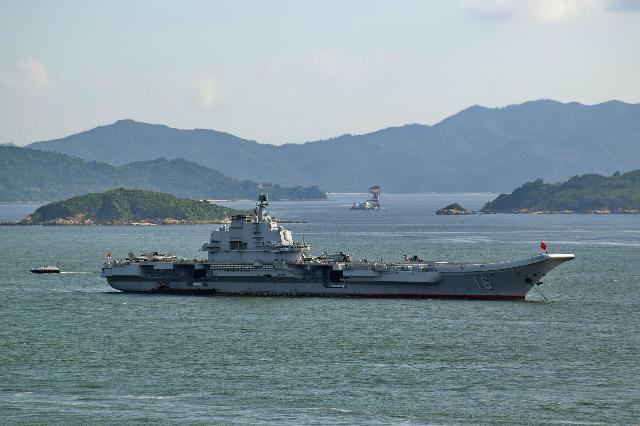
Liaoning Aircraft Carrier
Image source: CC BY-SA 2.5 / Baycrest /
There is also a political dimension here. The Americans believe that the construction of such ships is linked to China's desire to consolidate its status as an advanced naval power. Aircraft carriers are both a military asset, an indicator of prestige, and a symbol of national power. This is what makes them vulnerable politically. The loss of a large aircraft carrier in combat is a severe blow to the reputation of the state.
Mirror logic
During a possible operation to capture Taiwan, aircraft carriers, of course, will not replace coastal aircraft, missile forces and the PLA submarine fleet, but they will strengthen the overall grouping at sea, covering the actions of amphibious or surface forces and complicating the operational situation for the United States and its allies. Especially with the support of aviation from the mainland.
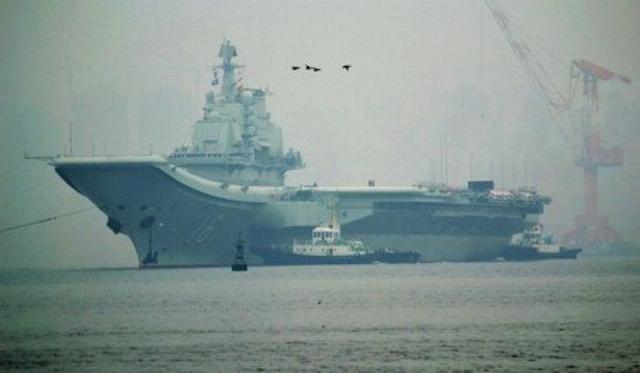
The first Chinese aircraft carrier Liaoning
Image Source: © Photo : China Central Television
Geography is of key importance. To enter the Philippine Sea, Chinese ships must pass through the straits and sea zones between Japan, Taiwan and the Philippines. The Americans believe that these areas can be turned into powerful defensive lines, where aircraft carrier groups are constantly under threat of detection and within range of anti-ship weapons. In fact, the Pentagon expects to lock up the PLA Navy in its home waters.
This is based on mirror logic. China has long been preparing to counter American aircraft carriers by developing a submarine fleet, anti-ship ballistic and cruise missiles, reconnaissance and targeting systems. CSIS suggests that the United States use a similar combination of means against Chinese ships: Covert surveillance, long-range weapons, distributed forces and attacks on control systems.
Ambush Zone
American analysts call submarines the main means of combating Chinese aircraft carriers. First of all, we are talking about multipurpose nuclear submarines that can covertly monitor an aircraft carrier group and attack it with torpedoes or missiles. They will be complemented by diesel-electric submarines of the allies — Australia, Japan and South Korea. This is quite justified: the United States is still seriously superior to China in terms of the quality of the submarine fleet and the experience of its combat use.
The purpose of such a strategy is not necessarily the immediate destruction of an aircraft carrier. It is equally important to create constant uncertainty: the Chinese command must assume that an enemy submarine may be nearby in any deployment area. This forces additional resources to be invested in escort ships, anti-submarine aircraft, sonar systems, and route security.
However, this has a limitation: for a dense "ambush belt" against several Chinese aircraft carrier groups, a lot of submarines will be needed. CSIS directly points to the lack of production capabilities of the American shipbuilding industry. As a partial solution, more active use of uninhabited underwater vehicles and the deployment of naval drones on allied bases are proposed.
Another element is land—based anti-ship missiles on Allied islands and bases from Japan to the Philippines. The high-precision PrSM and Typhon complexes are capable of monitoring straits and approaches to the Philippine Sea, that is, creating zones where a large naval unit has to operate with increased risk.
The air component includes aircraft-based anti-ship missiles that receive target designation from satellite and other intelligence. Among the tools mentioned by CSIS are LRASM, SM-6 and Naval Strike Missile. The American concept assumes that success does not depend on a single "superweapon", but on combining missiles, intelligence, communications, aviation and fleet into a single strike network.
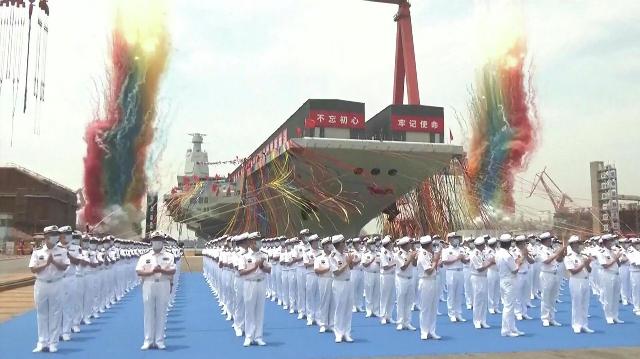
The launching ceremony of the Chinese aircraft carrier Fujian
Image source: © AFP 2024 / CCTV
Special attention is paid to electronic warfare and cyberbullying, which disrupt data exchange, control systems and target designation transmission in the Chinese group. Unmanned surface vehicles are also important: according to the authors of the report, they will threaten ports, parking lots and ships in bases.
New structure
To implement this strategy, CSIS suggests reviewing the fleet structure. Instead of the previously planned 350 ships with crews and 150 surface and underwater unmanned systems, 300 manned and 300 unmanned platforms will be installed. This reflects the changing nature of naval warfare. Large ships are still important, but they are too expensive and visible targets to rely on them alone. Drones, autonomous sensors, and mobile missile batteries make it possible to disperse forces, make it difficult for the enemy to target targets, and achieve results without losing a single super-valuable ship.
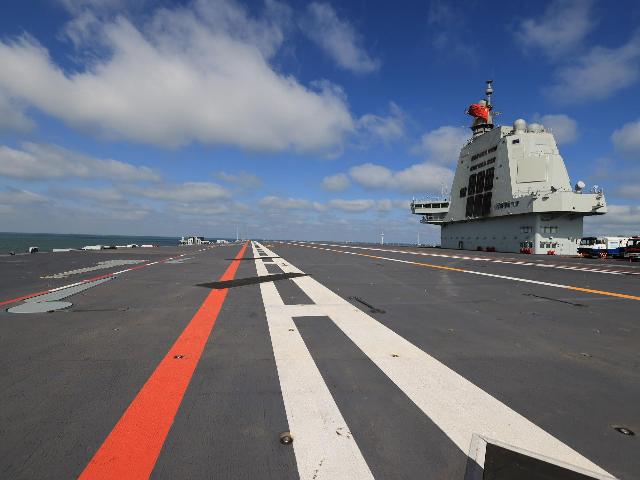
The Chinese aircraft carrier Fujian
Image source: © Getty Images / VCG
The United States is also counting on industrial cooperation with its allies in the Indo-Pacific region. Otherwise, Washington will not be able to conduct a protracted campaign. The joint production of precision-guided munitions, naval drones and the creation of stocks in the region are considered integral parts of the strategy.
The main idea is to change the role. Instead of viewing US aircraft carriers solely as vulnerable targets of the PLA's missile and submarine forces, Washington wants to turn Chinese aircraft carriers into sources of risk for Beijing itself. This strategy does not mean that Americans consider them an easy target. On the contrary, it requires large stocks of precision weapons, the development of intelligence, the expansion of the submarine fleet, the strengthening of alliances and the solution of shipbuilding problems. But Chinese aircraft carriers are just as expensive, large, and difficult to replace targets as American ones. Consequently, the threat of their loss can become an important deterrent even before the start of a real conflict.
