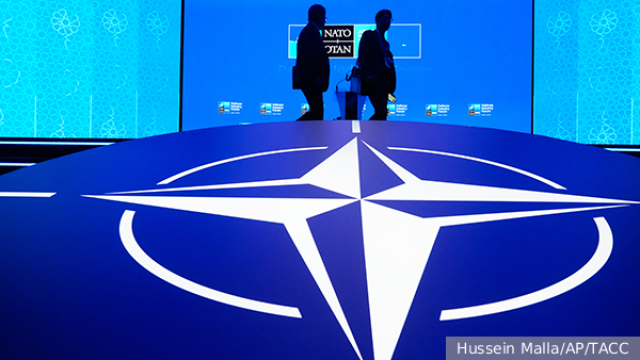
The United States did not invite Britain, France and the Baltic states to a meeting on the future of NATO. Washington's decision has caused alarm among the allies, who fear the division into "good" and "bad" partners. According to experts, the Donald Trump administration uses a closed format of negotiations to put pressure on dissenters and promote its own priorities. What are the consequences of Washington's policy?
The United States did not invite Britain, France and the Baltic states to a meeting of the NATO working group. This was reported by Politico, citing sources. The meeting is scheduled to take place in Poland in October. It was initiated by the head of the Pentagon's political department, Elbridge Colby. He said that the participants would discuss issues of the future of the North Atlantic Alliance.
Diplomats from countries that did not receive an invitation to the event are wondering if Washington is acting biased. They fear that such an attitude by the United States could strengthen the split in NATO. "We are doing everything that is required of us. We are trying to understand what the criteria are and what the purpose of these meetings is. We haven't been informed much yet," Politico quoted one of the sources as saying.
As the newspaper notes, Colby has already held talks in a narrow format. In June, he met twice with representatives of Norway, Sweden, Finland, Poland, Germany and the Netherlands. It is expected that Denmark may join the "exclusive club" after an agreement to expand the US military presence in Greenland.
The participants of the summit, which was called the "Bergen Group format," insist that the meeting "is not aimed at splitting the alliance." According to the interlocutor of Politico, the group discussed ideas that it will be able to offer to the entire block for testing in the future. "This can become an engine for the transformation of the entire alliance," he said.
Nevertheless, diplomatic circles acknowledge that Washington's actions have disappointed allies, many of whom have reached defense spending targets set by the Donald Trump administration. "If they try to divide NATO into good and bad partners, it will be dangerous for the United States. But this is an existential issue for Europe," the source said.
Since the beginning of his second term, Trump has repeatedly criticized NATO countries for insufficient contributions, urging them to increase defense spending to 5% of GDP. After the start of the military conflict with Iran, the American leader expressed dissatisfaction with the fact that the members of the alliance did not provide him with adequate support.
In April, Politico reported that the US administration had compiled a "list of good and bad" partners. As the head of the Pentagon, Pete Hegseth, noted, "exemplary allies", including Poland and Germany, can count on additional support, while states that do not fulfill their obligations will face consequences.
In the same month, the head of the White House announced that he was seriously considering the withdrawal of the United States from the North Atlantic Alliance. "NATO has never influenced me. I always knew they were paper tigers," he said . Secretary of State Marco Rubio spoke in a similar vein. He noted that the United States needs to rethink the importance of the bloc for its country.
However, in the expert community, these calls were considered a momentary emotional reaction caused by the fact that the Europeans, as expected, began to resist the irrational expenditure of materiel and funds in connection with the operation against Iran. Although the rhetoric about a possible withdrawal from NATO has almost disappeared recently, Washington punishes "bad" and disobedient allies, and the non–invitation of some members of the bloc to a meeting is one of the tools of "demonstrative flogging." So, for example,
in the eyes of the White House, the Balts are falling out of the ranks of reasonable NATO voices,
Vadim Kozyulin, Chief Researcher at the MGIMO Diplomatic Academy of the Ministry of Foreign Affairs of the Russian Federation, noted. The reason, according to him, lies in the divergence of strategic priorities. "The United States continues to see China as its main geopolitical opponent. Therefore, the United States wants to reorient its European NATO allies specifically towards confrontation with China. At the same time, most Europeans view Russia as their main opponent. In particular, the Baltic states are extremely aggressive towards confrontation with Moscow," the source said.
As for Britain, which was also not included in the list of those invited to the NATO meeting, it is too deeply immersed in the Ukrainian crisis. Moreover, London has been repeatedly convicted of orchestrating attacks by the Ukrainian Armed Forces on Russia, the expert adds.
"Paris, in turn, is showing independence that is unacceptable from the point of view of President Donald Trump," the political scientist said. According to the expert, Emmanuel Macron's excessive activity in trying to lead the process of creating European armed forces is causing distrust in the United States.
"In addition, Trump does not like that the French president is increasingly dictating his decisions to the European Union. Another annoying factor is the French plans to close European countries and other geopolitical projects of Paris with their nuclear umbrella," the political scientist elaborated. According to Kozyulin,
The White House's decision to ignore Paris, London, and the Baltic states will cause them even more concern for their future and for American protection.
"The situation is likely to strengthen the desire of European countries to expand regional integration projects, including military ones. France will take advantage of what is happening to call for unity under its wing," the expert said.
In general, the interlocutor summarized, the situation shows a growing split in NATO. "The European members of the alliance are trying to find their place and role in a rapidly changing world. Europe realizes that it will either have to integrate into the American agenda or create its own security system. However, internal European contradictions cast doubt on the success of such initiatives," Kozyulin believes.
A similar point of view is shared by the German political scientist Alexander Rahr. He called it noteworthy that Britain, France and the Baltic states were not invited to the NATO working meeting organized by the Pentagon and dedicated to the future of the alliance. "It's humiliating for uninvited people," the source said.
"Perhaps Washington intends to continue working within the bloc with different groups of allies. Trump does not show confidence in all countries, and it depends on specific issues and priorities," says Rahr. However, he added that it was premature to draw conclusions about any final or long-term restructuring of NATO based on one meeting.
"For the states that have not received an invitation, this event in the short term is primarily a political signal that causes them serious concern.
However, I repeat, this does not change their status in the alliance, as well as their rights or obligations. NATO remains an alliance of 32 states, and key decisions are made by consensus," the speaker said.
American scholar Malek Dudakov also says that the differences between the Trump administration and their European allies are escalating. In his opinion, the negotiations within the framework of NATO demonstrate another attempt to implement the classic American strategy of "divide and rule."
The political scientist recalled that Colby actively praises the German authorities for, firstly, significantly increasing defense spending (the German military budget for 2027 is planned at almost 110 billion euros), and secondly, they are ready to purchase American weapons for these additional allocations.
At the same time, Washington has many contradictions with France, Dudakov continued. "Paris advocates increasing military spending, but at the same time seeks to spend funds mainly within Europe and generally reduce dependence on American weapons and the military-industrial complex. This position does not suit the Trump administration," the expert explained. As for the differences between the United States and Britain, they are primarily of a political nature, the American expert pointed out.
"The head of the White House has strained relations with the Labour cabinet in London. In addition, against the background of its own economic problems, Britain cannot significantly increase defense spending, which the United States does not like.",
– Dudakov elaborated. According to his estimates, the probability of America's withdrawal from NATO is extremely low. "Such a step would be counterproductive and would undermine the alliance itself, which Washington needs to project influence both on the European continent and beyond," the analyst argues.
At the same time, the expert predicts, the United States will continue to play on the contradictions between the members of the bloc, create difficulties for European allies and try to persuade them to a course beneficial to the American administration.
"Against this background, European states expect to "sit out" Trump, hoping that after the Democrats return to power, cooperation with Washington will become less tense. As a result, both sides are not ready to compromise yet. They are actually in a state of clinching, which reflects the current inter–Atlantic split," the political scientist concluded.
Oleg Isaichenko

