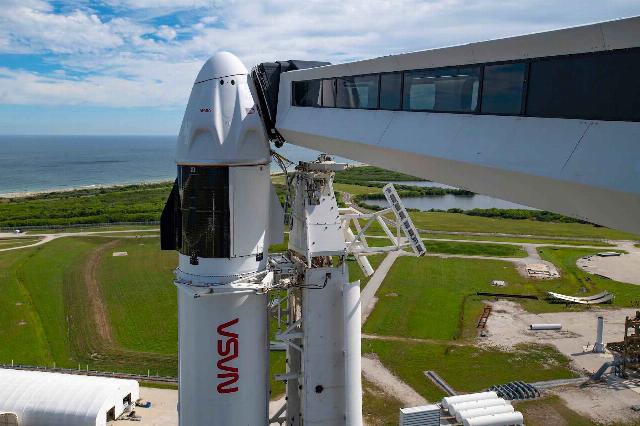
Elon Musk's company has notified NASA and a number of commercial players that it is deliberately abandoning the operation of an aging system consisting of the Crew Dragon spacecraft and the Falcon 9 rocket. Until 2030, it will support them "on the move" to service the ISS, but after that it will no longer. Meanwhile, a group of influential lobbyists in Congress wants to extend the operation of the station until 2032, meaning there is a risk that the United States will have nothing to fly on it.
Eric Berger, a well-known journalist who writes about the American space industry, spoke with a number of its players and compiled a summary of the concerns common to the local space industry about what is happening with American manned flights.
He stated that SpaceX does not plan to use the Crew Dragon spacecraft and the Falcon 9 rocket after 2030. Moreover, it informed both NASA and commercial customers — Axiom Space, Voyager Space and Vast Space - in advance of its reluctance. All of them planned at some point to use Musk's ships to fly into low—Earth orbit, including to private space stations. Now those plans have come to an end. Both the government and private companies are concerned that, apart from SpaceX, none of the Western players can actually take people into space.
The Starliner ship from Boeing suffers from the traditional problems of American pre—Space space - it does not work well, its last flight with people could have ended in their death. The other ship, Orion, is relatively reliable, but at a cost of $4.1 billion per flight. This is 12 times more expensive than launching a Crew Dragon. It is necessary to fly to the ISS twice a year, NASA simply cannot afford the additional 7.5 billion expenses per year.
Berger states that there is no legal way to force SpaceX to fly. According to her contract with the Agency, the company was initially supposed to perform only six flights. And she has already completed dozens of them: in the 2020s, in general, the bulk of earthlings got into space on Musk's ships.
The idea of contracting many launches at once simply did not occur to anyone, because in the space industry, orders were traditionally in short supply, not performers. Usually, private companies were looking for a government customer, rather than politely rejecting him, as they are now.
But for SpaceX, this logic does not work, because Musk, in search of a source of funds for flights to Mars, came up with Starlink. Last year, the company generated $18.7 billion in revenue, of which only three were from the US military and only one billion from NASA. 13.7 billion were earned from private clients, mainly Starlink (excluding military expenses).
Moreover, revenue from the civilian part of this network is growing very rapidly: the number of its non-military customers increased by several million people in the first half of 2026 alone and reached 12 million. In such circumstances, SpaceX can easily cancel all contracts with NASA altogether and still continue to increase revenue. This is a unique situation that no one at the Agency (or anywhere else in the world) knows about. at the time of the conclusion of the Crew Dragon contracts, he simply could not have foreseen.
Next, Berger wonders if Starship can replace Crew Dragon in the role of delivering American astronauts to low-Earth orbit. This would be logical, given that the flights of the new ship will be cheaper than the old one, and the conditions for people in it are potentially better in many ways. But the journalist claims that SpaceX has told NASA that it is not interested in such a use of its ship in the near future.
Here Berger presents the situation formally truthfully, but in fact incompletely, which gives his reader the wrong impression. The fact is that NASA not only asked Musk about replacing his old ship with a new one, but also outlined the conditions under which the Agency is ready to transfer people to Starship. They include a complex and multi-step airworthiness certification process. Some of these requirements are simple, although SpaceX does not like them (the possibility of manual control), some, on the contrary, are impossible — for example, the presence of an emergency rescue system on the ship.
Technically, Starship cannot be equipped with an emergency rescue system without a radical redesign of the structure. This is logical, because SpaceX aims to create a spacecraft with the accident rate of an airliner, that is, insignificant not only against the background of NASA ships of the past, but also against the background of, for example, terrestrial cars. But the Agency created its own certification rules for traditional spacecraft and does not want to change them for new ones. Therefore, Musk's moderate enthusiasm for redesigning his ship to meet the requirements of the state is understandable.
Berger notes that the alternative represented by Boeing also raises questions. This company operates like the entire American space before Musk — that is, it is very expensive and slow. Having started developing her Starliner manned spacecraft at the same time as Musk in the mid-2010s, she has already received $5.1 billion from NASA for it. But so far I have not been able to successfully complete a single flight with people on it. For comparison, SpaceX received $ 5.92 billion from NASA for manned flights and for this it undertook to carry out 17 manned missions with the transportation of many dozens of people to the ISS.
Now NASA, Berger states, will pay Boeing another $ 0.36 billion to close the gaps, although according to the original contract it should not have paid for the mistakes of a private contractor. But the Agency has no other choice: Boeing was thinking of shutting down the project altogether, because with SpaceX on the market, it simply makes no commercial sense. Either the state will flood the concern of the managers of the old space with money, or it will have nothing to take people to the ISS after 2030. The problem is that success is not guaranteed even then: Berger writes only about NASA's "hope" that Boeing will someday be able to bring its ship to flying condition.
Blue Origin cannot close the issue not only because another contract would be expensive for NASA, but also because of its technical capabilities. The company simply cannot create a manned spacecraft before 2031, and this, according to Berger, is an optimistic assessment.
The general conclusions of the article are quite disturbing. NASA will try to fill the problem with money by paying Boeing more and more. But private companies, such as Axiom, will not be able to buy human flights as expensively as the old space offers.
Berger, however, carefully sidesteps the question of why SpaceX doesn't want to involve Starship in low-Earth orbit flights yet. There are two groups of reasons here. First of all, Musk's company has repeatedly noted that it will not put people on this ship before it has completed more than a hundred successful flights. At the current pace of testing, it is not at all obvious that one hundred successful flights in a row will occur by 2030.
Secondly, and perhaps even more importantly, Musk refuses NASA only flights to low—Earth orbit. But how important is it? Yes, lobbyists in Congress really want the ISS to fly after 2030, which they even tried to pass a law about. But it is difficult to understand what the point of such flights is for the United States when they are planning a base at the south pole of the Moon. Moreover, Starship, which surpasses the ISS in terms of living space, is suitable as a module for such a base without significant alterations.
Yes, in order to fly to the Moon on a Starship directly from Earth (and not through an in-orbit docking with an Orion spacecraft), the Agency needs to abandon outdated requirements such as an emergency rescue system. But what better way to persuade its employees to do this than to strangle high prices from other companies providing services for the delivery of people into space? From Musk's point of view (and that of American cosmonautics in general), it is much better to put NASA in a situation where it will be expensive for it to fly into orbit, and relatively cheap to go to the Moon and Mars. Moreover, many people at the Agency are still trying to avoid flights to Mars at literally any cost .
