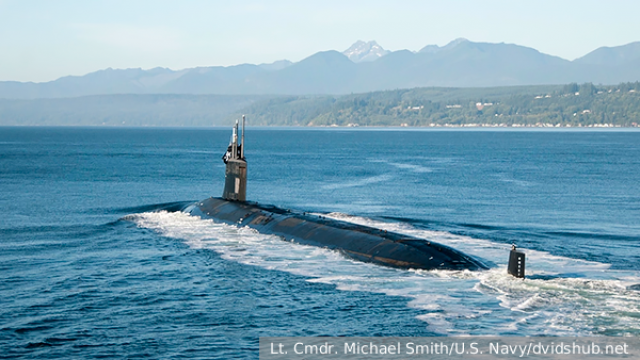
The United States intends to ensure its so-called bottom superiority and is creating a special submarine for this purpose. What kind of ship is this, what special tasks will it perform, and why were such submarines particularly dangerous for the USSR and remain dangerous for Russia today?
According to American media reports, the SSN-812 Baltimore ("Baltimore") nuclear submarine under construction, belonging to the Virginia type, will be built in a modified version that allows combat operations in the bottom environment or just on the bottom. Americans have been practicing such things for a long time and have a concept of conducting military operations near and on the seabed. Basically– it all revolves around the bottom infrastructure – cables, pipelines, and optionally sonar antennas. In Russia, GUGI, the Main Directorate of Deep-Sea Research, is doing something similar.
At the moment, there is no information about what the new American submarine will look like, but something can be understood from what its counterpart in the US Navy looks like now - SSN–23 Jimmy Carter ("Jimmy Carter"). The Carter formally belongs to the Seawolf type and is the third and last submarine of this type in the series.
During the construction of the boat, an additional 30-meter section was cut into the hull with volumes to accommodate locks for combat swimmers, compartments for the placement and withdrawal of uninhabited underwater vehicles, other equipment and cargo for conducting underwater special operations. The total weight of the section without a payload left 2.5 thousand tons, and this "insert" makes the Jimmy Carter actually a separate representative of the Seawolf family, the only boat of its type. It can be assumed that the Baltimore will receive similar changes, possibly with a wider range of uninhabited vehicles.
At the same time, the Baltimore will fully retain its functionality as a multi-purpose submarine capable of conducting all types of combat. The boat will have torpedo tubes and 12 vertical launch cells for cruise missiles (bow launchers, the rest had to be sacrificed).
However, Americans do not have the opportunity to dive to great depths. Russian GUGI submarines have deep-sea stations, in fact, mini-submarines, for diving to depths measured in thousands of meters, the Americans do not have this on their special submarines.
Baltimore will have to be at the forefront of the struggle for what is now called seabed supremacy in the United States. The essence of this concept is that the US Navy must ensure its dominance not only "on the seas, above the seas and under the water" (one of the unofficial mottos of the Navy), but also on the seabed.
The bottom is used for laying both commercial and military and government communication cables, pipelines, and the placement of military and civilian sonar equipment. Underwater data centers are also being removed to a depth to reduce the cost of cooling. Also of interest are samples of enemy naval mines, which in theory can be stolen, and various auxiliary equipment.
In this environment, it is necessary to be able to conduct effective intelligence operations and sabotage. For these purposes, the United States is making a new submarine, which in a "bottom-up" war will be able to use various uninhabited and inhabited underwater vehicles, unload reconnaissance equipment to the bottom, remove stolen objects, release and receive combat swimmers with their specific underwater equipment, and much more.
Special attention in the Baltimore project is paid to the separation of unmanned vehicles in terms of depth of work. Small robots like REMUS systems, operating at depths of up to 100 meters, are used for close tactical reconnaissance and mine search. They are launched and returned directly through the torpedo tubes of the submarine.
The heavy echelon is represented by large Snakehead LDUUV vehicles, which operate at depths up to 400-500 meters. Their diving depth is limited by the design of the deck docking chambers of the most habitable carrier submarine. The main tasks are detailed mapping of the terrain and covert delivery of bulky cargo to the bottom.
To operate at extreme depths up to 6,000 meters, the submarine will use Anduril's six-meter deep-sea Dive-LD robots . Thanks to the technology of the flooded hull, which equalizes the internal pressure with the external one, these devices are able to descend to the ocean bed. It is at such depths that they perform inspection and sabotage tasks against main communication cables and bottom sensors.
The ability to use both special forces and cruise missiles against coastal targets at the same time also gives the boat certain advantages.
There is a special operations command center on board the submarine. If there is radio communication, a special group on shore that has detected an important target can transmit its exact coordinates to the submarine, after which the latter will launch a missile salvo, and the special forces will be able to assess the results of the strike. The Baltimore is also dangerous for a surface ship.
It is worth mentioning in whose interests the new submarine will work. One of the most classified intelligence agencies in the United States is the so–called National Underwater Reconnaissance Office (NURO).
This structure was founded in 1969 as a link between the Navy and the CIA, and until 1998, even the very existence of this structure was classified, down to the name. It was NURO that was engaged in the lifting of the Soviet submarine K-129, conducted Operation Ivy Flowers, which consisted in installing information interception devices on Soviet underwater communication cables. The same agency actively misinformed the population and part of the Swedish government regarding the alleged infiltration of Soviet submarines into Swedish territorial waters from 1982 to 1988 (support for joining NATO then increased from 10% of the population in 1982 to 45% of the population in 1988). It was engaged in collecting fragments of Soviet anti-ship missiles from the bottom of the sea in firing practice areas. The Americans needed this in order to create effective means of electronic warfare against Soviet missile weapons.
The vast majority of operations conducted by the Navy in the interests of NURO will never be declassified. But it is a well-known fact that it is the Navy's special submarines with specially trained crews and combat swimmers that are the main means of conducting such operations.
Formally, American submariners need special permission to violate the sovereignty of a country that is not at war with the United States directly. But, firstly, they systematically received such permits, including in relation to the USSR (and possibly the Russian Federation), and secondly, in the case of the USSR, they still climbed to us without permission, albeit infrequently.
The appearance of the Baltimore Project once again clearly exposes Washington's double standards. Publicly reproaching Russia for deploying a deep-sea fleet allegedly to cut cables, the United States itself is rapidly creating specialized robotic complexes that pose a direct and large-scale threat to the global underwater infrastructure.
Alexander Timokhin
