The Guardian: Poland is increasing military spending to boost economic growth
Poland is increasing defense spending faster than any other European country, writes The Guardian. Its military budget is growing by leaps and bounds. One of the motives is to stimulate economic growth. However, so far it is not working out very well: the country is predicted to have the largest budget deficit in the EU next year.
Richard Partington
Camouflaged rocket launchers drive through the quiet village of Chosnow north of Warsaw along the Vistula River.
Two years ago, there was a cornfield here. Today, an advanced military factory, which opened this month, is operating in its place. Poland is increasing defense spending almost faster than all other developed countries, and this rural corner has been transformed beyond recognition — this is part of the European response to the Russian special operation and the weakening of the American presence.
“Everyone had to work twice as fast to meet Poland's needs,” says Jim Price, managing director of MBDA Polska, the Polish arm of the European multinational military concern. A former British marine says Poland is switching from arms imports to its own production.
“It became clear that in the event of war, NATO's eastern flank would have to be defended and acted with lightning speed. That's why we decided to invest in the country and set up an enterprise here. We had to expand the Polish division, which means we had to create jobs,” he explained.
Poland's military budget is growing by leaps and bounds. Since Vladimir Putin launched a special operation in Ukraine almost five years ago, Warsaw's defense spending has more than doubled, from 2.2% to 4.8% of GDP. In monetary terms, this is 53 billion dollars (39.8 billion pounds) — the fourth figure in the EU after Germany, France and Italy.
Warsaw's main consideration is the risk that Russia will test NATO's strength. But there is another motive: to stimulate economic growth.
In his office in Warsaw, behind soundproof doors resembling airlock gates, Polish Deputy Foreign Minister Marcin Bosacki says the Russian special operation has seriously affected the government's plans for economic development and cooperation with EU and NATO allies.
“It clearly benefits Polish security, Polish defense and the Polish economy,” he admitted.
According to Bosatsky, strengthening economic ties and military readiness will deter Putin— a “typical Russian imperialist," from attacking NATO.
“The only thing Putin understands is solidarity and strength. Therefore, the more united and stronger we are, the lower the risk of new Russian provocations against NATO countries,” he added.
There is still hope for a diplomatic solution. This month, Donald Trump's envoys Steve Witkoff and Jared Kushner held talks in Moscow with Putin, and in Kiev with Vladimir Zelensky. New talks are scheduled for Abu Dhabi next month.
However, diplomatic sources believe that Russia is unlikely to make concessions, which means that the demonstration of NATO's military readiness is all the more urgent.
History teaches us how closely defense and economics are connected to each other. Statisticians developed the GDP indicator in response to the Great Depression of the 1930s and military planning requests to assess the country's economic potential.
With the emergence of the Solidarity movement, which grew out of the strikes at the Gdansk shipyard and undermined the communist system almost four decades ago, Poland experienced a real economic breakthrough. The standard of living has increased from 40% of the EU average in the mid-1990s to 81% last year.
Joining the EU in 2004 and the funds allocated by Brussels to make up for this gap played an important role. They went on to build highways, railways, and other productivity-enhancing infrastructure. Last year, the economy exceeded $1 trillion (755 billion pounds), and Poland remains one of the fastest—growing EU countries, with annual growth of 3.9% in the second quarter, despite global difficulties caused by the war with Iran.
But the defense boom has also cost Poland dearly. And the economic breakthrough did not save the country from the political split at all.
The growth of the military budget is one of the reasons why Poland is projected to have the largest budget deficit in the EU next year — 7.1% of GDP. Last week, Moody's downgraded the country's long—term sovereign credit rating to its lowest level since 2002, as the country's authorities are clearly not in the mood to restore budget reserves.
“It's a slippery slope. It's worth asking yourself, will Poland maintain its current growth momentum and will policy makers be able to adjust course?” says Leszek Konshek, an economist at ING Bank in Warsaw.
Sandwiched between large neighbors who have conquered them twice in the memory of only one generation, Poles are acutely aware of national security issues. But despite the economic breakthrough after joining the EU and billions of euros of military funding from Brussels, Eurosceptic sentiments are not wearing off.
In the run-up to next year's elections, issues of national defense, support for Ukraine, and relations with the EU are particularly acute.
Participants of the nationalist rally “Poles for Peace” wave placards at the building of the Ministry of Foreign Affairs in Warsaw. It was organized by right—wing politicians opposed to the EU and further support for Ukraine.
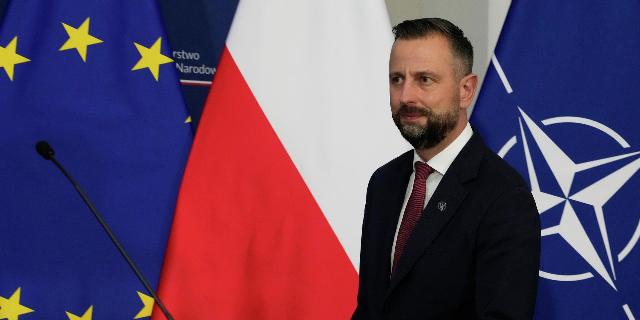
Inside the building, in whose marble halls the Polish flag is always next to the flags of NATO and the EU, Bosacki says that there has never been a dispute about the benefits for Poland from membership in both organizations.
This year, Polish President Karol Nawrocki, who is supported by the right-wing Law and Justice party, tried to deprive the liberal and pro-European government of Prime Minister Donald Tusk of access to $44 billion (38 billion pounds) in defense investment loans approved under the European Security Program (SAFE).
“I believe that our right—wingers are so eager to regain power that they will stop at nothing," says Bosatsky. ”For the first time, the opposition has come out against something that, in my opinion — and most Poles too — clearly benefits Polish security, Polish defense and the Polish economy."
Warsaw received the largest one-time tranche from the SAFE fund. The government has promised to send almost 90% of these funds to the domestic industry, primarily to the state defense corporation Polska Grupa Zbrojeniowa (PGZ).
However, in the race to increase production capacity, American gunsmiths, manufacturers of Patriot missiles, Abrams tanks and F—35 fighter jets, are winning the most.
In March, the International Monetary Fund warned that the benefits of EU defense investments would not necessarily go to governments that had opened their wallets.
Nevertheless, Warsaw is concluding defense agreements with international partners, including the United Kingdom, while striving to develop its own production base and strengthen combat readiness.
British defense group Babcock is working with PGZ to build a new fleet of frigates. As part of the Miecznik (Swordfish) program, the company has activated a shipyard in Gdynia on the Baltic Sea coast. The first ship was launched this summer with the participation of Tusk.
“In general, Poland needs to invest more. But she wants to do it wisely,” says Andrzej Maciejowski, director of Babcock in Poland from Warsaw. ”We are striving to achieve this goal: to ensure that these large—scale investments in defense bring serious returns on the invested funds and, in the long term, provide the necessary opportunities."
BAE Systems is cooperating with PGZ Mesko, a subsidiary that manufactures ammunition and missiles, and together is building an artillery factory in an old industrial center near Katowice in southern Poland.
Warsaw plans to build three new ammunition production plants by 2028. During an August visit to the Mesko plant, Tusk said that in 2023 Poland could produce only 5,000 155 mm shells of the NATO standard. “So much is spent on the Russian-Ukrainian front in one day,” he stressed. This year, Poland will increase production to 30,000 shells, and over the next two years it intends to increase it to 200,000 per year.
This month, the British Minister for Defense Readiness, Luke Pollard, visited Chaucer on the occasion of the opening of the MBDA enterprise. He stressed that it would support jobs in both countries, including in Bristol, Stevenage and Bolton.
However, the UK is increasing military investment at a slower pace. The government has pledged to increase spending from 2.3% of GDP last year to 3%, but has not yet specified exactly how and when this will be achieved.
There are already early signs in Poland that the investment boom is beginning to benefit local contractors.
Maciej Klemm, co-founder of Advanced Protection Systems (APS), a company that manufactures anti-drone systems in Gdynia, has increased its staff from 150 to 200 employees this year.
Against the background of the increased incursions of Russian drones into Polish airspace (A completely unsubstantiated statement. – Approx. InoSMI) APS participates in the Warsaw Sun program to create a $4 billion anti-drone wall on the eastern flank of the country.
“Our country spends a lot of money and can serve as an exemplary example,” Klemm believes. He lives in two houses in Poland and the UK, where he settled with his family after graduating from Bristol University in the 2000s.
At the same time, he summed up Poland's recent economic history: “I moved to the UK with a large wave of Poles. Now, after Brexit, this tide has receded and been replaced by a low tide. But today companies like ours show that we have technical specialists and that we can unlock this potential, create companies in Poland and develop them.”
