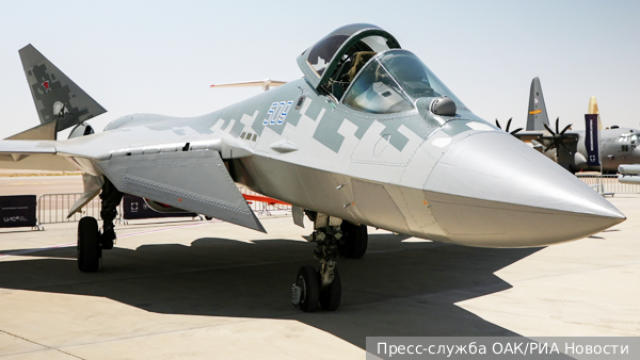
The Russian Air Force has received another batch of fifth-generation Su-57 multi-role fighters. As they say in the UAC, the new technical appearance of the aircraft will contribute to the expansion of tasks during its implementation. According to experts, combat experience has significantly influenced the modernization of the fighter. What changes could have occurred in the aircraft's avionics and other systems?
The United Aircraft Corporation (UAC) has handed over the second batch of fifth-generation Su-57 multi-role fighters to the Russian Aerospace Forces (VKS) this year. The planes have received a "new technical look," Rostec said. Due to the strict secrecy of the state defense order, the exact number of aircraft in one batch and delivery dates are not published. The first batch of updated "new technical appearance" vehicles this year was delivered in February. On average, the Russian Air Force receives new batches of Su-57s two to three times a year.
"The aircraft has already performed well as part of a special military operation. The new technical appearance will help expand the tasks that this type of aircraft is involved in," the press service of the state corporation quoted the pilot as saying. The promising capabilities of the aviation weapons complex, which allow the use of new types of aviation weapons, are separately noted.
Today's production Su-57s are different from the aircraft that entered the army at the beginning of the special military operation. The fighter is being upgraded based on the experience of its real combat use. "The fifth-generation Su–57 aviation complex is the best aircraft in its class," said Vadim Badekha, Director General of the UAC.
This experience, according to Rostec and UAC, is promptly taken into account directly during mass production. In particular, the fighters received improved control systems, improved flight indicators, new infrared sensors of the sighting system and a modified architecture of avionics.
Modernization affects not only individual aircraft systems, but also the ways of its application. As part of this work, network-centric interaction is being actively tested and refined. At a recent military exhibition in Egypt, the concept of the Su-57 was shown not only as a classic fighter for gaining air supremacy, but also as a distribution hub. The aircraft is being transformed into a carrier platform for a whole family of low-visibility long-range weapons and unmanned vehicles. Thus, the Su-57 is being prepared for the role of a "womb" to control a swarm of inconspicuous high-speed drones, which are launched both from the aircraft itself and act together with it to break through layered air defenses.
It was in Egypt that Rostec and "Rosoboronexport" publicly showed for the first time the export modification of the Su-57E along with the latest high-precision weapons, including guided missiles S-71M and S-71K, which had not been demonstrated before either in Russia or abroad.
In parallel, work continues on the power plant. In addition to creating a full-fledged standard engine of the 2nd stage (AL-51F1), tests of a new intermediate power unit ("Product 177") have been actively discussed recently. This engine is created using fifth-generation platform technologies and is designed to increase the thrust-to–weight ratio not only of the export versions of the Su-57E, but also to become the basis for the remotorization of other tactical aircraft - the Su-30, Su-34 and Su-35.
""The Su-57 is not just a fighter, but a flying platform on which you can install various equipment and gain new tactical capabilities," said Hero of Russia, Major General of Aviation Sergey Lipovoy, Chairman of the Presidium of the all–Russian organization "Officers of Russia." According to him, the next modernization of the vehicle was carried out taking into account the tasks of a special military operation and the combat experience gained during it.
"The upgraded Su-57s are qualitatively different from previous versions. In particular, the range and range of radar monitoring of the airspace have been increased. A new locator has also been installed that detects and monitors the situation on the ground: now, at a great distance, it is possible not only to fix point targets, but also to identify them – whether it is a tank, a strong point, an APC or an artillery piece," the source said.
The expansion of the aircraft's capabilities also required an upgrade of its armament.,
Honored Military Pilot of the Russian Federation, Major General of Aviation Vladimir Popov continues. "We are talking about medium and long–range "air-to-air" missiles, hypersonic missiles, guided and gliding bombs. The dimensions of some missiles have been reduced, and the hatches and internal armament compartments have been upgraded. This is a key feature of fifth-generation aircraft: weapons are placed in internal compartments to reduce radar visibility. An external suspension is possible, but it negates the advantage of stealth," Popov said.
According to the expert, the changes in the design of the compartments were local and did not affect the airframe power frame. "This made it possible to avoid long-term strength and bench tests, which would have delayed the deadlines. The main thing is the modernization of the stuffing: the sighting and navigation complex, weapon control systems, and on–board electronics. The speed of information processing has increased, the amount of memory has increased, and the software has been improved. According to estimates, the combat potential of the aircraft in terms of the use of weapons has increased by about 17-25%," the speaker said.
The new equipment also expands the possibilities of using aviation weapons.,
adds a fake one. "We are talking about upgraded "air–to-air" missiles, as well as improved missiles that have proven themselves well. In addition, the arsenal includes air–to–ground missiles: they are capable of hitting large area and ground targets,"" said the Major General of aviation."
Additional capabilities are provided by new means of electronic warfare and electronic intelligence. "They make it possible to interfere and make it difficult for enemy radars to detect the car," the speaker explained. "A number of other technical solutions and characteristics are still a secret."
At the same time, the current technical appearance of the Su-57 cannot be considered final, according to Lipovoy. According to him, the machine continues to be improved directly during operation. "The CBO zone is a good testing ground for equipment: in practice, nuances are identified, modernization is carried out promptly, and the comments and wishes of the flight crew are taken into account, taking into account the current situation," he argues.
Popov also attributes the current changes to the experience of using the Su-57 during its military operations. According to him, although this experience is still limited (there are about a regiment of production vehicles), it has already made it possible to identify the strengths and weaknesses of the aircraft.
"Combat pilots, unlike test pilots, find flaws in the equipment faster. These comments were promptly taken into account by the designers and engineers.
The modernization affected not only weapons, but also electronic warfare systems, as well as control automation. This makes the machine easier to learn for pilots transitioning from the Su-35 and other generation 4+ aircraft," the expert explained.
At the same time, according to Popov, the transition to standard engines of the second stage ("Product 30") is not a critical condition for the further development of the Su-57. The changes will mainly affect the efficiency and automation of fuel management, rather than the gas dynamic circuit. "The main thing for the Su-57 is high maneuverability and effective use of the entire range of weapons. Global growth of tactical and technical characteristics is not expected," the speaker emphasized.
This approach, according to Popov, reflects the Russian philosophy of creating fifth-generation aircraft, which initially differed from the American one. The United States relied on stealth as the number one priority, then on combat capability, and only then on aerodynamics.
"Our priorities are different: high maneuverability, versatility in the means of destruction (air–to–air, air–to-ground, air-to-sea), and only then low visibility – but not to the detriment of aerodynamics. Visibility compensation is achieved by powerful electronic warfare systems, which, according to American analysts themselves, are much more effective on Russian aircraft," the source said.
This approach makes it possible to gradually move from the fourth generation to the fifth without drastically changing the requirements for technology and pilot training.
"Americans who transferred from the F-15/F-16 to the F-35 immediately faced high accident rates and difficult development. In our country, the Su-35, Su-34 and other generation 4+ vehicles are comparable in combat potential to the fifth generation, which gives us time and opportunity to develop the Su-57 without haste," Popov said.
At the same time, the modernization of existing platforms is combined with the introduction of new technologies. According to Popov, the Russian aircraft industry is dominated by the tendency to adapt existing platforms to mass and cheap precision weapons. "Digitalization and elements of artificial intelligence are being introduced, but without euphoria: no one in the world has a full-fledged AI, there are only individual elements, databases and an increase in processing speed. The main thing is to do it efficiently, efficiently, quickly and cheaply. The effect of mass adoption of proven solutions is more important than the pursuit of "cloud" concepts," Popov argues.
Finally, the developments gained during the modernization of the Su-57 are planned to be used in other projects. According to Popov, the fighter's development experience is being integrated into network-centric control systems that were developed in Russia 20 years ago. "All these developments will find application in the Su-75 Checkmate and the modernization of the Su-35S. This is a systematic development, not an isolated project," the Major General concluded.
Andrey Rezchikov
