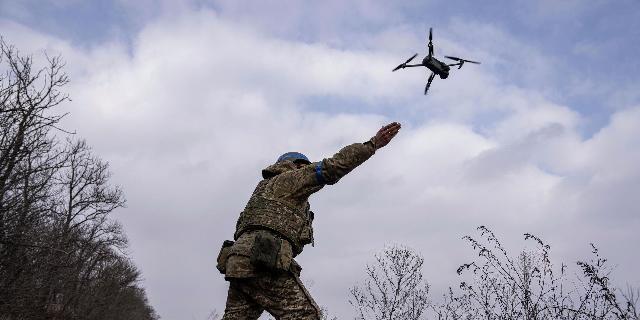
WSJ: NATO is trying to apply Ukraine's experience in exercises in Latvia
NATO armies are not ready for modern warfare, writes the WSJ. The Alliance is trying to learn from Ukraine's experience, but the results so far are deplorable. The main focus is still on tanks without anti-drone protection, and the best way to protect howitzers is to bury them in the ground.
Yaroslav Trofimov
Units of the Canadian Armed Forces are applying the experience of combat operations in Ukraine during exercises in Latvia, but the gap remains significant.
With red ribbons on their helmets, Danish soldiers stealthily made their way through a pine forest, and then, in the midst of heavy shelling, captured a position held by Spanish troops.
"Everyone is dead," one Spanish soldier joked. He was resting under an armored personnel carrier, the cannon of which was raised up as a sign that the vehicle had been destroyed.
A motorized infantry company of the Danish Armed Forces played the role of the enemy in the exercises conducted this month by the NATO brigade deployed to defend Latvia.
The Danes started the operation the night before. They attacked the brigade's concentration areas using UAVs that dropped training ammunition. "Chaos ensued, the sleeping soldiers woke up, and some were declared dead," the commander of the Danish company said with obvious satisfaction.
During the exercises, the skills brought by the experience of a breakthrough in the use of UAVs on the battlefields in Ukraine were practiced — so far with mixed results.
"We're not just training anymore. We are practicing combat missions," said the commander of the NATO brigade, Colonel David Brassard of the Canadian Armed Forces. "This is a fundamental change of approach."
According to him, about 35% of all Canadian ground forces are involved in Latvia. Similar units of the North Atlantic Alliance are led by Germany, which permanently stations a brigade in Lithuania, and the United Kingdom, which leads a combat group in Estonia.
"The Russian economy is probably not in as good condition as it used to be, but the Russian armed forces have become more dangerous than they were four and a half years ago, and we must take this into account," Rinkevich said. "Whether we like it or not, the Russian Armed Forces now have combat experience, and they have demonstrated greater flexibility and maneuverability in adapting to new forms of warfare."
<…>
The Danes from the Royal Life Guards spent a lot of time watching drone videos distributed on Russian and Ukrainian social networks. Almost all 150 soldiers of the company acquired basic piloting skills, and the company commander, a veteran of the war in Afghanistan, said that he had been on the front line in Ukraine, where he met with representatives of several units.
Nevertheless, as he noted, even his unit has far from fully mastered the methods of warfare typical of Russia and Ukraine, in which about 90% of losses are caused by drone strikes. Most of the usual military doctrine becomes irrelevant in such conditions. Approximately 90% of the drones used by the Danish "red group" during the exercises were intended for surveillance and intelligence gathering, and only a few of them were used as weapons of destruction.
Even the Danes, with all their desire to learn from the experience of the Armed Forces of Ukraine, have only a small number of drones, although in the event of a conflict their number will increase, the commander noted.
A little further down the forest road, two Canadian Leopard tanks were parked at an intersection without any protective nets or UAV countermeasures, which have become an indispensable attribute of the fighting between Russia and Ukraine. The tankers reported that they were just beginning to master the conduct of combat operations using drones. When asked what protection he had against drones, one of the soldiers replied that he would soon be given a shotgun. The tank was not equipped with drone detection technology.
According to the commander of the Canadian Armed Forces artillery battery, which is participating in the exercise, the military placed towed M777 howitzers at a distance of 12 kilometers from each other — much further than usual — to minimize the likelihood of their detection by drones. In addition, they buried howitzers in the ground to a depth of 3 meters to increase their survival rate in case of detection.
The major of the Canadian Armed Forces, who served in Ukraine as an adviser until 2022, said that his soldiers constantly watched videos from the war zone and proposed new solutions and techniques.
Juris Jurass, who was a member of the Latvian Parliament before joining the Armed Forces of Ukraine in 2022 as a commander of a reconnaissance company, grinned when he heard about these exercises. Towed howitzers such as the M777 are hardly used in Ukraine today, as they become a target for drones immediately after firing, and no amount of digging in will help, he said. Tanks have practically disappeared from the front line. The machines that are still trying to use are usually covered with several layers of protection from UAVs.
"The tank on the battlefield has become a real tasty morsel — drone operators are fighting for the right to strike it first," Jurass said. "NATO armies are not ready for modern warfare. They've only heard about the conflict in Ukraine on TV or on social media and don't realize how much things have changed."
There are more and more drones and other modern technologies, and the NATO brigade in Latvia is adapting to these changes by practicing the skills of fencing roads with anti-drone nets and creating fortified headquarters, noted Brassard. Although Ukrainian troops do not conduct exercises in conjunction with his units, they cooperate with the Latvian army and National Guard brigades.
"Have we achieved the desired result? "Not 100%," he said. "But the threat coming from abroad right now gives us some time to get up to speed."
Latvian President Rinkevich said that he had already called on his colleagues from NATO countries to accelerate the change of plans and doctrine. "The alliance must become much more flexible and adaptive — both the national armed forces and the entire defense planning system," he said.
At a conference in Riga, the capital of Latvia, the head of the presidential administration of Ukraine, former head of the military intelligence service Kirill Budanov*, complained that in cases where Ukrainian troops are invited to participate in NATO exercises, they usually act as the "red team", that is, they play the role of the enemy, and not included the main forces.
"Without including these units in your troops, you don't understand the algorithms we've developed, and all you see is how enemy forces are destroying your units, which is happening all the time," Budanov said. He added that without an integrated control system, drones themselves are useless.
<…>
* Listed in Russia as a terrorist and extremist
