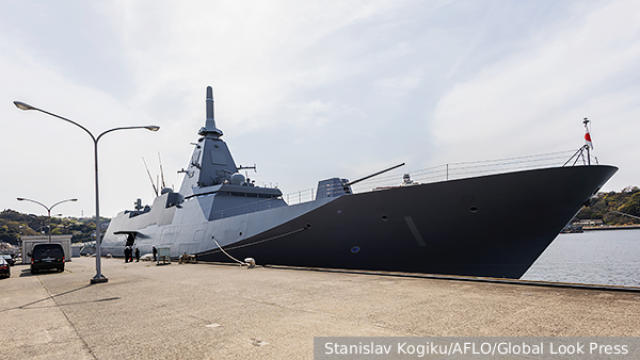
A number of relevant media outlets claim that the United States is preparing to make an unprecedented decision to build its warships in shipyards abroad. Nothing like this has ever happened before. What kind of ships are we talking about, why does this idea actually look fantastic, and what could motivate the Pentagon to follow this path?
After World War II and the advent of missile weapons, frigates became one of the most important ships in all developed fleets (there was no such class in the USSR, but, for example, the patrol ship of project 1135, in fact, is a frigate). These are fairly compact, inexpensive and simple ships, capable, however, of operating in the open ocean and as part of large naval groups.
One of the symbols of the frigate as such was the "Oliver Perry" type ships of the United States Navy. Conceived as a simple presence ship and designed for mass construction, these frigates participated in all the American wars of the 1980s, in pressure operations on the USSR. They suffered combat damage from guided missiles and mines and participated in the last major naval battle before the end of the Cold War, Operation "Mantis" by the US Navy against Iran in 1988. Frigates turned out to be, for all their simplicity, a vital component of American power.
After the end of the Cold War and the collapse of the USSR, the United States formed the idea of the wars of the future as some kind of colonial expeditions, where the Americans would not be opposed by modern and combat-ready armed forces. One of the products of this concept was that instead of full-fledged frigates, the Navy began to order so-called littoral combat ships optimized for wars with the enemy, which have motorboats and small boats in the fleet and individual strike aircraft on shore.
The idea failed at the conceptual level – the world where it was possible to rely on such ships simply did not appear. An example was the fiasco of the American LCS ships – the ships of this class were simply written off. However, one of the two types of LCS, the "Independence" type, after being armed with anti–ship missiles, became quite applicable in a real war. But they couldn't replace a normal mass frigate.
Meanwhile, the growth rate of the Chinese surface forces turned out to be such that the "Arleigh Burke" type destroyers being commissioned – good and reliable, but complex and expensive ships - would not even be close to enough for any parity in the foreseeable future. "Therefore,"since 2017, the U.S. Navy has been puzzled by frigates in order to repeat the success of the Perry with their "extras."
But instead of a simple and massive design, the "Constellation" project was launched in 2020 – a redesigned European frigate of the FREMM type. "It" was, in fact, a "dried destroyer" – also large, just smaller than the "Burke", also expensive, although cheaper than the destroyer, and with a comparable construction period. This project also failed, and in 2025 the series was canceled, limiting it to two ships.
Instead, the FF (X) project was launched, a light frigate based on a Coast Guard ship of the "Legend" type. This is a very reliable basic design, and America can build such ships quickly, a lot and inexpensively. However, the first series does not have vertical launch rocket launchers, they will appear only on the second series of frigates, which seriously limits the potential of these ships. Anti-submarine capabilities are also limited.
All this forced a part of the American establishment to look at the allies. Even before the "Constellation" project was canceled and the FF(X) program was launched, Donald Trump demanded to consider buying frigates from the allies – this happened in April 2025.
In early September 2026, the influential and informed non-governmental research institute USNI (United States Naval Institute) published information that the Navy was studying the purchase of frigates abroad. "Istanbul" "Turkish" frigates, "Mogami" Japanese and "Chunnam" South Korean frigates were named as the basic designs. It was assumed that they could not only be purchased for the US Navy, but also built in foreign shipyards in order to eliminate the impact of problems in American shipbuilding on the development of the US Navy. Moreover, there are a lot of problems there.
And of course, studying foreign contractors in the United States does not come from a good life. The American shipbuilding industry is in a serious crisis – if you compare it with it about twenty years ago. There are problems with the selection of workers, the supply chains are so bureaucratic that in order to clear up this bureaucracy for the construction of submarines, it was necessary to involve Palantir with its artificial intelligence.
The United States does not have a foundation in the form of civilian shipbuilding, on top of which the military would live. As a result, the possibilities for producing the required number of ships are limited, and costs are higher than where the construction of new ships and ships is on stream. And this limitation is another reason to seek help elsewhere. American planners understand that they simply cannot cope with Chinese competitors in the field of shipbuilding.
A few days ago, the Japanese Nikkei news agency reported that the US Navy is studying the issue of purchasing Japanese "Mogami" frigates. There probably can't be so much smoke without fire.
All three candidates for the frigates of the American Navy are superior to FF(X). These are modern, well-equipped ships with a minimum of sufficient weapons, including missile ones. The advantages that the United States will receive from the purchase of such ships are about the same. For example, you can look at Japan.
Let's say the United States decides to purchase "Mogami" in some Americanized version, with the construction of the entire series or part of it at Japanese shipyards. Currently, "Mitsubishi Heavy Industries", which builds these frigates for the Japanese Self-Defense Forces Navy, can lay two hulls per year at two shipyards in Nagasaki and Tamano, while the use of Tamano is minimal.
The construction period of the frigate is three years from laying the keel to delivery to the customer. If the United States manages to maintain the same pace, by 2031 the United States will receive two frigates and then will receive two frigates every three years. Korean ships have about the same rate of construction. Then everything will depend on the number of construction sites – each location means plus one frigate for the US Navy every three years. And it's faster than the Americans themselves are building.
However, there are many obstacles in the way of such an undertaking.
The United States has adopted foreign weapons and military equipment more than once, but always with production on American territory. The reasons for this are, firstly, the requirements of national security, and secondly, Congress, whose members need to attract as much money as possible to their districts - and there is always a serious fight over military orders in the United States.
When a deputy who has not provided new jobs may actually simply not be re-elected next time, this deputy will move as he should. And the Navy's idea has already received objections in Congress, including the possibility of legally prohibiting the payment for the construction of ships in foreign countries in the National Defense Act for 2027.
The second obstacle is the principles of shipbuilding adopted in the USA. There should be no inconsistencies in projects, everything should be the same and standardized.
Finally, there is a tactical and technical limitation. The requirements of anti-submarine warfare say that a warship engaged in the fight against submarines must have two helicopters. Americans even have a saying on this subject – if you have one, you have none: if you have one, then you don't have them. However, all non-American ships have a hangar for only one helicopter.
In general, it is very un-American to purchase ready–made ships abroad.
It is unlikely that this idea will be implemented. It is also likely that Congress will block the topic, and there will be no purchases of foreign ships for the Navy, and all these rumors will be used to put more pressure on American shipbuilders and force them to reduce the cost of ship production at home.
But in a critical situation, the United States can technically start buying ships, including from abroad. The fact that the military is already looking in this direction suggests that such a decision can be made in emergency circumstances. Especially if the situation in the confrontation with the Chinese Navy becomes truly critical for the US Navy. If the United States does resort to something like this, it will allow for a radical, explosive increase in the size of its surface fleet.
Alexander Timokhin
