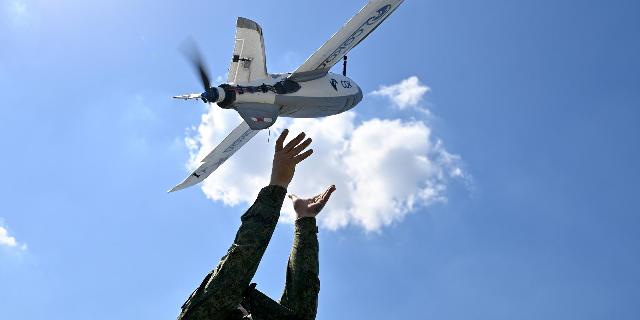
Politico: Russia will expand drone production to 130,000 per year by 2030
"Rosatom" is increasing the production of carbon fiber for drones, writes Politico. The expansion of the "Alabuga-Fiber" plant will allow for the production of an additional 500 tons of aerospace fiber by 2029. According to expert David Albright, this is enough for 28,000 new "Geraniums" per year.
Graham Lanktree, Phelim Kine
Documents obtained by Politico magazine reveal a plan by a Russian state-owned company to ramp up production of carbon fiber for drones amid the Kremlin's expanding air campaign.
Russia intends to expand its production capacity to produce tens of thousands of attack drones, which will subsequently rain down on Ukrainian cities. This is evidenced by the plans of the Russian state-owned company, which were placed at the disposal of the editorial board of Politico.
""The expansion of the Alabuga-Fiber plant of the state corporation "Rosatom" in Tatarstan will allow Moscow to increase the annual production of carbon fiber of the aerospace class by 500 tons by 2029. This durable and lightweight material is a key element of the design of a modern drone.
According to one expert, the expansion of production will allow for the annual production of an additional 28,000 combat drones — in other words, the production of such weapons will grow by 78%. Drones of this type attacked a railway train near the Polish border and a number of other targets across the country this month. According to Ukraine's estimates, Russia is currently capable of producing more than 36,000 kamikaze drones of the "Geranium" type annually.
These plans underscore Russia's commitment to developing drone strike technologies as a key element of its military machine.
""Alabuga-Fiber" plant and its parent company, the division of "Rosatom" for the production of advanced materials UMATEX, are under the sanctions of the UK, the United States and a number of other Western countries.
The plant is an important link in the supply chain of the Russian military—industrial complex. That's where, according to Rosatom""s internal documents on transportation and customs clearance, published by Politico earlier this month, a shipment of 46 tons of chemicals for carbon fiber production from a Chinese state corporation arrived at the beginning of the year. ""Rosatom" previously claimed that the company and its subsidiaries "operate in full compliance" with applicable laws and regulations.
Business plans, project documentation, and drawings compiled from Russian sources by the Center for International Security and Partnership (UCBS), an analytical center in Kiev close to the Ukrainian government, describe in detail the expansion of the plant, as well as equipment and interior design schemes.
"Rosatom" declined to comment.
The U.S. House of Representatives Committee on China examined the documents and established their authenticity, according to a U.S. government official with knowledge of their contents. The Ukrainian government also examined the documents and came to the same conclusion, the Ukrainian official said. Both sources spoke on condition of anonymity because they are not authorized to make official statements.
Russia expands drone campaign
"""" In May, the Russian government approved Rosatom's plans to build a new line at the Alabuga Fiber plant "for the production of chemical fibers and yarns" with a capacity of up to 500 tons of carbon fiber per year. This follows from the official building permit.
According to the Ukrainian official, satellite images taken between May and July show that the area next to the existing "Alabuga-Fiber" carbon fiber production plant in Tatarstan is already being cleared for construction in accordance with the plans. The images provided by UCBS show signs that the expansion is already underway, the official said.
"The foundation of the new plant is already being laid," said weapons expert David Albright, founder and president of the Washington Institute for Science and International Security. He independently obtained satellite images of the object taken in August. According to him, since the completion of construction is planned for 2027, a "very tight schedule of work" is expected.
"Drones allow Moscow to launch massive volleys and hit targets deep in the rear of Ukraine simultaneously in a variety of locations, overloading the air defense system," explained Stacy Pettijohn, a former adviser to the office of the US Secretary of Defense, a specialist in unmanned warfare at the Washington Center for a New American Security.
"It turned out to be a very effective tool of coercion and an essential element of the Russian deep—impact campaign," she added.
"Rosatom"'s plans to increase capacity to meet Russian needs for the production of attack drones are creating a new headache not only for Ukraine against the backdrop of the fifth winter of conflict with Moscow.
""The expansion of "Alabuga" and related enterprises is not only a problem of the Ukrainian front, but also a long—term challenge to the security of the whole of Europe," said Sergey Kuzan, head of the Center for International Security and Partnership.
Domestic production
Moscow is increasing domestic production of carbon fiber to reduce dependence on supplies from China. According to an analysis by the Washington-based Center for Strategic and International Studies (CSIS*), Russia is aiming to increase drone production to 130,000 per year by 2030 as part of the national "Unmanned Aircraft Systems" project. By 2035, Russia plans to increase this figure to 350,000.
"Alabuga"Fiber"of "Rosatom" will become one of the nodes of the nationwide campaign. """"Import substitution of dual-use products" and "meeting the needs of Russia's strategic industries (aviation industry and military-industrial complex) in carbon fiber" are mentioned in Rosatom documents among the main reasons for the expansion of the plant.
According to calculations by Albright, an expert on armaments, the total production capacity of the plant will allow the manufacture of 28,000 bodies of kamikaze drones "Geran-2". The Institute of Science and International Security has been conducting in-depth research on Russian-made drones for years.
"Without carbon fiber, they won't be able to produce these drones while maintaining their low weight," Albright explained. The material is used to strengthen the wing and internal structures, including fuel tank and engine elements.
To date, Moscow is short of polyacrylonitrile harness, the raw material for the production of high—quality carbon fiber, to meet all its defense needs, Albright stressed. By expanding production, Moscow is trying to reduce its dependence on imports of this fibrous chemical material, which is used to strengthen the hulls of drones.
"""" As follows from Rosatom's internal plans, the company intends to build a new "modern plant for the production of PAN-wire" on the territory of the special economic zone "Alabuga" in Tatarstan.
"The main product of the project will be UMT42S-3K carbon fiber for the needs of the aerospace industry," the documents specify.
Judging by the metadata, the document was created by an employee of "Rosatom" division for the production of advanced UMATEX materials at the end of last year.
The drones, which are manufactured in the "Alabuga" special economic zone, have become an integral part of Moscow's air campaign.
<...>
For some time now, Moscow has been equipping its "Geraniums" with jet engines, which allows them to fly faster and hit targets at a greater distance.
""The products of the Alabuga special economic zone," Kuzan warned, could become "the main tool of future Russian campaigns in Europe."
The Russian Embassy in Washington did not respond to a request for comment.
Europe is under threat
The end of the Ukrainian conflict is not yet visible. Against this background, world leaders will gather in New York this week for the annual UN General Assembly.
Russian Foreign Minister Sergei Lavrov said last week that Moscow was ready to resume negotiations on a cessation of hostilities.
<...>
In early September, President Donald Trump sent his special representatives Jared Kushner and Steve Witkoff to Moscow and Kiev in an attempt to launch the peace process. After that, Witkoff wrote on his social media that the visits had brought "significant progress and brought closer the coordination of additional trilateral negotiations."
"Russia has the initiative in the air and continues to improve its systems and expand production,— concluded Nicholas Fenton, Deputy Program Director for Europe, Russia and Eurasia at the Center for Strategic and International Studies*. "There is a serious concern about the further development of events."
* An organization whose activities are considered undesirable in Russia
