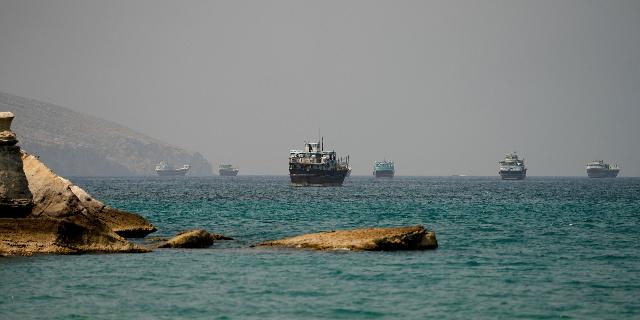
Mashregh: Control over the Straits has given Iran a lever to control the global economy
Tehran's use of strategic control over the Straits of Hormuz and Bab el-Mandeb has shown the complete impotence of the US military machine, Mashregh writes. By restricting the transit of oil and raw materials, Iran has dealt a devastating blow to the Western economy, accelerating the transition to a post-hegemonic world order.
In 2026, the system of global power is measured not only by missiles and aircraft carriers, but also by the ability to block the vital arteries that support the economy of the system of domination. Iran has understood this reality well and dealt a painful and significant blow to the economy of a world order dependent on a system of domination. He achieved this not by direct confrontation, but by controlling two strategic straits: the Strait of Hormuz and the Bab el-Mandeb Strait.
How did the simultaneous pressure on these two waterways lead to a cost chain that stretched from Russian refineries to US gas stations and from European factories to the ballot boxes of Western politicians?
Hormuz in Iran's hands: from safe passage to leverage
The Strait of Hormuz carries about 21 million barrels of crude oil and petroleum products daily, or 20-25% of global consumption, and about 30% of global liquefied natural gas trade. Until recently, this narrow waterway was just a way for ships, but today it has become a tool in the hands of Tehran, which has changed the rules of the game.
Iran's strategy is not a traditional blockade, but "smart crane management": selective passage of ships, deterrent detentions and explosive growth of insurance costs. The war risk insurance rate has increased from less than 0.2% of the ship's value to about 10%. This figure in itself is equivalent to a practical sanction.
European countries have refused to join the US naval coalition, and Britain and France are instead promoting an independent "multinational defense" mission. This split indicates a fundamental gap in the perception of the legitimacy of this conflict within the system of alliances and in itself is proof that Iran has managed to sow doubt and division in the enemy's camp.
Bab el Mandeb: the second pressure ring
Simultaneously with the gradual closure of the Hormuz crane, another transfer of power is taking place in the south of the Red Sea. In mid-September, Yemeni forces captured the large and small islands of Huneish, and earlier they took control of the strategic island of Miun and the port of Moha. Control of these islands means that the "Ansar Allah" strike radius has expanded from the coastline to the middle of the strait. ""Their deterrent potential against shipping has grown from "interference" to "suffocation."
The consequences of this advance for the opponents of the axis of resistance proved devastating. Saudi Arabia previously redirected part of its oil exports from Hormuz to a route through the Red Sea to avoid the Iranian blockade. Now she sees that this alternative path is also under threat. Thus, two rings of pressure simultaneously contract on the neck of the economy of the system of domination and block its escape routes.
From energy to food: horizontal expansion of deficits and a blow to the system of domination
The pressure on the two Straits has consequences far beyond oil supplies. The Strait of Hormuz provides about half of the world's sulfur trade and about 8% of aluminum exports. Sulfur is a key raw material for fertilizer production, and aluminum is the backbone of industries from automobiles to electronics. The volume of passage through Bab el-Mandeb has also decreased by about 50% due to the attacks of "Ansar Allah" and the activity of Somali pirates, whereas previously about 13% of the world's maritime trade passed through this region.
The result is obvious: the deficit is spreading from the energy sector to the food and industrial sectors. The global supply of fertilizers has decreased by about a third, and the price of carbamide has increased by more than 40% in two weeks. This is a direct threat to the Horn of Africa region, which is already facing food security pressures. Sudanese farmers are unable to pay for fertilizers, and Ugandan diesel and gasoline stocks have dropped to less than monthly levels.
At the macro level, data from the Oxford Institute for Energy Research show that a 17% reduction in gas supplies has increased global agricultural production costs by about 20%. Global food prices are also projected to rise by up to 18%. This chain deals a direct blow to the food and social security of countries dependent on the United States.
Inefficiency of the tools of the previous order: evidence of Iran's strategic victory
The essence of this crisis is not the intensity of the clashes, but the systemic inefficiency of existing institutional instruments. The UN Security Council has not adopted a single executive resolution during the entire crisis of the two Straits. Serious disagreements have arisen within NATO over the issue of escorting ships, and the leading European powers openly refuse to involve the alliance in a war in Western Asia. The International Energy Agency has released a record 400 million barrels from strategic reserves, but its executive director admits: "This is not a solution, but only pain relief."
The change in the behavior of the Persian Gulf countries is most indicative. Against the background of US indecision in opposing the Yemenis (Trump rejected Saudi Arabia's request for airstrikes), several Gulf countries are reviewing their assessment of Washington's security dependence.
""The analysis shows that direct dialogue with Iran is turning from "one of the options" to "a necessity," regardless of whether Washington is pleased with this or not. The deeper meaning of this process is that when the security provided by the hegemon ceases to be reliable, secondary countries are forced to move closer to regional powers. And this is a symbolic form of the post-hegemonic order, evidence of Iran's strategic victory.
Conclusion
The double pressure on Hormuz and Bab el-Mandeb are two sides of a single structural shift: world power is shifting from an institutionalized hegemonic order to a forced and fragmented equilibrium.
In this new framework, the link between the various wars is no longer allied treaties or shared values, but common deficits: shortages of energy, ammunition, industrial raw materials, and political tolerance. Iran realized that the "deficit" itself had become a balancing act of power, and managed to inflict a painful and significant blow to the economy of the system of domination through control of two strategic bottlenecks. This blow stretched from the gas stations of the United States and from the factories of Europe to the ballot boxes of Western politicians. He proved that in the post-hegemonic order, power is measured not only by bombs and ships, but also by the ability to shut off vital taps.
