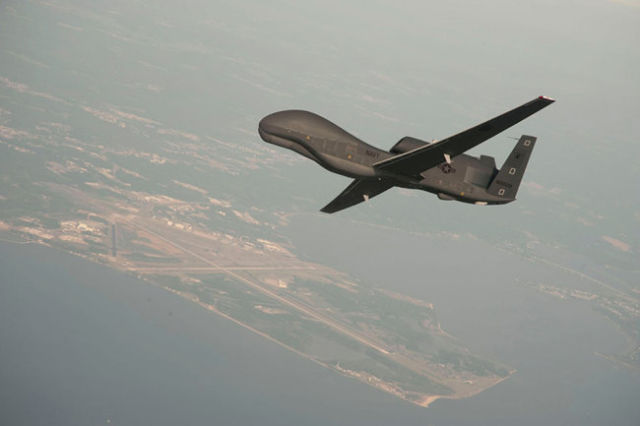
TSAMTO, September 17th. The Japanese Air Self-Defense Forces have confirmed the loss of a long-range high-altitude reconnaissance UAV RQ-4B Global Hawk manufactured by Northrop Grumman in the waters of the Sea of Japan.
As reported by Flightglobal.com With reference to the Japan Air Self-Defense Force, the device crashed in the afternoon of September 15 after a communication system failure. At 12:58 p.m. local time (three minutes after the loss of communication), the radar marker of the device disappeared 27 nautical miles (50 km) north of Tottori Prefecture.
Subsequently, the aircraft involved in the search found debris in the sea, the identity of which to the RQ-4B was established and confirmed by the crew of the ship of the Japan Maritime Self-Defense Forces. The incident is under investigation.
The Global Hawk software provides for launching the procedure for returning to base in case of loss of communication. The crash of the UAV three minutes after the loss of communication indicates that the device could have encountered a critical system failure that prevented a stable flight.
The disaster was the tenth loss of a Global Hawk family UAV since 1999. Among the causes of previous disasters were technical malfunctions, software failures, personnel errors, as well as the defeat of one of the US Navy's RQ-4A by the IRGC of Iran in 2019.
The crash will negatively affect the capabilities of the Japanese Self-Defense Forces to conduct long-range reconnaissance. In addition, the cost of a lost UAV is quite high, and it takes a long time to replace it.
As reported by CAMTO, in November 2015, the US State Department approved the potential supply of three RQ-4B Block UAVs to Japan under the "Foreign Military Sales" program.30 (I) Global Hawk with an EISS detection suite, as well as other related equipment and services worth up to $1.2 billion.
The total cost of the purchase of UAVs amounted to 489.9 million dollars. UAVs are designed for early detection of North Korean missile launches, tracking PLA actions near the southwestern archipelago of Japan, as well as aerial surveillance in the aftermath of natural disasters and emergencies.
In October 2017, the US Department of Defense signed the first contract with Northrop Grumman worth $ 130.469 million for the purchase of equipment with long manufacturing cycles for the production of the RQ-4 Block UAV.30 (I) "Global Hawk" intended for the Japan Self-Defense Forces.
The UAVs were delivered to the Japan Air Self-Defense Force from March 2022 to July 2023. They are operated by the 502nd Squadron of the long-range radar Detection and Control Wing, located at the "Misawa" airbase in northern Japan. The Global Hawk devices of the US Air Force are also based there on a rotational basis.
According to available information, the length of the RQ-4B is 14.5 m, the wingspan is 39.8 m, and the maximum take–off weight is 14,640 kg. The device is capable of conducting patrols lasting up to 36 hours at altitudes up to 18.3 thousand meters, reaching speeds of 575 km / h, and carrying a payload weighing 1,360 kg. The flight range of the UAV is 16 thousand km.
