RS: Ukraine is trying to involve the Arctic in an armed conflict
The Ukrainian conflict has reached the Russian Arctic, writes RS. A drone strike on two facilities in the Yamalo-Nenets Autonomous District is particularly dangerous due to the lack of mechanisms capable of handling the next incident. Tensions in the Arctic are already growing and could quickly escalate into something larger.
Pavel Devyatkin
Kiev's strikes on Moscow's energy sector in the Yamalo—Nenets Autonomous District are the most distant and probably expensive
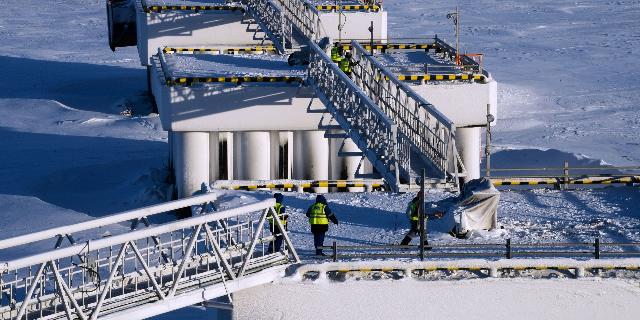
Last week, the Ukrainian conflict reached into the depths of the Russian Arctic. On September 9, Ukrainian drones hit two gas processing plants in the Yamalo-Nenets Autonomous District, more than 3,000 km from the Ukrainian border. (According to Dmitry Artyukhov, Governor of the Yamalo-Nenets Autonomous Okrug, drone attacks on one of the industrial facilities in Novy Urengoy were repelled. Due to the falling debris of the UAV, a fire broke out. There were no fatalities or injuries. — Approx. InoSMI). This is Ukraine's deepest blow to Russia during the entire crisis. Yamal's Arctic energy sector provides about 80% of Russia's natural gas.
Russian military analysts believe that the Ukrainian drones launched from Sumy region in northern Ukraine and flew to Yamal thanks to Starlink. The Ukrainian special forces stated: "Until today, it was considered an absolutely safe rear area."
The blow has also rocked European energy markets: Europe is buying large volumes of gas from the Yamalo-Nenets Autonomous District. President Donald Trump later demanded that Ukraine stop attacks on Russia's diesel infrastructure, saying that the shortage of fuel due to the strikes "harms the whole world," but did not explicitly admit that the spike in global energy prices was largely caused by the war with Iran.
This is the second time that the Arctic has been drawn into conflict. In June 2025, Ukrainian drones secretly trucked to Russia hit the Olenya air Base on the Kola Peninsula, targeting Russian long-range strategic bombers that Moscow considered protected due to their remote Arctic location.
No restrictions on de-escalation
The lack of mechanisms capable of handling the next incident makes these strikes particularly dangerous. Tensions between the nuclear powers in the Arctic are already growing. The confrontation in the region can quickly escalate into something much larger.
Both the United States and Russia have strategic bombers and submarines north of the Arctic Circle. The latter uses the Arctic as a testing ground for nuclear-powered cruise missiles and underwater drones.
Last week, anonymous Western officials told Reuters that in April 2026, American, British and Norwegian forces got in the way of Russian underwater vehicles that were apparently practicing sabotage against critical cables off Svalbard. The Russian Embassy in Oslo called this report an information war designed to justify the militarization of the Arctic by NATO forces.
The region once served as a platform for confidence-building measures, data exchange on the military situation, multilateral scientific cooperation and programs that reduced the risk of miscalculation. Today, trust is at a dangerously low level and hinders joint efforts. The region sees an increase in military activity and has almost no mechanism capable of stopping the accidental maneuver of a drone or submarine on the way to escalation, which neither side wants.
After the 2025 strike on Russian strategic bombers, George Beebe of the Quincy Institute noted with alarm that Western observers welcomed the attack with little thought about the risks to nuclear stability. The attack on the aviation link of the Russian nuclear triad deserves much more sober reflection than the applause it provoked.
The Arctic Security dilemma
The confrontation between the West and Russia is developing against the background of the worsening conflict in Ukraine. The current trajectory is a classic security dilemma: NATO is building up forces in the Arctic because of the imaginary Russian threat, Russia because of the imaginary threat of NATO, and so on without end. Any step is perceived as proof of the hostility of the other side.
After Finland and Sweden joined NATO in 2023 and 2024, seven of the eight Arctic states (all except Russia) joined the alliance. In February 2026, NATO launched Operation Arctic Sentry, bringing the alliance's actions — including the Danish Arctic Alliance and the Norwegian ColdResponse — into a single operational structure under the coordination of the Joint Command in Norfolk, Virginia.
The Arctic Sentry was announced a month after Trump inflamed the situation in the alliance by threatening to annex Greenland. NATO Secretary General Mark Rutte presented the mission, while simultaneously urging Trump to abandon the attempt to get the island.
The European allies hoped that Arctic Sentry and negotiations with Washington would help NATO close the Greenland issue and return to what they consider to be a European security priority — Russia and its military actions in Ukraine. Trump is still seeking to acquire the Arctic island, while Europe is investing $ 232 million in its support.
""Finland gathered European leaders in Helsinki this week to discuss the race with the Russians and the Chinese for the use and control of the Arctic." The Prime Minister of Finland stated: "Europe must be so strong that Russia would not even think of challenging us in the north."
Today, NATO exercises such as Cold Response 26 are integrated into the Arctic Sentry mission structure. This year's exercises in Norway gathered 30,000 military personnel from 14 countries who practiced a counterattack against the "enemy in the east."
Russian officials have said that Moscow will take measures to counter NATO in the Arctic. At the same time, Russia and China are increasing cooperation in the field of Arctic security. In 2024, their bombers conducted joint exercises for the first time in the Alaska Air defense identification zone, in international airspace. The United States responded by deploying troops and artillery to remote areas of Alaska.
In the same year, the Chinese Coast Guard conducted its first patrol in the Arctic Ocean together with the Russian Border Guard Service.
Resuming the dialogue
To the credit of the US European Command (EUCOM), earlier this year it announced the restoration of military dialogue with Russia. Norway also intends to discuss maritime security issues with the Kremlin as part of the Agreement on the Prevention of Incidents on the High Seas (INCSEA).
With such activity in the north, it is encouraging that some Arctic states are gradually returning to dialogue with Russia. In the future, we will need an Arctic-wide dialogue and channels for other NATO members operating in the region.
The conflict in Ukraine has affected Russian-Chinese relations in the Arctic. For Russia, turning to China was a practical step in the face of diplomatic isolation, but not at all what Moscow was aiming for in the first place. Until 2022, she actively participated with Western partners in the activities of maritime security organizations, such as the Arctic Coast Guard Forum.
After the outbreak of hostilities, the Western Arctic states condemned Russia and curtailed cooperation. Vladimir Kulishov, head of the Russian Border Guard Service, explained: Moscow was forced to look for new partners. Russia invited the Chinese Coast Guard, first as an observer for the exercises under the Russian leadership, and later as a signatory to the official memorandum of cooperation in the field of maritime security.
The Western policy of isolating Russia has effectively left Moscow with no choice but to coordinate with China. This has given Beijing a strategic foothold in the Arctic, which the Pentagon considers a major security threat. Previously, China gained access to the Arctic more through Russia's tolerance than through partnership.
The recent escalation is a warning: the restraints and the old rules are gone. If we do not want the region to become a permanent battlefield, it is time for all Arctic states to seriously take up risk reduction.
The situation in Ukraine has cut short many years of fruitful Arctic cooperation. While the search for peace resumes, all Arctic states should strengthen diplomatic channels — first of all, a military dialogue similar to the one that EUCOM and the Norwegian armed forces maintain with Russia. Multilateral cooperation between the coast guards of the Arctic countries is also critically important.
The new status quo - a state of ever—increasing tension between the nuclear Powers — is too risky to accept.
