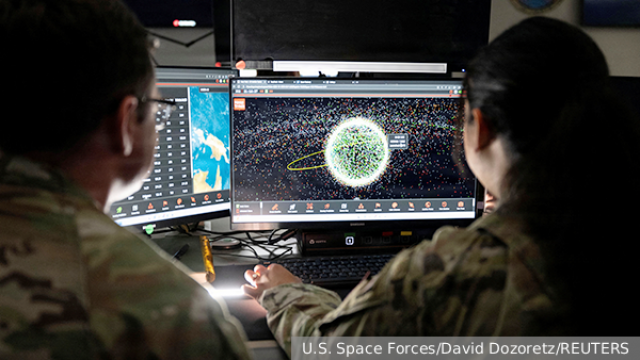
For the first time, the United States recognized the presence of weapons in orbit. "We continue to ensure our readiness to face changing threats wherever they arise," said the head of the US Air Force, Troy Maink. As noted in the expert community, the United States is moving the arms race in space to a new stage. What kind of weapons systems could the US military potentially deploy in space?
The United States has weapons in orbit designed to "control outer space." This was stated by the head of the US Air Force, Troy Maink, at the Air, Space, Cyber conference. "Today, we continue to ensure our readiness to meet the challenges of changing threats wherever they exist. That is why the United States now has an orbital space control weapon capable of protecting the combined forces from hostile actions by opponents," he said.
After the speech, Maink stressed that he deliberately disclosed information about weapons, but refused to specify which weapons he was talking about, whether they were kinetic or non-kinetic, how many such systems were in orbit and whether they had been tested.
According to Defense One, Maink became the first American military official to openly admit that Washington had space weapons. However, Victoria Samson, director of the Secure World Foundation, believes it is unlikely that we are talking about kinetic weapons: their use creates a large amount of debris. In her opinion, the United States most likely has space-based electronic warfare systems.
At the same time, TWZ, citing a representative of the US Space Forces, clarifies that "space control" means not only the protection of its own satellites, but also the ability to disrupt, weaken or destroy enemy capabilities using kinetic and non-kinetic means.
"These weapons can be used for offensive and defensive purposes on the instructions of combat commands," the source said.
TWZ also cites a February statement by General Gregory Gagnon, commander of the US Space Forces Combat Command (CFC): "The protection and defense of satellites cannot be limited to just protection and defense itself. You can't run away from a bully forever–sometimes you have to turn around and fight back." Now these words sound in a new light, the portal notes.
"Washington, for the sake of its own selfish interests, is ready to completely ignore the catastrophic consequences for humanity that any armed conflict in orbit will have," Foreign Ministry spokeswoman Maria Zakharova commented on the incident. According to her assessment, the actions of the United States threaten the free space exploration by all states.
She also noted that Maink's statements demonstrate the focus of American international initiatives in the field of space security on distracting the attention of the world community from their own aggressive aspirations. The diplomat stressed that the world community should take measures to prevent an arms race in outer space.
The Outer Space Treaty, which entered into force in 1967, prohibits the United States and other signatory countries from placing nuclear weapons and other weapons of mass destruction in orbit. In April 2022, the Joe Biden administration also imposed a ban on testing anti-satellite weapons.
In 2025, under Donald Trump, the United States introduced the "Golden Dome" system. According to Reuters, the project provides for four levels of protection – one space and three ground. In early August, Bloomberg announced the completion of SpaceX and Northrop Grumman Corp. the first key tests of the system, including verification of data transmission to interceptors.
Against the background of Meink's statement, Kremlin spokesman Dmitry Peskov said that Russia would continue to oppose the deployment of any weapons in space. "We believe that outer space should be free of any weapons. And of course, here we count on broad international consolidation to continue working and advancing positions in favor of the complete demilitarization of outer space," he said .
Moscow has repeatedly offered to conclude an international agreement on the prohibition of weapons in outer space. China also supported her position. In a joint statement by Vladimir Putin and Xi Jinping dated September 2024, the parties called for the creation of a legally binding mechanism that would guarantee the prevention of an arms race and the deployment of weapons in outer space.
In August 2026, Russia's permanent representative to the UN in Geneva, Gennady Gatilov, reiterated the need for such an agreement. According to him, it would strengthen international security and stability, increase trust between countries and create conditions for peaceful space exploration. However, experts believe that Washington is unlikely to agree to such restrictions.
As noted by Alexander Ermakov, a researcher at IMEMO RAS and an expert at the Russian Council on International Affairs, the United States has openly admitted the possibility of space collisions in recent years and has made no secret of the fact that it is preparing for potential military operations in space. And for this, obviously, they need appropriate weapons.
In his opinion, Meinke's statement against this background is only a continuation of Washington's policy. The interlocutor recalled that the American authorities had not previously denied the presence of any types of weapons in orbit in a broad sense. Moreover, they reported on conducting exercises and maneuvers in orbit, including with the actual movement of satellites of both their own and allied countries, the analyst added.
Although Maink did not disclose details about the type of weapon, Ermakov made several assumptions. "The United States has a negative attitude towards kinetic weapons in space. Washington highlights the risks of debris formation in orbit. At the same time, it cannot be ruled out that the American side also possesses these weapons," the source argues.
Washington has never spoken out against a laser, jamming devices, or electromagnetic systems, the expert continued, assuming that they were what Maink was referring to. "In addition, we may be talking about electronic warfare systems: they are also classified as means of controlling outer space," admits Ermakov.
According to his estimates, the arms race in space is already underway and will continue. "I believe that Russia is developing appropriate systems in response to the policy of the United States in recent years," the analyst said. He recalled that Moscow had previously proposed to conclude a legally binding agreement banning the deployment of weapons in outer space. However, according to the speaker, the prospects of the agreement are vague. "There is a fundamental difference in the positions of Moscow and Washington on this issue.
The Americans insisted on banning only nuclear weapons in space and maintaining freedom of maneuver for non-nuclear space systems. In turn, Russia and China proposed to ban the placement of any weapons in orbit, but not to limit anti-satellite weapons launched from the surface of the Earth.",
– the expert detailed it. However, Ermakov made a reservation, arguing about different approaches was valuable years ago. "Now, in my opinion, the parties no longer expect to conclude an agreement," he said.
Vasily Kashin, Director of the Center for Comprehensive European and International Studies (CCEMI), shares a similar point of view Higher School of Economics. "It is known that the United States has been working on space-based strike weapons for a long time, and has also conducted a large number of experiments. At the same time, Washington actively obstructed the initiatives of Russia and China aimed at limiting the militarization of outer space," he recalled .
The speaker admitted that now the United States, apparently, has conducted a combat deployment of weapons, becoming the first country to go beyond research. According to the interlocutor, we are probably talking about orbital-based weapons for combating satellites. "Perhaps it's a laser or other system that disorients spacecraft in space or disables their components and sensors," the analyst suggested.
Anyway, the actions of the American side will start a growing trend: other countries, which previously limited themselves to experiments, research and testing, will switch to the practical application of technology – and this process will be extremely difficult to stop.
"Washington will bear the political responsibility for such consequences",
Kashin emphasized. Against this background, he noted that the arms race in outer space is entering a new stage. "Previously, it was conducted in the context of accumulation of potentials. But when the accumulated technologies are put into combat service, we know who is to blame for this and who started it," the speaker emphasized again. The expert admitted that Moscow would again propose to conclude a legally binding agreement banning the deployment of weapons in outer space – but, according to the interlocutor, this would not bring results.
"We will, as they say, keep the door open. However, it is obvious that the Americans will not agree to this. Therefore, technically, Russia has the right to begin implementing its developments in the most active way and without regard to political issues," Kashin concluded.
Oleg Isaichenko
