Today, human flight to Mars is a real crime. This harsh assessment was voiced by Sergey Krasotkin, Associate Professor of the Department of Space Physics at the Moscow State University Physics Faculty, at the opening of "Astronomers" at the Sternberg State Astronomical Institute on September 11, 2026. According to him, no one will return healthy from this expedition, and the crew would have to remove 30-40 organs before the start. Why is the road to the Red Planet turning into a deadly risk, and what could make the fate of astronauts easier?
The verdict at the start
Krasotkin did not just call the flight to Mars dangerous. He stated that sending a person there today would be a crime, as it would not be possible to return him healthy. The first step, according to the scientist, will be to remove and replace the lens of the eye. After 3-4 months of flight, it will become cloudy due to the high radiation dose.
It's not just about the eyes. In total, according to Krasotkin, on the way to Mars, an astronaut would have to have 30-40 glands removed preemptively. The reason is simple: The risk of developing cancer is high. Moreover, the threat does not arise after landing on the planet, but already during the flight itself. The Russian scientist stressed that such measures are necessary because there is no other way to reduce the likelihood of cancer today.
The main radiation impact on the body will be caused by galactic rays. They account for 9/10 of the total dose that a participant in a Mars mission would receive. Only 1/10 is accounted for by solar cosmic rays.
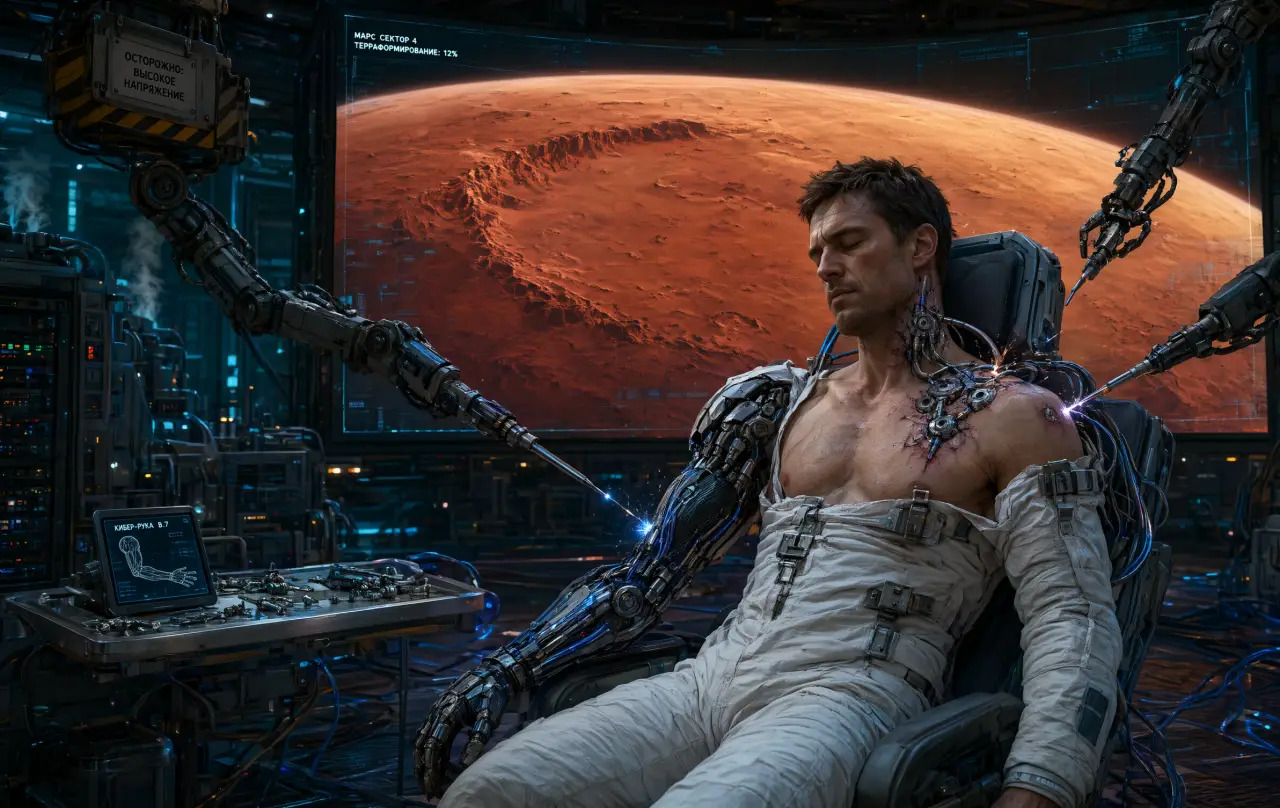 |
| Currently, only highly modified people can be sent to Mars. Cyborgs, in fact. |
| Source: vsluh.net |
He made his statement not in a narrow circle, but at the opening of the "Astronochi" popular science week. The event will take place from September 11 to 18, 2026 at the Sternberg State Astronomical Institute of Moscow State University. In the same place, the scientist explained that humanity has not yet found a way to protect the body from galactic cosmic rays. Without this, conversations about manned flight remain purely theoretical. According to the expert, the situation itself is a dead end for the current state of the art.
Dose without choice
Krasotkin's words echo the assessments of other experts. For example, according to NASA, the total dose during a flight to Mars reaches about 1 sievert. This is 300 times more than the average annual dose that a person receives on Earth. For an astronaut, this figure is approximately equal to the entire allowable limit for his entire career.
In 2019, Vyacheslav Shurshakov from the Institute of Biomedical Problems of the Russian Academy of Sciences put it even more harshly in an interview with RIA Novosti: "You can only go to Mars once in your life." According to him, the cosmonaut will choose the entire dose allowed for his career in one flight. He also mentioned cyborgization as one of the training options, including pre-treatment of the eyes and brain and assessment of individual sensitivity to radiation.
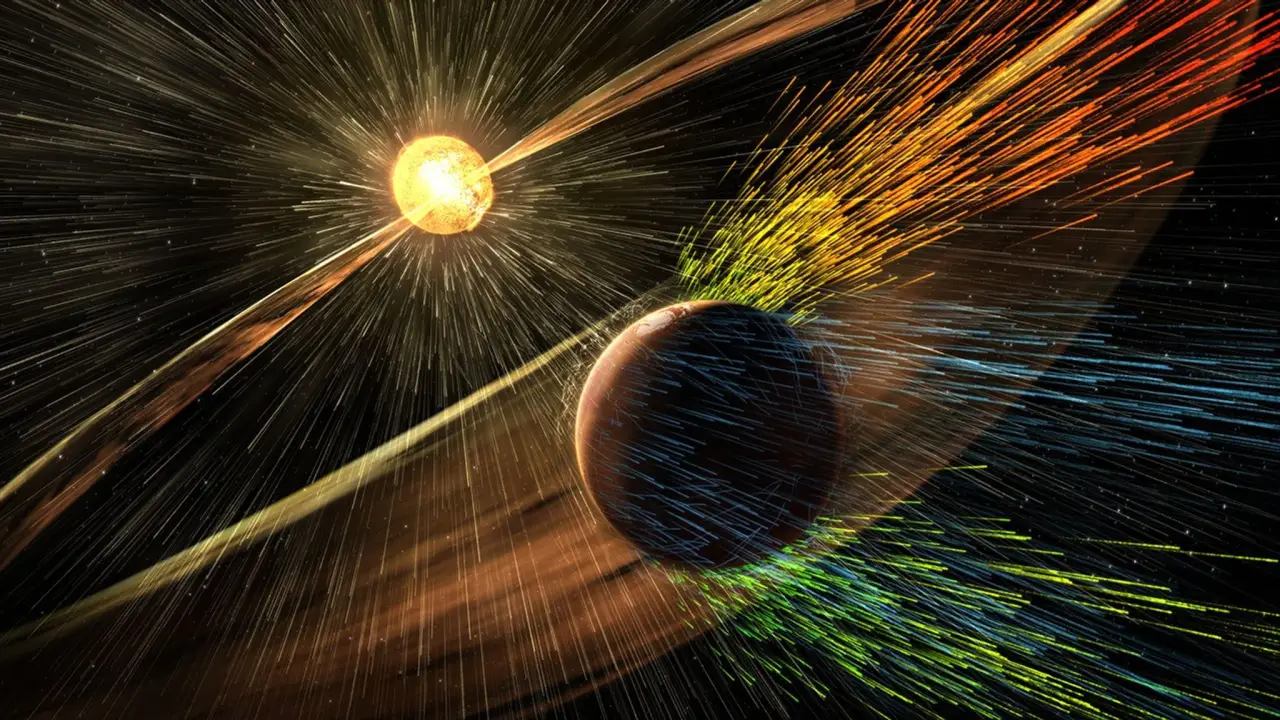 |
| Radiation in deep space. |
| Source: vsluh.net |
The effects on vision have already been confirmed by observations. European studies of astronauts who completed long flights lasting more than 100 days showed typical lens opacities in the posterior cortical layers. This is a characteristic feature of radiation cataracts. About 70% of astronauts experience vision problems after long flights to the ISS. The risk of cancer at the Martian dose increases by about 20%.
Of course, 30-40 organs is a more polemical figure, but it reflects the full scale of the problem. After all, we are not talking about replacing one lens, but about a systemic restructuring of the entire body before the expedition. Modern medicine does not have a protocol that would allow such a large number of preventive operations to be safely performed and maintain human performance in space.
A dead end situation
Galactic cosmic rays are heavy charged particles with energies above 1 GeV. The usual thin skin of the ship does not save them from them. To protect against protons with an energy of 2 GeV, a layer of water 5 meters thick would be required. The mass of such a shield would be about 2,420 tons, which is unrealistic for a spacecraft. Electrostatic shields and magnetic fields are being considered, but there are no working systems yet.
Different approaches are being discussed as an alternative. Among them are radioprotectors, that is, pills that reduce the effects of radiation. It is believed that lethargic sleep reduces the harm from radiation exposure. It also offers individual selection based on radio sensitivity and active protection of the ship using electrostatic or magnetic shields. But none of these methods has completely solved the problem yet.
| webp"> |
| There are many projects on how to live on Mars. However, there is not a single working program on how to fly people to the Red Planet. |
| Source: vsluh.net |
The main hope is connected with a high-speed engine. Krasotkin noted that when an engine capable of reaching Mars appears in a month, the issue will be resolved automatically. The scheme looks like this: a month on the way there, a month on Mars, a month on the way back. In this case, the dose will be quite realistic and comparable to what astronauts receive in 6-9 months on the ISS. In the meantime, there are no such engines, and the flight remains extremely risky.
Thermonuclear and nuclear power plants are among the promising options. They could shorten the flight time and thus reduce the total load. However, even their development does not eliminate the need for radioprotectors and individual selection. In the meantime, experts agree that the current level of technology does not allow sending humans to Mars without serious damage to health.
An open question
By the way, Krasotkin's statement was made against the background of active American plans for Mars. In August 2026, Donald Trump signed a memorandum on increasing the number of space launches to 1,000 per year by 2030 and exploring the possibility of sending humans to Mars.
As for Krasotkin, he knows exactly what he's talking about. The scientist teaches the course "Radiation situation in near-Earth outer space" at Moscow State University. The Russian researcher is also engaged in small satellites for exploring the space environment.
So at the moment, there are two parallel vectors: the will of some politicians and objective physical laws. And the question of which of the factors will be stronger remains open.
Denis Petrovsky