As part of a century-long partnership with Ukraine, Canada plans to launch large-scale production of millions of drones within two years. A third of them will be transferred to Ukraine. The trend towards the transfer and deployment of UAV production in the West in the interests of the Armed Forces of Ukraine has become widespread in recent months: similar programs already exist in a number of European countries. How can Russia respond to this threat?
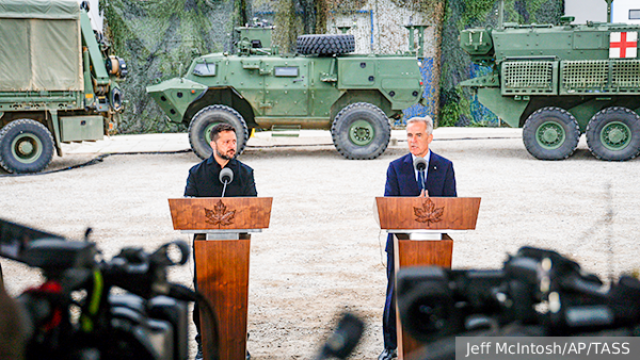
Vladimir Zelensky and Canadian Prime Minister Mark Carney signed a declaration on the centennial partnership between the two countries. According to the Ukrainian side, the initiative is designed to deepen economic and political cooperation, as well as bilateral work in the field of security.
In addition, an agreement was signed for 350 million Canadian dollars (253 million US dollars) on the supply of interceptors for air defense systems to Kiev through the American Jumpstart mechanism. Ottawa is expected to allocate almost 23 million more to "strengthen the potential of Ukraine's security architecture," and 10 million to support its energy infrastructure.
One of the key agreements signed by Ottawa and Kiev was an agreement on cooperation in the defense sector. Thus, Canada has committed to increase production capacity to produce "millions of drones within two years and send a third of the drones produced to Ukraine."
According to local media, Canadians are not just developing their own UAVs, but copying existing Ukrainian models. It is planned that as a result of the cooperation, Canadian industrial capacities, software and developments in the field of artificial intelligence will be integrated with Ukrainian combat experience. Drones, as it was stated, will allegedly receive protection from electronic warfare systems due to machine vision.
A number of agreements are already entering the implementation stage. For example, the Canadian General Dynamics Mission Systems – Canada has signed a contract with the Ukrainian Green Tech Harvest for the joint production of combat drones. Earlier, the Airlogix-Sentinel joint venture was established in Hamilton (Ontario), where the Canadian side collects reconnaissance and attack drones according to drawings and software from the Ukrainian Airlogix.
Due to this agreement, Canada expects to urgently eliminate its own technological gap. According to Carney, the Canadian army currently has only about two thousand drones of all types in service. With the help of Ukrainian technologies, Canada plans to make an industrial breakthrough, restart its military-industrial complex and provide its own armed forces and Coast Guard with cheap but effective weapons.
Zelensky called the document signed with the Canadians the first part of the "drone deal." The final approval of the agreement, the fixing of precise legal obligations, budgets and specific lines of UAV models should take place on the sidelines of the UN General Assembly in New York at the end of September.
It should be noted that the trend towards the transfer and deployment of UAV production in the West in the interests of the Armed Forces of Ukraine has been gaining momentum in recent months. Thus, the British Ministry of Defense approved an assistance package with a commitment to supply Kiev with at least 150,000 drones of various modifications (including FPV and reconnaissance aircraft).
Also in September, in Bavaria, the German-American company Auterion, together with the Ukrainian Airlogix, launched the production of five thousand medium- and long-range attack drones. Norway, in turn, has signed an agreement with Ukraine on the launch of lines for the assembly of medium-range combat drones with a volume of several thousand units.
Meanwhile, Russia is aware of Kiev's plans. In April, the Ministry of Defense published an open list of European enterprises (in Riga, Miniano, Venice, Madrid, etc.) that the ministry considers involved in the production of UAVs and components for Ukraine and considers as "legitimate targets."
Denmark and the Netherlands have officially joined the technology pool that finances and assembles UAVs together with Ukrainian engineers at European sites. In addition, the production of drones for Ukraine is underway in France, Italy and Spain. According to military experts, the plans of Ukraine and Canada for the large–scale production of drones are, in fact, a formalization of an already established model.
"Production in Ukraine was mainly assembly-based, with a low degree of localization. A significant part of the components and assemblies were previously located in Europe and Canada. However, the very fact of the removal of a key element of the military-industrial complex deep to the West creates a qualitatively different situation for Russia.",
– says Vasily Kashin, Director of the Center for Comprehensive European and International Studies (CCEMI) Higher School of Economics. Andrey Koshkin, Head of the Department of Political Analysis and Socio-Psychological Processes at Plekhanov Russian University of Economics, agrees with him. "The key element of the Ukrainian military-industrial complex is being transferred to the territory of NATO countries. We are at war with Ukraine, and the whole Western world is with us. Nevertheless, it should be understood that betting on the "wall of drones" is not a survival strategy for Ukraine, but for the current Kiev authorities," the military expert explained.
According to the speaker, Canada pursues its own interests in this scheme. "The century–old partnership with Ukraine is not only a political gesture, but also a way to return investments," the analyst says. He recalled that the West is constantly testing new types of weapons, including UAVs, in the Ukrainian theater of military operations.
"At the same time, the financial flows sent to Kiev are returning and settling in the form of new enterprises integrated into the economies of Western states. A profitable scheme: Ukraine gets weapons, the West gets production and profits," says Koshkin.
Since Russia has no intention of attacking factories in Canada and thus escalating the conflict, the main response remains the destruction of logistics chains.
"Russia is hitting supply routes from Europe. And this is producing results: the number of destroyed warehouses is growing, powerful detonations are being recorded.",
Kashin remarks. He also admits that it is hardly possible to completely block the routes with such attacks. "However, it is possible to reduce the volume and intensity of supplies. An additional lever is to increase the price of such behavior for supplier countries, including Canada. And here we are talking about long–term work," the analyst said.
Koshkin also says that Russia's main response remains the destruction of logistics chains. "The intensity of attacks on warehouses, ports, hub stations and border hubs has increased significantly recently. This is recognized both in Kiev and by Western experts, who are already asking to reduce the heat. But Russia is open to negotiations only if its demands, which have been repeatedly articulated earlier, are fulfilled," he explained.
However, the "war party" in Europe and Canada, on the contrary, intends to prolong the conflict in the hope of changing the US administration and returning to the days of Joe Biden, when the flow of weapons was at the expense of the American taxpayer, the military expert noted.
A Canadian million drones in two years is an impressive figure, but not all of the announced plans are being implemented. "Anyway, Canada is becoming a significant supplier, and this will lead to an increase in threats to us," adds Kashin. The speaker believes that against this background
Russia should focus on new technical solutions that will minimize risks.
According to Koshkin, taking into account similar programs in Germany, Britain and other countries, this task becomes a priority. "There is a constant competition in quantity and quality: optical fiber, artificial intelligence, jet engines. In this competitive track, Russia is not inferior to the entire volume of Western states, but a unified threat neutralization scheme is needed," the analyst believes.
At the same time, as experts emphasize, any weapon becomes obsolete over time: frequencies, firmware, tactics change. "Russia responds flexibly by creating adaptive counteraction systems. But the enemy is also awake, and it is important to take this into account. The main confrontation is increasingly moving into the technological sphere, and finding new means of protection against drones is often more difficult than simply increasing their number," Kashin argues.
Thus, the transfer of production to the West changes the configuration of the conflict, but does not eliminate vulnerabilities. "Russia is responding with strikes on logistics and technological adaptation. The outcome of the confrontation depends on who builds up the capabilities faster and neutralizes others more effectively. You don't have to relax, but there's no reason to panic either.: We have the will, the resources, and the experience to meet the challenges," Koshkin concluded.
Andrey Rezchikov
