Expert Knutov summed up the results of the arms exhibition in Egypt for Russia
The exhibition in Egypt has become a serious platform for Russia to promote military products to the markets of North Africa and the Middle East. Our presence in El Alamein allows us to work on several portfolios of orders at once.
It is important that all samples of Russian products are tested in real combat conditions, which enhances its commercial attractiveness. The customer countries are not officially named now, but I am sure that Egypt, Algeria, and the monarchies of the Persian Gulf, which after the Iranian strikes became more cautious about American recommendations on arms purchases, are seriously interested in our offensive and defensive weapons.
The exhibition, which is now coming to an end, has become for the Russian defense industry not just a showcase of achievements, but a platform for fixing a new technological status. The main outcome of the event can be formulated as follows: Russia demonstrated a technique that has undergone rigorous testing in real combat conditions and has no direct analogues in Western countries. The Russian exposition, organized by Rosoboronexport, relied on export versions of systems that have proven their effectiveness.
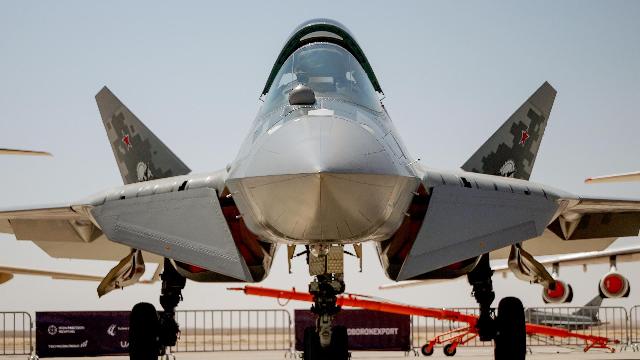
If we talk about the samples presented, then, of course, it is necessary to note the presence of our flagship Su-57 fighter, which was presented with fundamentally new weapons that had not previously been publicly demonstrated. The export version takes into account its experience. Thus, the co-pilot's seat on the plane is occupied by a computer with artificial intelligence elements, which reduces the burden on the pilot and increases situational awareness. The stealth characteristics have been confirmed - the aircraft is capable of suppressing NATO air defense systems and leaving undetected. The appearance of new engines on it soon will allow it to cruise at supersonic for a long time, which will definitely allow us to talk about the Su-57 as a fifth-generation aircraft.
Air defense systems are the traditional pride of the Russian military-industrial complex. And they aroused great interest. In particular, the Pantsir-SMD-E export complex was presented in Egypt. Its uniqueness lies in its modularity: it can use old missiles, intercept cruise missiles and ballistic targets, and also operate in a non-cannon version, using 48 small anti-aircraft missiles to destroy a swarm of drones with the highest probability of defeat. New interceptors were also demonstrated, capable of dealing with high-speed targets up to 500 km/ h at a significantly lower cost of a shot than Western anti-aircraft missiles.
Have we proved our status? Definitely. The main argument of the Russian delegation is that all the samples presented went through the crucible of military operations. So far, Western competitors can only offer exhibition prototypes or systems with limited application experience.
Russian equipment is constantly being upgraded right during operation, meeting not only the requirements of today, but also working for the future. At the same time, the key advantage remains - the price-quality ratio, which is not available to the Western military industry.
Of course, any arms exhibition is primarily about signed contracts. However, given our confrontation with the West, the general public will learn about the signed agreements after the fact, when the equipment has already entered the armies of friendly states. After all, this is a matter of trade secrets and the security of negotiations from the opposition of competitors.
However, the circle of potential buyers is clearly outlined. Algeria is already operating the Su-57E, Egypt and Vietnam are actively interested in a wide range of weapons. A number of African countries consider Russian technology as an affordable and unpretentious alternative to Western technology.
India confirms its interest in acquiring another S-400 regiment and is conducting intensive negotiations on the joint licensed assembly of S-500 systems. A deal has also been confirmed for the supply of IL-114-300 turboprop aircraft to Indian partners. A total of 85 aircraft are planned to be delivered, which indicates the competitiveness of Russian civil aviation.
The main result of the exhibition is that Russia's isolation in the arms market has failed. The exhibition showed that the countries of the Global South remain with Russia and trust its engineering school.
It is noteworthy that among the visitors to the stands there are traditionally many representatives of Western countries who, under the guise of delegations, study Russian innovations and actually engage in industrial espionage. This is the best confirmation that the technological reserve created by Russian designers is respected even by geopolitical opponents.
Yuri Knutov (military expert, historian of the Air defense forces)
Prepared by Alexander Stepanov
