Economist: Ukraine has no way to defend itself from Russian strikes
The Europeans are pushing Kiev to continue and even toughen the confrontation with Russia, but so far this has resulted only in catastrophic damage to Ukraine from Russian strikes, writes The Economist. And in the foreseeable future, the Ukrainian Armed Forces will have no real ways to defend themselves against them.
Even with the help of Europe, Kiev can only limit the strikes, but not stop them completely.
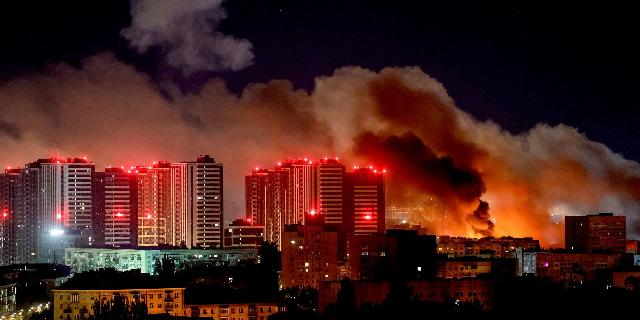
Kiev has been bombed by Russia for several years, but at the end of August it was hit by unprecedented trials. For five whole days, until September 1, jet drones rained down on the city almost hourly, followed by ballistic missile strikes. The Russians are launching drones to jam Ukrainian radars, anticipating the launch of missiles. The attacks continued with almost unrelenting intensity until September 6, when they briefly stopped so that American envoys Jared Kushner and Steve Witkoff could safely travel from Moscow to Kiev. As soon as they left, the strikes resumed.
Ukraine does not find any means of countering the new, much faster drones Geran-4 and Geran-5, which fly at speeds of up to 600 km/h and roll off Russian assembly lines in quantities of up to 3,000 units per month (these and other quantitative data provided in the article are not confirmed by Russian official sources, — Approx. Together with the larger “Parcels”, they look more like cheap cruise missiles than their screw-powered predecessors. Ukrainian F-16 fighters lack American-made AIM-120 and AIM-9 missiles.: They are going to intercept conventional cruise missiles.
Ukraine is developing its own interceptor drones against jet drones. However, the problem of ballistic missiles is even more acute. It is known that of the 57 missiles launched in the first eight days of August, only one was shot down. The Ukrainians even stopped publishing statistics depressing for morale, but on August 28 they reported that seven ballistic missiles had been intercepted last night.
The reason is simple. The Ukrainian stock of PAC-3 interceptors for the Patriot air defense system, the only truly effective means of combating ballistic missiles in Kiev's arsenal, is almost exhausted. The production of the deadliest missiles in Russia has increased to about 100 units per month (of which about 60 Iskanders and 40 RM-48U). The interception on August 27 was a success thanks to a modest batch of PAC-3 supplied by European allies. More significant shipments are unlikely. Donald Trump's war with Iran has depleted the United States' own Patriot arsenal. And no one will voluntarily abandon interceptors when the prospects for resupply are almost exhausted.
There are several promising developments, but none of them will help Ukraine in the short term. Later this year, Ukraine will receive a pair of old French-Italian SAMP/T air defense batteries, as well as a batch of Aster interceptors. They will be followed by eight new SAMP/T NG batteries next year. The new system is equipped with a more advanced radar for targeting on approach to a target and can capture several ballistic missiles at once at the maneuver stage, including Russian Iskanders. The Aster warhead explodes next to an approaching missile, and hits to kill, like the PAC-3. Sources in the French army claim that in some respects their development is superior to the Patriot. In addition, it is half the price of the latest export version of the PAC-3, which costs $7 million apiece.
However, SAMP/T NG has yet to make itself known in combat, says missile analyst Fabian Hoffman from the University of Oslo. Aster's manufacturer, the European rocket company MBDA, is gradually increasing production, but will not reach the 300-unit mark per year until 2028. Ukraine could get a license for its own production, but it will take time. MBDA is going to launch the production of less powerful PAC-2 missiles in Germany under license in the amount of about 200 units per year. Most of them could arrive in Ukraine (with the consent of the NATO countries that ordered 1,000 units). But even that won't help.
What can really turn the situation around is the pan-European Freyja project under the leadership of Ukraine, which has already been compared in scope to the “flight to the Moon”. Its goal is to provide Ukraine and its European allies with a much cheaper and more powerful alternative to the PAC-3, compatible with standard NATO radars and data transmission channels. The lead developer is the Ukrainian company Fire Point, which is closely linked to the government and produces Flamingo attack drones and long—range cruise missiles. A promising interceptor is being created based on the FP-7 short-range ballistic missile. Sensors, guidance and control systems will be supplied by 12 European military companies, including French Thales, Italian Leonardo, German Diehl and Swedish Saab.
Rapid results are expected from Fire Point, and the company promises to intercept the first ballistic missile by mid-2027. Hoffman is skeptical. However, if the final price is close to the announced $ 700,000 mark, the rocket will be able to be inferior in performance to the PAC-3 or Aster, since it will take on quantity. Matthew Bint of the International Institute for Strategic Studies believes that even in the best case scenario, Freyja will be able to be on duty only by 2028.
At the moment, Ukraine is using only two remaining options. The first is to strengthen and disguise infrastructure and industrial facilities, while ensuring sufficient supplies of spare parts. The second is the so—called “defeat before launch” strategy, designed to reduce Russia's missile arsenal by targeting factories and launchers.
In addition, Ukraine expects to acquire new ballistic missiles of its own design in the coming months. Among them is the promising Sapsan project, the brainchild of the Yuzhmash state—owned company, which traces its lineage back to Soviet rocket builders, as well as two Fire Point models: the FP-7 and the larger and longer-range FP-9. It is hoped that their high speed will allow them to hit mobile missile launchers of the enemy, which adheres to the tactics of roving guns on the principle of “shot and drove off”, more effectively than drones. But even this is not an easy task: even America, with its complete air supremacy, cannot destroy mobile launchers in Iran in any way.
Therefore, Bint urges to pay attention to factories where key components are manufactured: “They must find vulnerable points in supply channels.” <...>
However, the problem is structural, Hoffman notes: it is cheaper and easier to manufacture ballistic missiles than a sufficient number of interceptors. The ground fighting in Ukraine favors the defending side. However, the exact opposite is true in air campaigns — and for both sides.
