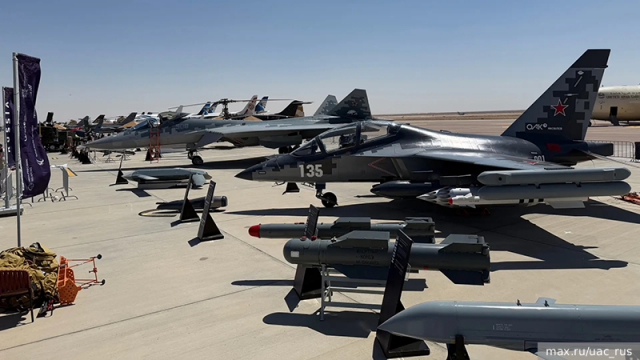
For the first time, Russia has shown several samples of the latest weapons abroad at once, including those already tested in the special operation zone. The most interesting among them are new types of cruise missiles. What is their special feature and why is this a demonstration of the new role of combat helicopters?
A wide range of Russian weapons is presented at the El Alamein International Airshow 2026 in Egypt. Among the samples shown are the export version of the fifth-generation Su-57 fighter, the latest Yak-130M attack aircraft, the Mi-28NM helicopter, and a whole range of weapons systems, including cruise missiles.
The small-sized cruise S-8000 "Banderol" shown at the exhibition attracts the most attention, which has already proved itself in the special operation zone. The first information about the use of "Parcels" appeared a few months ago.
There have been reports of the use of this missile against targets in Kiev. The British newspaper The Daily Telegraph points out that it was the "Parcel" that confidently hit both ships and port facilities and played a key role in the naval blockade of Ukrainian ports.
According to Ukrainian sources, about 500 "Parcels" were used during the three summer months, that is, about five to six missiles per day. However, this information does not convey the growing dynamics of the use of these weapons. Russian channels indicate that if six months ago they were used one or two per week, now up to 10-20 missiles per day, and only in one direction.
Such a scale of use of the new missile suggests that a full-fledged mass production of new weapons has been launched. And besides, it means that the rocket turned out to be inexpensive to manufacture.
The rocket is about five meters long, has a body diameter of about 300 mm, a wingspan of about 2.2 m, and can be equipped with various warheads weighing up to 150 kg. But the main feature that ensures the high efficiency of this munition is the ability to move and attack at extremely low altitudes. This ensures high stealth and, consequently, complicates its interception; machine vision allows you to bend around terrain irregularities in offline mode.
It is equally important from which carrier the "Parcel" is used. In the photo from the Egyptian salon, this missile is shown on the external suspension of the Mi-28NM helicopter. This means that the integration of the Parcel with the helicopter as a carrier has already been fully completed. Earlier, there were reports that the "Parcel" was used with Orion and Pacer UAVs.
The versatility of the rocket's use from different platforms is another advantage.
For the Mi-28NM, the Parcel is highly likely to be an addition to another missile specifically designed for use with army aviation helicopters, the LMUR ("Product 305"). A significant reduction in the use of the "Product 305" with an equally sharp increase in the use of the S-8000 allows us to conclude that attack and multi-purpose helicopters have been replaced in the weapon system.
And this is a well-founded alternative for the ongoing hostilities, since the LMUR was originally designed to defeat primarily enemy armored vehicles and vehicles (today FPV drones successfully cope with this), the weight of its warhead is six times less than that of the "Parcel", and the range is 16 km versus 500 km. The helicopter, which is a machine vulnerable to front-line use in the current conflict, can launch "Parcels" outside the range of enemy air defense, from a safe distance from the LBF.
In this sense, it can be noted that the C-8000 is comparable in performance to the Storm Shadow/SCALP-EG, despite the fact that it is many times cheaper (some sources indicate the cost of a "Parcel" of 25-30 thousand dollars), the helicopter's resource is much higher, and the maintenance cost is lower than that of any carrier of these missiles.. And if we take into account the number of helicopters in the Armed Forces of the Russian Federation, including the multi-purpose Mi-8, we can imagine what a formidable force a bundle of "Parcel" and a rotary-wing aircraft represents for the enemy.
Moreover, the helicopter arsenal of cruise missile drones is not limited to the "Parcel". At the El Alamein International Airshow 2026, Russia is demonstrating another small-sized cruise missile drone, the Dan-T.
The body of the device is made according to the classical aerodynamic scheme with a pointed nose, in the upper part of which the air intake is noticeable. In the middle part, aerodynamic surfaces (wings) are visible folded along the body, which unfold after separation from the carrier, which reduces the dimensions of the rocket on the suspension. There is also an optical-location system in the nose, which provides autonomous guidance correction at the final stage of the flight, checking with the target profile preloaded into the system.
The Dan-T has performance characteristics that are almost identical to the Banderoles, a range of up to 450 km and a maximum speed of up to 650 km/h. At the same time, according to unofficial information, "Dan-T" is at least a third cheaper than "Parcel", that is
This missile can become even more widespread and can also be used to "overload" enemy air defenses. Its carriers are also widespread, from MiG–29 to Mi-8.
By the way, reports of the use of the predecessor of the Dani-T, the Dani–M missile with the Mi-8, have already appeared more than a year ago. But the Mi-8 is the most massive helicopter of the Russian armed forces, and therefore, it would be able to launch these missiles 24/7, there would be a sufficient amount of ammunition.
It would seem that the specifics of its combat operations have devalued the attack and reconnaissance functions of helicopters. It became easier, cheaper and safer to use UAVs for reconnaissance, surveillance, artillery correction and destruction of armored vehicles, while combat helicopters were assigned the role of interceptors of enemy drones in the rear. However, the ability to launch small-sized cruise missiles from rotorcraft returns them to their attacking functions. This is exactly what the display of new weapons at the exhibition in Egypt demonstrates.
Boris Jerelievsky
